


Is Ghk-Cu FDA-approved?
Drug Pathway: No FDA New Drug Approval
The FDA drug approval system is based on the NDA (New Drug Application) process. It requires a complete review of clinical data, toxicology data, manufacturing processes, finished product formulations, therapeutic indications, and administration routes.
Only products that pass this process can be called "FDA-approved drugs."
A single chemical ingredient does not receive an independent drug approval certificate. As of July 2026, no company has submitted an NDA application for GHK-Cu as the main active ingredient. No GHK-Cu drug products have received FDA approval.
Therefore, from a drug regulatory perspective, GHK-Cu has not received FDA drug approval.
Regulatory Differences by Administration Route
• Injectable GHK-Cu
Injectable GHK-Cu Copper Tripeptide-1 Powder products have faced stricter regulatory review. In 2023, GHK-Cu was placed on the FDA 503A list for compounded pharmaceutical substances under Category II restrictions. This limited its use in large-scale compounding pharmacies.
In April 2026, the FDA removed the Category II restriction. However, GHK-Cu was not added to the Category I list of substances allowed for routine compounding. It remains under regulatory review.
The FDA Pharmacy Compounding Advisory Committee (PCAC) began reviewing the qualification of Copper Peptide GHK-Cu Powder as a compounded drug substance in July 2026. However, committee recommendations are advisory only and do not represent FDA drug approval.
Due to concerns including potential immunogenicity, peptide aggregation, heavy metal impurity control, and copper accumulation risks, injectable GHK-Cu Copper Tripeptide-1 remains under strict regulatory control. It is unlikely to complete the new drug approval process in the near future.
• Topical Therapeutic Products
If a product claims therapeutic benefits, such as wound repair, dermatitis treatment, or improvement of pathological skin damage, it must follow the OTC drug application pathway.
The product must provide safety and efficacy evidence and meet FDA requirements for drug approval. Currently, no company has completed this process for GHK-Cu Copper Tripeptide-1 Powder products. No related FDA drug approval number exists.
Cosmetic Pathway: Allowed for Use Without FDA Pre-Market Approval
Under the U.S. Federal Food, Drug, and Cosmetic Act and the updated 2022 MoCRA (Modernization of Cosmetics Regulation Act), most cosmetic ingredients do not require FDA pre-market approval. The main responsibility for product safety belongs to cosmetic manufacturers and brands. The FDA mainly performs post-market activities, including safety inspections, adverse event monitoring, and product recalls.
GHK-Cu Copper Tripeptide-1 Powder is listed under the INCI name Copper Tripeptide-1 in the PCPC (Personal Care Products Council) International Cosmetic Ingredient Dictionary. It is recognized as a cosmetic ingredient used in topical skincare applications. The main limitation is product claims. Finished cosmetic products may only claim benefits related to improving skin appearance. Claims involving disease treatment, physiological regulation, or medical effects are not allowed.
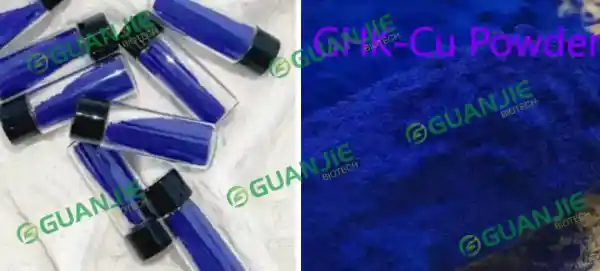
Guanjie Biotech supplies 98% pure GHK-Cu blue crystalline powder to beauty industry clients. The product meets U.S. cosmetic ingredient labeling requirements and can be supplied to North American skincare and haircare manufacturers. The raw material itself has no special import restrictions.
Food and Dietary Supplement Pathway: No FDA GRAS Certification
GRAS (Generally Recognized As Safe) is an FDA safety evaluation system for ingredients used in foods and dietary supplements.
This pathway applies only to orally consumed ingredients. Raw material GHK-Cu Copper Tripeptide-1 Powder is mainly developed for topical skincare applications. Currently, no company worldwide has completed the required oral toxicity studies, metabolism studies, and long-term safety evaluations for GHK-Cu and submitted a GRAS notification to the FDA. Therefore, GHK-Cu does not have FDA GRAS status for oral dietary supplement use. For beauty industry customers, this pathway is generally not relevant because Pure GHK-Cu is mainly used as a topical cosmetic ingredient.
Common Market Misunderstandings About GHK-Cu FDA Status
There are three common misunderstandings in the industry. Guanjie Biotech often clarifies these issues during technical discussions with beauty industry clients.
• Misunderstanding 1: Topical Use Means FDA Approval
Correction: Cosmetic ingredients do not require FDA pre-market approval in most cases. However, "allowed for cosmetic use" and "FDA-approved drug" are two different regulatory concepts.
A cosmetic ingredient being legally used in skincare products does not mean it has FDA drug approval.
• Misunderstanding 2: Use in Compounding Pharmacies Means FDA Approval
Correction: The review of compounded pharmaceutical substances only applies to physician prescription and pharmacy compounding scenarios. It does not represent approval for mass-market cosmetic applications. In addition, GHK-Cu Copper Tripeptide-1 Powder is not currently included in the FDA Category I list of bulk drug substances for routine compounding. Therefore, this pathway does not provide a basis for cosmetic market approval.
• Misunderstanding 3: Positive Cell Studies Mean FDA-Approved Efficacy
Correction:
In vitro cell studies and animal studies cannot be considered FDA approval of cosmetic efficacy.
Cosmetic products can only make claims related to appearance improvement. Claims involving biological repair, disease treatment, or physiological regulation require drug-level approval.
Why has GHK-Cu not been approved by the FDA?
The approval costs are mismatched with the return on commercial investment.
FDA New Drug Application (NDA) requires extremely high financial and time commitments. The complete approval process consists of five major stages: preclinical toxicology studies, Phase I human safety and tolerance testing, Phase II efficacy evaluation, Phase III large-scale controlled clinical trials, and GMP manufacturing site audits. The total investment for a single drug application can range from $80 million to $1.2 billion, with an overall development timeline of approximately 8-12 years.
From a commercial perspective, copper peptide GHK-Cu is mainly positioned as a cosmetic ingredient used in skincare formulations, including anti-aging serums, skin repair products, and scalp care formulations. The major market opportunities for GHK-Cu anti-aging applications are concentrated in affordable skincare products and mid-to-high-end cosmetic products. The raw material price of GHK-Cu powder for cosmetic applications is relatively accessible, while the average retail price of finished products is usually between $50 and $300.
If GHK-Cu were developed as a pharmaceutical drug, its applications would likely be limited to specialized medical fields, such as wound healing and injectable therapies. Compared with the broad consumer market of copper peptide skincare products, pharmaceutical applications have a smaller market capacity, making it difficult to justify the significant investment required for FDA drug approval.
Unlike ingredients such as retinol and benzoyl peroxide, which have established pharmaceutical pathways and cosmetic applications, Copper Tripeptide-1 has primarily developed as a GHK-Cu cosmetic ingredient with strong demand in the beauty and personal care industry. Although GHK-Cu has attracted significant attention due to its potential skin repair and anti-aging properties, the current commercial landscape does not provide sufficient financial incentives for a company to pursue an FDA New Drug Application (NDA). Therefore, no company has officially initiated the NDA approval process for GHK-Cu.
The raw material itself presents several technical challenges in pharmacological evaluation and safety management.
• Copper Ion Accumulation Risk
GHK-Cu Copper Tripeptide-1 Powder exerts its biological activity by chelating copper ions at a 1:1 ratio. However, long-term use of high concentrations, large-area topical applications, or injectable administration may increase the potential risk of copper accumulation in skin tissues. This concern creates specific usage limitations for individuals with Wilson's disease or other copper metabolism disorders.
From a GHK-Cu safety perspective, FDA drug approval requires comprehensive toxicological evaluations covering specific populations, long-term continuous exposure, and different administration routes. Current publicly available studies mainly focus on short-term GHK-Cu topical applications in healthy individuals. Large-scale human studies evaluating long-term exposure, systemic absorption, and potential adverse effects remain limited. Therefore, the existing safety evidence is insufficient to support pharmaceutical approval.
• High Difficulty in Controlling Formulation Stability
The peptide chain structure of Copper Tripeptide-1 is sensitive to ultraviolet light, strong acids, and metal ion interactions. In pharmaceutical formulations, especially injectable products, GHK-Cu may face challenges related to peptide aggregation during storage. These aggregated substances may increase the risk of formulation instability and potential sensitization.
For GHK-Cu FDA approval, pharmaceutical products must meet strict requirements for impurity control throughout the entire shelf life. Regulatory standards also require precise control of formulation composition, packaging materials, storage conditions, and degradation products. Existing cosmetic-grade manufacturing processes for GHK-Cu cosmetic ingredients generally cannot fully meet pharmaceutical standards for stability evaluation and quality control.
• Lack of Safety Data for Different Administration Routes
FDA regulations require independent toxicological assessments for different administration routes, including topical, injectable, and oral administration. Current research on GHK-Cu skincare applications mainly focuses on in vitro studies involving skin fibroblasts and limited human topical studies.
However, significant data gaps remain regarding systemic absorption, multi-organ metabolism, long-term exposure, and potential liver-related risks. These limitations affect the overall assessment of copper peptide safety and regulatory approval decisions.
Generating sufficient safety evidence would require large-scale clinical trials involving thousands of participants. The technical requirements, financial investment, and regulatory complexity make this process difficult to complete within a short timeframe. Therefore, although GHK-Cu has become a widely discussed anti-aging skincare ingredient, it currently remains primarily positioned in the cosmetic field rather than as an FDA-approved pharmaceutical drug.
The FDA clearly distinguishes between cosmetics and drugs. This eliminates the need for companies to apply across categories.
US regulations define product classification based on advertised claims and efficacy. This creates two separate business paths:
• Cosmetic Path:
GHK-Cu cosmetic ingredient products can only claim cosmetic benefits, such as firming the skin, reducing the appearance of fine lines, and improving rough skin texture. No drug approval is required. Companies only need to complete raw material safety assessments, batch GHK-Cu Copper Tripeptide-1 Powder COA quality checks, and adverse reaction monitoring. This path has lower operating costs and a shorter time to market. It meets the needs of most beauty companies.
• Drug Path:
Products that claim physiological or therapeutic effects, such as promoting collagen regeneration, repairing damaged dermis, treating skin inflammation, or accelerating wound healing, are classified as drugs by the FDA. These products require mandatory NDA approval.
Globally, more than 95% of GHK-Cu Copper Tripeptide-1 Powder downstream applications are focused on the cosmetics sector. Brands usually position their products within cosmetic regulations and use compliant marketing claims. Therefore, drug certification is generally not required for GHK-Cu cosmetic ingredients.
The industry's research findings do not meet FDA drug application data requirements.
Although nearly 50 years of published research show that GHK-Cu Copper Tripeptide-1 Powder can increase skin glycosaminoglycan production, inhibit matrix metalloproteinases, and regulate mild inflammatory responses, the existing data has major compliance limitations. It cannot be used directly for FDA new drug applications.
Most studies have sample sizes of fewer than 100 participants. They also lack randomized, double-blind, placebo-controlled Phase III clinical trial designs. In addition, the purity of raw materials, formulation concentrations, and delivery systems vary between studies. This leads to poor data consistency and limited reproducibility.
Many publications appear in journals focused on cosmetics, personal care, and cell biology. These studies are not designed, documented, or archived according to FDA clinical research standards. Therefore, they lack sufficient regulatory value.
FDA drug approval requires standardized clinical trials. These trials must be sponsored by the applicant company and supervised by independent third-party organizations. Individual academic studies cannot serve as the primary evidence for drug approval. Currently, no company in the GHK-Cu industry has completed a full FDA-compliant clinical development process.
Guanjie Biotech specializes in producing active peptide raw materials for the beauty industry. Its core product is high-purity GHK-Cu Copper Tripeptide-1 Powder. The production line is fully designed according to cosmetic GMP standards. The company does not produce injectable or oral pharmaceutical-grade raw materials. This allows it to better meet the needs of skincare and haircare customers.
The production process follows a triple quality control system. HPLC is used to test purity after solid-phase synthesis. ICP-MS is used to verify the copper chelation ratio. Comprehensive tests are also performed for microorganisms and heavy metals. Each batch of raw materials meets US cosmetic raw material safety standards. There is no risk of exceeding regulatory limits. Products exported to the North American market can pass FDA post-market sampling inspections.
FAQs:
Q1: Is GHK-Cu FDA-approved for skincare products?
A: No. GHK-Cu Copper Tripeptide-1 Powder is not FDA-approved as a drug. However, it is an INCI-listed cosmetic ingredient widely used in skincare formulations.
Q2: Can I use GHK-Cu powder in my skincare formula for the US market?
A: Yes. GHK-Cu powder can be used as Copper Tripeptide-1, a cosmetic ingredient for skincare products in the US market, when used with compliant cosmetic claims.
Q3: Why hasn't GHK-Cu obtained FDA drug approval like some active ingredients?
A: The main reasons are limited drug-level clinical data, high FDA approval costs, and insufficient commercial incentives for pharmaceutical development.
Q4: Do I need FDA approval to purchase GHK-Cu raw material for cosmetics?
A: No. Cosmetic ingredients generally do not require FDA pre-market approval. Companies are responsible for ensuring ingredient safety, quality control, and regulatory compliance.
Q5: What type of GHK-Cu raw material does Guanjie Biotech provide?
A: Guanjie Biotech supplies 98% pure GHK-Cu Copper Tripeptide-1 Powder, a blue crystalline peptide raw material designed for cosmetic and beauty applications.
Conclusion:
Based on the FDA regulatory framework, GHK-Cu Copper Tripeptide-1 Powder has not received FDA drug approval. However, as an INCI-listed cosmetic ingredient known as Copper Tripeptide-1, it is legally used in skincare products in the US without prior FDA pre-market approval. The current GHK-Cu FDA approval status is mainly influenced by high drug development costs, limited clinical data, formulation stability challenges, and its established role as a GHK-Cu cosmetic ingredient. Current GHK-Cu regulation mainly focuses on cosmetic applications, including anti-aging and skin care formulations.
Guanjie Biotech can support compliance with FDA requirements in the US market by strictly controlling end-user marketing claims and standardizing formulation systems. Raw material suppliers should continuously improve their cosmetic GMP production capabilities and regulatory support services. They should also clearly communicate the regulatory boundaries between cosmetics and drugs under FDA guidelines to downstream beauty customers, reduce market misunderstandings, and promote the compliant and sustainable global development of copper tripeptide skincare ingredients. Welcome to enquire with us at info@gybiotech.com.
References:
[1] Orrick, Herrington & Sutcliffe LLP. (2026, April 16). FDA Announces Removal of 12 Peptides from Category 2 and Schedules PCAC Meetings to Consider Adding Peptides to 503A Bulk Drug Substances List.
[2] U.S. Food and Drug Administration. (2026). Meeting of the Pharmacy Compounding Advisory Committee. FDA Advisory Committees. https://www.fda.gov/advisory-committees/pharmacy-compounding-advisory-committee/meeting-pharmacy-compounding-advisory-committee
[3] Alliance for Pharmacy Compounding. (2023, October 5). FDA puts some peptides off-limits. https://a4pc.org/news/2023-10/fda-puts-some-peptides-off-limits
[4] Cosmetic Ingredient Review Expert Panel. (2018). Safety Assessment of Tripeptide-1, Hexapeptide-12, Their Metal Salts and Fatty Acyl Derivatives, and Palmitoyl Tetrapeptide-7 as Used in Cosmetics. International Journal of Toxicology, *37*(Suppl. 2), 28S-48S.
[5] National Medical Products Administration. Technical Specifications for Cosmetic Safety (2015 Edition) [S]. Beijing: China Standards Press, 2015. (Regarding the management of cosmetic raw materials, GHK-Cu/copper tripeptide-1, as a cosmetic raw material, must comply with the requirements of this specification.)
[6] Regulations on the Supervision and Administration of Cosmetics (Decree No. 727 of the State Council, 2020) [S]. Beijing: State Council of the People's Republic of China, 2020. (Regulates the management of the use of cosmetic raw materials and product classification.)
[7] China National Institutes for Food and Drug Control. List of Prohibited Raw Materials for Cosmetics (2021 Edition) [S]. Beijing: National Medical Products Administration, 2021. (GHK-Cu is not listed in the prohibited list and can be used in cosmetics.)
[8] China Association of Fragrance, Flavor and Cosmetic Industries. Guidelines for Reporting Information on the Safety of Cosmetic Raw Materials [S]. Beijing, 2022. (Regulates the information management of cosmetic raw materials.)


