Latest Products


Contact Us
-
Building 2, QinChuang Chang'an Industrial Park,Chang'an District, Xi'an City, Shaanxi Province
-
+86-2988253271

Liposomal Vitamin C Powder
Appearance: Off-white powder
Good Water Solubility
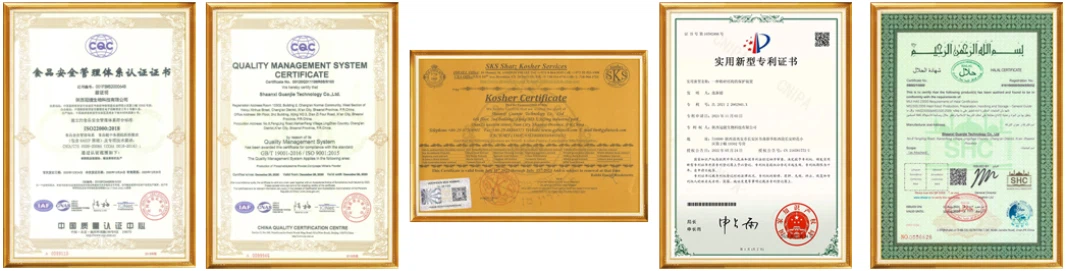
Certifications: HALAL,ISO9001, PAHS Free, NON-GMO,KOSHER,SC
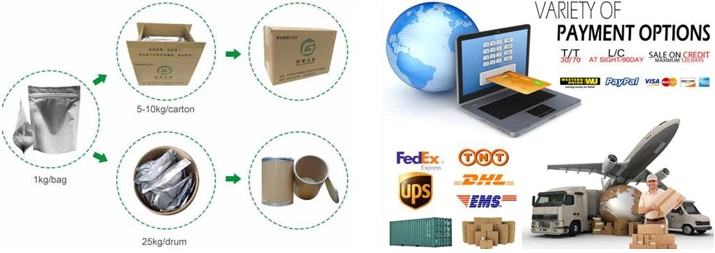
Delivery term: DHL, FEDEX, Air freight, Sea freight
Provide Free Sample
MOQ: 1KG
Not for Private Person Sale
Description
Liposomal Vitamin C Powder Supplier:
Guanjie Biotech is a Liposomal Vitamin C Powder Supplier dedicated to providing high-quality ingredients for the health and nutrition industries. Liposome Vitamin C Powder is produced using advanced liposomal encapsulation technology, which surrounds vitamin C with phospholipid-based liposomes. This structure helps improve absorption and bioavailability compared to conventional vitamin C products. The powder offers good water dispersibility, enhanced stability, and gentle gastrointestinal tolerance. It is also designed to support sustained nutrient release. Due to these advantages, Liposome Vitamin C Powder is widely used in dietary supplements, functional foods, beverages, and other health-focused formulations worldwide.

COA:
| TEST ITEM | SPECIFICATION | RESULT | ||
| Description | Off-white powder | Conform | ||
| Loss on drying | ≤5.0% | 2.2% | ||
| Bulk Density | Measured value | 320g/L | ||
| Tapped Density | Measured value | 510g/L | ||
| Heavy Metals | Arsenic (As) Lead (Pb) Mercury (Hg) Cadmium (Cd) | <2.0ppm <3.0ppm <0.3ppm <0.3ppm | Conform | |
| Conform | ||||
| Conform | ||||
| Conform | ||||
| Total plate count | ≤1000cfu/g | 70cfu/g | ||
| Microbiological | Total molds and yeasts | ≤100cfu/g | 15cfu/g | |
| Coliforms | ≤10MPN/g | Conform | ||
| E.Coli | Negative/25g | Negative | ||
| Salmonella | Negative/25g | Negative | ||
| Staphylococcvs | Negative/25g | Negative | ||
| Conclusion | Meet the in-house standard | |||
What is Liposomal Vitamin C?
Liposomal vitamin C is an enhanced form of vitamin C. Liposomes are nanoscale spherical vesicles with a phospholipid bilayer structure. They are made from phospholipids extracted from sunflower or soybean. They encapsulate water-soluble vitamin C inside. This bilayer structure is similar to human cell membranes. It allows liposomes to fuse with cells and deliver vitamin C directly into them.
Liposomal vitamin C powder is made by converting liquid liposome suspensions into powder. This is done through processes such as spray drying. It has good stability and is easy to store and use.

What is The Core Mechanism of Liposomal Vitamin C?
Traditional oral vitamin C is absorbed in the small intestine through sodium-dependent vitamin C transporters (SVCTs), including SVCT1 and SVCT2. This system has a saturation limit. When daily intake is 30–180 mg, absorption is about 70–90%. When intake exceeds 1000 mg, absorption drops to below 50%. Unabsorbed vitamin C moves into the large intestine and may cause gastrointestinal discomfort such as osmotic diarrhea.
Liposome encapsulation uses a different absorption pathway. Vitamin C enclosed in a phospholipid membrane can enter cells through endocytosis and membrane fusion. This process does not depend on SVCT transporters. The phospholipid structure has a natural affinity for cell membranes. It helps bypass the saturation limit of intestinal transporters and improves systemic delivery efficiency. Liposomes may also enter the lymphatic system directly, reducing first-pass metabolism in the intestine.
What Are The Structural Differences Between Liposome And Vitamin C?
Traditional vitamin C is free ascorbic acid. It can be degraded by gastric acid, digestive enzymes, and oxidation in the gastrointestinal tract. Liposomal vitamin C powder is enclosed in a phospholipid bilayer membrane. This structure forms a protective barrier. It reduces oxidative damage and enzymatic breakdown. As a result, more active vitamin C reaches the absorption site in an intact form.
What Is The Water Solubility of Liposomal Vitamin C?
What Is The Water Solubility of Regular Vitamin C?
Vitamin C (ascorbic acid, molecular formula C₆H₈O₆) is a water-soluble vitamin. Its structure contains multiple hydroxyl groups. This makes it highly soluble in water.
This property determines its behavior in the human body. After oral intake, it must dissolve in gastrointestinal fluids. It is absorbed through sodium-dependent vitamin C transporters (SVCTs).
However, the strong water solubility of regular vitamin C also creates some limitations.
• Stability
Vitamin C is easily oxidized in aqueous solutions. It is sensitive to light, heat, pH changes, and metal ions. These factors reduce its stability, especially in liquid formulations. Studies show that vitamin C in solution has lower thermal stability than liposome-encapsulated vitamin C.
• Cell membrane permeability barrier
Cell membranes are made of phospholipid bilayers with a hydrophobic interior. This makes it difficult for water-soluble molecules to pass through directly. Therefore, regular vitamin C depends on specific transport proteins to enter cells. This can limit absorption efficiency.
What Is The Water Solubility of Liposomal Vitamin C?
Liposomal vitamin C does not change the chemical solubility of vitamin C itself. Instead, it physically encapsulates vitamin C within a phospholipid bilayer structure. This changes how it behaves in water.
Liposomes are spherical vesicles formed by phospholipids. They have a hydrophilic core and a hydrophobic bilayer membrane. Water-soluble vitamin C is enclosed in the inner aqueous core. When dispersed in water, liposomal particles show strong water dispersibility. They form a stable and uniform suspension.
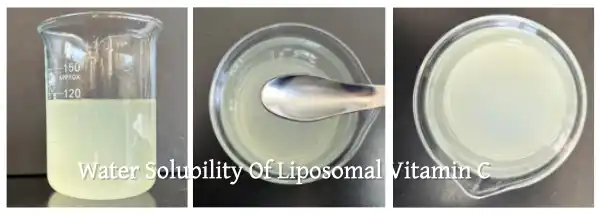
Water Solubility Between Liposomal Vitamin C And Regular Vitamin C
From a water solubility perspective, regular vitamin C is fully water-soluble at the molecular level. However, it has lower stability in solution and limited cellular uptake.
Liposomal vitamin C maintains water dispersibility while improving physical protection and transport efficiency.
From a water solubility comparison perspective:
| Comparison Dimensions: | Ordinary Vitamin C | Liposomal Vitamin C |
| Dissolved/Dispersed State | Molecular-level true solution | Nanoparticle uniform dispersion |
| Apparent Behavior in Water | Rapidly dissolves, clear solution | Rapid dispersion, milky white/semi-transparent suspension |
| Stability | Easily oxidized and degraded, unstable | Phospholipid membrane protection, significantly improving stability |
| Membrane Permeation Mechanism | Requires SVCT transporter protein | Endocytosis/membrane fusion, bypassing transporter limitations |
Significance of Water Solubility Differences:
Liposome encapsulation does not reduce the water solubility advantage of vitamin C.
• Protective Effect:
The phospholipid bilayer acts as a physical barrier. It isolates vitamin C from degradation factors such as oxygen and metal ions in the aqueous environment. This significantly improves the storage stability of vitamin C in water-based solutions.
• Revolutionary Absorption Pathway:
The liposomal structure enables better cellular uptake of vitamin C. Studies show that the peak plasma concentration of liposomal vitamin C is 27% higher than that of ordinary vitamin C. Leukocyte concentration is also 20% higher.
• Expanded Applications:
Liposomal vitamin C powder disperses rapidly in water. It can be stored as a stable solid powder. It can also be consumed as a liquid after reconstitution. This provides both convenience and improved absorption efficiency.
What Are The Liposomal Vitamin C Benefits?
• Immune Support Function
Vitamin C supports immune function by accumulating in leukocytes and protecting immune cells from oxidative stress during infection. A double-blind, placebo-controlled, crossover study with 12 healthy participants showed that after taking liposomal vitamin C powder, blood vitamin C levels were significantly higher at all time points compared with the same dose of free vitamin C (p < 0.01). In addition, the phospholipid component in liposomes showed a rapid anti-inflammatory effect. It significantly reduced inflammatory cytokines IL-6, MCP-1, and MIP-1α within 2 hours. This study shows that liposomal vitamin C powder is not only a vitamin C supplement. The phospholipid carrier may also provide a synergistic anti-inflammatory effect.
• Antioxidative Stress and Collagen Synthesis
Vitamin C is a strong electron donor. It is an essential cofactor in collagen biosynthesis, carnitine metabolism, catecholamine metabolism, and dietary iron absorption. It plays an important role in wound healing, cartilage repair, bone health, and gum health. Liposomal vitamin C powder supports these functions while improving bioavailability. It helps maintain higher vitamin C levels in tissues and better supports collagen synthesis and redox balance.
• Research Progress in Cancer Adjuvant Therapy
The use of liposomal vitamin C oil is expanding beyond nutritional supplementation. A 2026 study explored combining liposomal vitamin C with the ATR kinase inhibitor ceralasertib for ovarian cancer treatment. The study found that liposomal vitamin C powder improved the stability of vitamin C in physiological fluids. Vitamin C is easily degraded due to its high redox activity, which can reduce its anticancer support effect. Encapsulation in liposomes significantly improved its stability. The combination therapy showed higher anticancer activity than single-drug treatment in genetically diverse ovarian cancer cell lines. Liposomal vitamin C also showed protective effects as an adjuvant.
• Reducing Common Cold Symptoms
A meta-analysis of more than 30 clinical trials showed that vitamin C can reduce the duration and severity of common cold symptoms, especially in people under high physical stress. Liposomal vitamin C may achieve higher tissue concentrations due to improved absorption. It may therefore offer better potential for cold prevention and symptom relief than traditional vitamin C supplements.
What Is Liposome Vitamin C Suitable For?
Liposomal vitamin C powder is especially suitable for the following groups:
• High-intensity athletes and fitness enthusiasts: Exercise increases oxidative stress and requires higher antioxidant support.
• People under chronic stress: Long-term mental stress can accelerate vitamin C depletion and affect immune function.
• Individuals with poor digestion and absorption: Liposomal encapsulation improves absorption and reduces dependence on intestinal transport.
• Smokers: Smoking significantly reduces the body's vitamin C levels.
Individuals who want to replace intravenous infusion with oral intake: Suitable for those seeking high bioavailability without invasive methods.
What Is Liposomal Vitamin C Usage and Dosage?
Liposomal vitamin C powder can be mixed with water, juice, or other beverages. It is usually taken on an empty stomach. Many studies use a dosage range of 500–1000 mg, which shows a good balance between absorption and effectiveness. Because liposomal vitamin C liquid has higher bioavailability than traditional forms, similar blood levels can be achieved at lower doses. Research also shows that it maintains stable absorption even on an empty stomach, which allows more flexible intake schedules.
Is Liposomal Vitamin C Safe?
Liposomal vitamin C powder has a good safety profile and is generally well tolerated. Liposome technology improves absorption into the bloodstream and reduces unabsorbed vitamin C in the gut. As a result, gastrointestinal side effects such as osmotic diarrhea and bloating are less common compared to high-dose traditional vitamin C. Current studies show no clinically significant changes in laboratory results or serious adverse events in healthy subjects. The most common side effect is mild stomach discomfort, which usually disappears as the body adjusts.
Company Advantages:

Certification
Package & Shipment
Hot Tags: liposomal vitamin c powder, China liposomal vitamin c powder manufacturers, suppliers, factory
You Might Also Like