

Latest Products

Contact Us
-
6th Floor, 2nd Building, Xijing NO.3, XiJing Industrial Park, DianZi Western Street, Xi'an, Shaanxi, China
-
+86-2988253271


Red Yeast Rice Granules
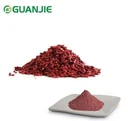
Red Yeast Rice Particle
Size:20-40 Mesh
Specification:0.1%-5.0%
Active Ingredient:Monacolin K
Test method: HPLC
Appearance: Light red to dark red granules
Two Factories & Three production lines
GMP standard workshop & two independent laboratories
Certifications: Halal,ISO9001,PAHS Free,NON-GMO,KOSHER,SC
Overseas warehouse(NJ,USA)
Delivery term: DHL, FEDEX, Air freight,Sea freight
Provide Free Sample
Not for Private Person Sale
MOQ:1kg
Description
Red Yeast Rice Granules Supplier:
Guanjie Biotech has focused on red yeast rice granules for 20 years. Because red yeast rice powder is usually 80-100 mesh and has poor flowability, Red Yeast Rice powder is easy to clog the machine and capsule during the process of filling capsules and pressing tablets. We use an extruding granulator to make 20-40 mesh granules. This makes the flowability strong and easy to fill capsules and make tablets.

COA:
|
Item |
Specification |
Result |
Method |
|
Basic Product Information |
|||
|
Country of Origin |
China |
Conform |
/ |
|
Genus and Species |
Oryza sativa subsp. indica |
Conform |
/ |
|
Marker Compounds |
|||
|
Monacolin-k |
>3.0% |
3.19% |
HPLC |
|
Organoleptic Data |
|||
|
Appearance |
Granular |
Conform |
GJ-QCS-1008 |
|
Color |
Light red to dark red granular |
Conform |
GB/T 5492-2008 |
|
Odor |
Characteristic |
Conform |
GB/T 5492-2008 |
|
Taste |
Characteristic |
Conform |
GB/T 5492-2008 |
|
Physical Characteristics |
|||
|
Peroxide value |
<10 meq/kg |
Complies |
CP2010 |
|
Particle Size |
20-80mesh |
Conform |
GB/T 5507-2008 |
|
Loss on drying |
<8.0% |
4.25% |
GB/T 14769-1993 |
|
Ash Content |
<5.0% |
2.18% |
AOAC 942.05, 18th |
|
Solvent Residue |
Eur Pharm |
Conform |
GJ-QCS-1007 |
|
Aflatoxin B1 |
Max.2ppb |
Complies |
HPLC |
|
AflatoxinB1,B2,G1,G2 |
Max.4ppb |
Complies |
HPLC |
|
Citrinin |
Max.50ppb |
Not Detected |
HPLC |
|
Heavy Metals |
|||
|
Total Heavy Metals |
<10 ppm |
<10.0ppm |
USP <231>, method II |
|
As |
<2.0ppm |
0.33ppm |
AOAC 986.15, 18th |
|
Pb |
<2.0ppm |
0.07ppm |
AOAC 986.15, 18th |
|
Cd |
<0.5ppm |
0.10ppm |
AOAC 986.15, 18th |
|
Hg |
<0.5ppm |
<0.01ppm |
AOAC 971.21, 18th |
|
Microbiology Analysis |
|||
|
Total Plate Count |
Max.10000cfu/g |
Complies |
USP |
|
Yeast & Mold |
Max.100cfu/g |
Complies |
USP |
|
E.Coli |
Negative |
Not Detected |
USP |
|
Salmonella |
Negative |
Not Detected |
USP |
|
Staphylococcus |
Negative |
Not Detected |
USP |
How To Produce Red Yeast Rice Granules?
The production process is roughly divided into the following steps:
• Cultivation of Aspergillus rubra:
First, under suitable temperature and humidity conditions, Aspergillus erythropolis is inoculated on steamed rice or wheat. These grains will become the growth substrate for Aspergillus erythropolis.
• Solid state fermentation:
The inoculated rice or wheat together with Aspergillus erythropolis undergoes solid-state fermentation in a specific environment. During this process, Aspergillus erythropolis will utilize the nutrients in the substrate for growth and metabolism.
• Red pigment production:
As fermentation proceeds, A. erythropolis produces red pigment, causing the surface of rice or wheat to gradually take on a red color.
• Separation and Processing:
Finally, the fermented rice or wheat will be separated to form red yeast rice granules. These pellets can be further processed to meet specific product requirements and specifications.
The process of making red yeast rice pellets focuses on environmental hygiene and temperature control to ensure product quality and safety. The process also requires strict adherence to food safety management standards and regulations to ensure product traceability and compliance with food safety requirements.

The source of red yeast rice bulk granules is made by solid-state fermentation of Aspergillus erythropolis (Monascus purpureus). Aspergillus erythropolis is a red pigment-producing fungus that typically grows on the surface of rice or wheat. During the growth process, Aspergillus erythropolis releases red pigment, which results in the formation of red yeast rice grains.
Flow Chart:


Appearance And Color:
Red yeast rice extract granules usually show a bright red color. This color is given by the natural pigment produced by Aspergillus oryzae during the fermentation process. The appearance is characterized by a uniform granular form. The granules are generally uniform in size, with no visible lumps or foreign matter. Their appearance should be free of impurities, with a smooth surface and no obvious discoloration or adherence to foreign matter. These characteristics make the red yeast rice granulars have good application properties in food processing, which can give a red color to food products and increase the attractiveness and visual effect of the product.
Nutritional value
It is rich in a variety of nutrients, including vitamins and minerals, which have a variety of health benefits:
- Vitamins:
It is rich in B vitamins, especially riboflavin (vitamin B2), niacin (vitamin B3) and folic acid (vitamin B9). These vitamins play an important role in cell metabolism, the nervous system and the maintenance of health.
- Minerals:
It contains minerals such as calcium, iron and zinc. These minerals are important for bone health, hemoglobin formation and immune system function.
What Do Red Yeast Rice Granules Do?
● Cardiovascular Health:
The erythrocyanidin pigment in red yeast rice granules is believed to be beneficial to cardiovascular health as it helps maintain normal cholesterol levels, thus contributing to normal cardiovascular function.
●Antioxidant effects:
The pigments in red koji granules have certain antioxidant properties that counteract the production of free radicals and help protect cells from damage caused by oxidative stress.
●Blood Sugar Regulation:
Some studies have suggested that it may have a regulatory effect on blood sugar levels, which may be beneficial for blood sugar management and the prevention of diabetes.
They are used as a natural product rich in vitamins and minerals. It may offer multiple benefits for cardiovascular health, antioxidants and blood sugar control.
What Are Red Yeast Rice Granules Used For?
Red Yeast Rice Granules are a food additive made from solid-state fermented red yeast (Monascus purpureus). It has a bright red color and rich nutritional value. Therefore, it has a wide range of applications in the food industry. Red yeast rice particles are not only used as natural color additives, but also play an important role in flavoring and functional foods. Its application not only improves the color and taste of food, but also enhances the nutritional value and quality of the product.
1. Applications in the food industry
•Color additives
Red Yeast Granules are known for its naturally derived red color pigment. It is used as a color additive in food. It is widely used in bread, cookies, pastries, jellies, and other kinds of food products. It imparts an eye-catching red color to food products, increasing the attractiveness and aesthetics of the products. The natural coloring properties of red yeast rice particles have made them popular among consumers and producers, and have gradually replaced traditional artificial coloring.
2. Flavoring
In addition to being used as a pigment, Red Yeast Rice Granules is also commonly used as a seasoning. It is used in the preparation of fermented foods. Its unique flavor and presentation effect can increase the level of taste and freshness of food texture. For example, it is used in seasonings such as tempeh and soy sauce. This not only gives the food the traditional seasoning flavor, but also adds red appearance characteristics to the food.
•Functional foods
Because red granules are rich in vitamins and minerals, they are also widely used in the production of functional foods. Red yeast rice granules can increase the nutritional content of products such as health products and dietary supplements. This provides consumers with more diversified nutritional choices and also gives the products a natural red color, which is in line with the consumer trend of healthy and natural.
3. Meat Products
Red yeast rice bulk granules have an important role in the processing of meat products. In particular, it is widely used in the production of processed foods such as sausages and ham. In addition, red currant granules can also effectively improve the taste and flavour of meat products, making them more tasty and rich. More crucially, Red yeast rice bulk particles also have certain antioxidant properties. It can extend the shelf life of meat products to a certain extent, which helps to maintain the freshness and quality of the products.
4. Confectionery and desserts
Red yeast rice granules also have a variety of uses in confectionery and dessert making. Its natural red pigment adds a rich colour to confectionery and desserts, while maintaining the healthy attributes of the product. As a natural coloring agent, it is widely used in the production of red-colored desserts. Examples include jellies, ice creams and candies. Consumers' desire for natural and healthy food has further contributed to the widespread use of red currant granules in this field.
Impact And Effect On Food Processing
•Improvement of food color
Red yeast granules act as a powerful natural color additive. It can provide a bright red color to food products. This red color is not only stable but also enhances the visual appeal of food products. This makes the products more attractive and enticing and improves their market competitiveness.
•Adding nutritional value
In addition to the impact of color, red granules can also add rich nutritional value to food. Its content of vitamin B, minerals and other nutrients provides additional nutritional supplements to the food, making it more nutritious and in line with the demand for a healthy diet.
•Increase food quality
Some of the ingredients in red yeast granules have antioxidant and antibacterial properties. It can help extend the shelf life of food and improve food taste.
How To Store Red Yeast Rice Granules?
Preservation conditions
•Moisture-proof and sealed:
Red yeast rice particles need to be kept dry during storage. Therefore, the best preservation condition is to put it in an airtight container and place it in a dry and ventilated environment to avoid humidity.
•Avoid light:
It should avoid exposure to direct sunlight and are best placed in a cool place. Prevent light exposure from causing damage to the stability of the pigment.
•Keep away from odor:
It should be kept away from items with volatile odors so that they do not absorb other flavors. This can affect the flavor and quality of the product.
•Temperature control:
Suitable storage temperature is generally at room temperature (15-25 degrees Celsius), avoid high temperature or too cold environment to ensure that the stability of the product and pigmentation remain good.
Shelf Life And Stability
•Shelf life:
Red yeast rice granules can maintain a long shelf life, usually one to two years, under proper storage conditions. However, to ensure product quality and safety for consumption, it is recommended that they be used within the date of manufacture and expiration date.
•Stability:
The stability of Redcurrant Granules depends on storage conditions such as sealing, drying, and protection from light. Proper storage ensures the pigment stability and quality of the product, maintaining its optimal effect and nutritional value.
Product Qualification

Our factory:

Certification
We have obtained the NON-GMO by Pony test international group. And we get the certifications about HALAAL,ISO 9001,ISO 22000,Kosher, PAHS,SC and so on.

Package&Warehouse:

Hot Tags: red yeast rice granules, China red yeast rice granules manufacturers, suppliers, factory, Indole-3-carbinol Powder, Water Soluble bulk Resveratrol Powder, Sunflower Lecithin Powder, Raw Material Indole 3 Carbinol, Pure bulk Indole-3-Carbinol Powder, bulk Resveratrol Powder
You Might Also Like


