


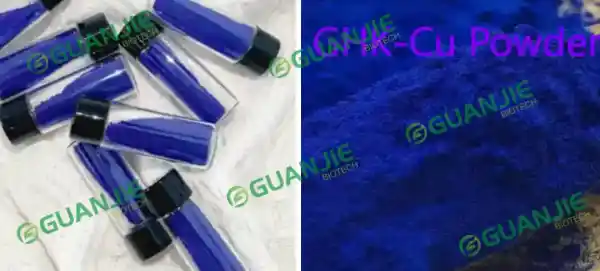
Potential Effects on Hair Follicles
Research using in vitro and ex vivo hair follicle models suggests that GHK-Cu Copper Tripeptide-1 Powder may influence hair follicle length, size, perifollicular blood vessel formation, and biological signaling pathways associated with the hair growth cycle. These findings make GHK-Cu copper peptide ingredient of interest for developing scalp care products. However, laboratory findings do not establish clinical effectiveness in people with androgenetic alopecia or telogen effluvium.
Applications in Cosmetic Formulations
From a formulation perspective, GHK-Cu powder is a water-soluble peptide ingredient suitable for aqueous formulations, oil-in-water emulsions, and hydrogel systems. It can be considered for scalp serums, ampoules, hair tonics, shampoos, and hair masks. Formulators should evaluate its compatibility with other ingredients, pH conditions, processing temperatures, and manufacturing procedures. Adding the peptide during an appropriate low-temperature production stage may help protect its stability.
Stability and Formulation Considerations
The performance of GHK-Cu cosmetic ingredients depends on copper-peptide complex stability, concentration, delivery system, and application method. Changes in pH, oxidation conditions, and interactions with other ingredients may affect product stability and appearance. Although GHK-Cu is water-soluble, its penetration through the skin barrier may be limited. Therefore, suitable delivery systems and formulation testing are important when developing GHK-Cu scalp serum and other hair care products.
Why Can GHK-Cu Be Used in Hair Care Products?
GHK-Cu consists of three amino acids: glycine, histidine, and lysine, combined with a copper ion. As a cosmetic ingredient, GHK-Cu copper peptide has attracted attention because of its potential roles in cellular signaling, antioxidant defense, and tissue remodeling. These properties provide a scientific basis for exploring GHK-Cu in hair care formulations, particularly scalp serums and leave-on treatments.
Copper Ions and Hair Follicle Metabolism
Copper is an essential trace element involved in several biological processes. It acts as a cofactor for enzymes such as cytochrome c oxidase, superoxide dismutase (SOD), and lysyl oxidase. These enzymes contribute to cellular energy production, antioxidant defense, and collagen and elastin formation. Hair follicles are metabolically active structures that require an appropriate supply of nutrients and essential trace elements. GHK-Cu is different from simple inorganic copper salts because its peptide structure binds copper ions and may influence their biological availability. In addition, the GHK peptide itself has been investigated for its potential signaling activities.
This combination of copper binding and peptide signaling makes GHK-Cu powder an interesting ingredient for cosmetic research and scalp care product development.
The Wnt/β-Catenin Pathway and the Hair Growth Cycle
The Wnt/β-catenin signaling pathway plays an important role in hair follicle development and cycling. It is associated with the transition of hair follicles into the anagen phase, also known as the active growth phase.
Beta-catenin activity in dermal papilla cells is particularly important for regulating signals involved in hair follicle development and stem cell activity. Some preclinical research suggests that copper peptides may influence signaling pathways associated with tissue repair and cellular activity.
However, the direct effects of topical GHK-Cu on the human hair growth cycle have not been sufficiently established. Therefore, its potential relationship with the Wnt/β-catenin pathway should be considered an area of scientific investigation rather than a proven hair growth mechanism.
VEGF and the Microenvironment Around Hair Follicles
Vascular endothelial growth factor (VEGF) is involved in angiogenesis, the formation of new blood vessels. The blood vessel network surrounding hair follicles helps supply oxygen and nutrients to follicular tissues.
GHK-Cu has been studied for its potential influence on VEGF expression and tissue remodeling. These properties have generated interest in its possible applications in scalp care formulations.
For cosmetic manufacturers, this provides a research-based reason to investigate GHK-Cu copper peptide for hair care, especially in leave-on products designed for direct scalp application. However, improved blood circulation or increased hair growth should not be claimed without appropriate clinical evidence.
Antioxidant and Skin-Conditioning Properties
Oxidative stress and persistent inflammation can affect the biological environment surrounding hair follicles. Maintaining a healthy scalp environment is therefore an important consideration in hair care product development.
GHK-Cu has demonstrated antioxidant and anti-inflammatory activities in certain experimental models. Its potential relationship with superoxide dismutase activity and inflammatory signaling has attracted attention in cosmetic research.
These properties make GHK-Cu for scalp care a promising research ingredient for formulations targeting scalp conditioning and maintaining a balanced scalp environment. Actual cosmetic performance depends on concentration, formulation compatibility, stability, and application conditions.
Extracellular Matrix Support and Tissue Remodeling
The extracellular matrix provides structural support to skin and surrounding tissues. Collagen, elastin, and other matrix components contribute to tissue structure and elasticity.
GHK-Cu has been investigated for its potential effects on collagen synthesis, matrix metalloproteinases (MMPs), and their tissue inhibitors. These activities are relevant to cosmetic applications involving skin conditioning and tissue appearance.
In scalp care products, GHK-Cu peptide powder may be considered for formulations designed to support scalp skin quality. Its effects on the structural components of human hair follicles require further investigation.
GHK-Cu and Androgen-Related Hair Loss: What Does the Evidence Show?
Androgenetic alopecia is associated with genetic factors and androgen signaling, including the activity of 5α-reductase and dihydrotestosterone (DHT). Although some theoretical discussions explore possible relationships between copper ions and androgen-related pathways, there is currently insufficient clinical evidence to establish GHK-Cu as a treatment for androgenetic alopecia. For cosmetic manufacturers and ingredient buyers, it is important to distinguish laboratory findings from proven human outcomes. GHK-Cu should not be marketed as a pharmaceutical alternative or a clinically established hair loss treatment.
How Should GHK-Cu Be Used in Hair Care Products?
GHK-Cu powder is a cosmetic raw material that can be incorporated into different hair care products, including scalp serums, hair tonics, sprays, and shampoos. When developing GHK-Cu hair care formulations, manufacturers should consider product type, ingredient concentration, formulation stability, and processing conditions.
Formulation Strategy: Prioritize Leave-On Hair Care Products
Hair care products can be divided into rinse-off and leave-on formulations. The contact time between GHK-Cu and the scalp is an important formulation consideration. Therefore, leave-on products are generally more suitable for formulations designed to maintain longer scalp contact.
Recommended product formats include:
• Scalp serums and hair growth tonics:
These leave-on products allow longer contact with the scalp and are suitable formats for copper peptide formulations.
• Hair ampoules and sprays:
These products provide convenient application and can be developed with GHK-Cu as an active cosmetic ingredient.
• Hair masks and scalp treatments:
These formulations can incorporate copper peptides, depending on their composition and application time.
• Shampoos:
These are rinse-off products with relatively short contact times, typically around 1–3 minutes. Surfactants and other formulation ingredients may also affect peptide stability.
For product development, manufacturers can combine a shampoo with a leave-on scalp serum. The shampoo focuses on cleansing, while the serum provides a longer-contact formulation containing GHK-Cu copper peptide.
Recommended GHK-Cu Concentration in Hair Care Formulations
The appropriate GHK-Cu dosage depends on the raw material specification, final formulation, intended application, and applicable cosmetic regulations.
A preliminary formulation screening range may be 0.05%–0.2% GHK-Cu raw material. However, this range should not be treated as a universally established effective or safe concentration. Formulators should distinguish between the amount of GHK-Cu powder added and the actual concentration of the copper-peptide complex in the finished product.
Analytical testing, such as HPLC and suitable copper analysis, can help evaluate ingredient content and formulation stability. The analytical method should be validated for the specific formulation because total copper content alone cannot confirm the amount of intact GHK-Cu complex.
Processing Guidelines: Low-Temperature Addition
Proper processing helps maintain the quality of GHK-Cu cosmetic raw materials during manufacturing.
First, dissolve the GHK-Cu powder in deionized water or a suitable aqueous buffer. Add the prepared solution during the final production stage, preferably after the formulation has cooled below 40°C, subject to ingredient stability testing.
Use gentle stirring to achieve uniform distribution and avoid unnecessary prolonged high-shear processing. For emulsified products, add the copper peptide after emulsification and assess its compatibility with thickeners, electrolytes, preservatives, and pH-adjusting agents.
The formulation's pH and ethanol concentration should also be evaluated because they may influence peptide stability. Before commercial production, conduct compatibility, stability, and finished-product quality tests.
Recommended Key Parameters for GHK-Cu Hair Care Formulations
|
Item |
Recommended range: |
|
System pH |
5.0 to 6.5 (must remain within 4.0 to 7.0) |
|
Addition temperature |
Below 40°C (ideally below 35°C) |
|
Recommended dosage |
0.05% to 0.2% (calculated as the complex) |
|
Chelating agent |
Avoid EDTA and strong chelating systems. |
|
Surfactant |
Avoid direct contact with high concentrations of anionic surfactants. |
|
Antioxidant and reducing agent |
Avoid sulfites and high concentrations of ascorbic acid. |
|
Packaging |
Store in a sealed container, protected from light, and minimize headspace oxygen. |
GHK-Cu Powder Formulation: Ingredient Compatibility and Combination Strategies
GHK-Cu powder, also known as copper peptide, can be combined with selected cosmetic ingredients, including acetyl tetrapeptide-3, biotin, caffeine, niacinamide, and panthenol, for scalp care and hair care formulations. These ingredients serve different formulation purposes, such as supporting scalp conditioning and maintaining skin barrier function. However, GHK-Cu peptide compatibility should be carefully evaluated before combining multiple active ingredients.
Four key formulation considerations are important. First, avoid combining GHK-Cu with strongly acidic ingredients, such as high concentrations of AHAs or salicylic acid, without stability testing. Second, evaluate compatibility with reducing agents, including vitamin C and sulfites. Third, assess potential interactions with copper-chelating agents and high concentrations of zinc or iron salts. Fourth, consider separate phases or dual-chamber packaging in surfactant-based formulations. For manufacturers sourcing bulk GHK-Cu powder, formulation decisions should always be supported by stability and compatibility data.
FAQs:
Q1: Can GHK-Cu powder be used in hair growth products?
Yes. GHK-Cu powder, also known as copper peptide powder, can be used as a cosmetic active ingredient in scalp care and hair care formulations. Laboratory studies suggest that GHK-Cu may influence hair follicle biology, angiogenesis, antioxidant activity, and cellular signaling. It is commonly considered for scalp serums, hair tonics, ampoules, and other leave-on products. However, clinical evidence supporting its effectiveness in treating human hair loss remains limited.
Q2: Is GHK-Cu effective for androgenetic alopecia or hair loss?
GHK-Cu is being investigated for its potential effects on hair follicle biology, but there is insufficient clinical evidence to establish it as an effective treatment for androgenetic alopecia or other types of hair loss. It should be positioned as a cosmetic scalp care ingredient rather than a proven hair loss treatment. It is not a substitute for established treatments such as minoxidil or finasteride.
Q3:What is the recommended GHK-Cu concentration in hair care formulations?
A preliminary formulation screening range for GHK-Cu powder in cosmetic hair care products is 0.05%–0.2%, depending on the raw material specification and formulation objectives.
However, this range is not a clinically established effective dosage or a universal safety limit. Formulators should distinguish between the percentage of commercial raw material added and the actual GHK-Cu complex concentration. Stability, compatibility, and finished-product safety testing are necessary before determining the final concentration.
Q4:What is the ideal pH for GHK-Cu hair growth serum formulations?
A pH range of 5.0–6.5 is a practical starting point for developing GHK-Cu scalp serums and other aqueous hair care formulations. Formulators should avoid strongly acidic or alkaline conditions unless ingredient stability has been demonstrated.
The final pH should be determined through compatibility and stability testing. Monitoring pH during accelerated and long-term stability studies can help identify potential changes in copper-peptide complex stability.
Q5:Is GHK-Cu powder water-soluble?
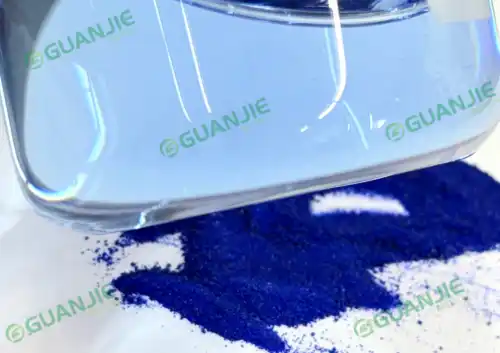
Yes. GHK-Cu copper peptide powder is generally water-soluble, making it suitable for aqueous cosmetic formulations. It can be incorporated into water-based scalp serums, tonics, sprays, and hydrogel systems.
For formulation development, manufacturers should:
- Use deionized water or a suitable aqueous phase.
- Dissolve GHK-Cu gradually with gentle stirring.
- Avoid unnecessary high-temperature processing.
- Check for precipitation or color changes.
- Evaluate compatibility with preservatives and other active ingredients.
Actual solubility and stability should be confirmed using the specific GHK-Cu raw material.
Conclusion:
GHK-Cu powder, also known as copper peptide powder, is used as an active ingredient in scalp and hair care formulations. Laboratory studies suggest that GHK-Cu may influence hair follicle growth cycles, angiogenesis, and antioxidant activity. However, clinical evidence remains limited, and it should not be considered a replacement for established hair loss treatments such as minoxidil. For cosmetic formulation development, a typical suggested concentration is 0.05%–0.2% in leave-on products, with a pH of 5.0–6.5. Add GHK-Cu copper peptide below 40°C. Avoid EDTA, strong chelating agents, anionic surfactants, and reducing agents. Stability and compatibility testing is recommended.
Guanjie Biotech is an active peptide ingredients supplier for cosmetics, offering GHK-Cu copper peptide powder along with technical support for related formulations. Welcome to enquire with us at info@gybiotech.com.
References:
[1] Pickart, L. (2008). The human tri-peptide GHK and tissue remodeling. Journal of Biomaterials Science, Polymer Edition, *19*(8), 969-988.
[2] Pyo, H. K., Yoo, H. G., Won, C. H., Lee, S. H., Kang, Y. J., Eun, H. C., Cho, K. H., & Kim, K. H. (2007). The effect of tripeptide-copper complex on human hair growth in vitro. Archives of Pharmacal Research, *30*(7), 834-839.
[3] Trachy, R. E., Fors, T. D., Pickart, L., & Uno, H. (1991). The hair follicle-stimulating properties of peptide copper complexes. Results in C3H mice. Annals of the New York Academy of Sciences, *642*, 468-469.
[4] Liu, T., Liu, Y., Zhao, X., Zhang, L., Wang, W., Bai, D., Liao, Y., Wang, Z., & Wang, M. (2024). Bio-based ionic liquid-based microemulsion for enhanced topical delivery of copper peptides for hair regeneration. Bioactive Materials, *32*, 502-513.
[5] Pickart, L., Vasquez-Soltero, J. M., & Margolina, A. (2015). GHK-Cu may prevent oxidative stress in skin by regulating copper and modifying expression of numerous antioxidant genes. Cosmetics, *2*(3), 236-247.


