GHK-Cu copper peptide powder and copper gluconate powder both contain divalent copper ions, but they differ in chemical structure, biological functions, applications, and safety requirements. GHK-Cu (Copper Tripeptide-1) is a bioactive copper peptide formed by three amino acids (glycine, histidine, and lysine) coordinated with copper ions. It is widely used in cosmetic formulations and skincare research. In contrast, copper gluconate powder is an organic copper salt mainly used as a copper source in dietary supplements and nutritional formulations.
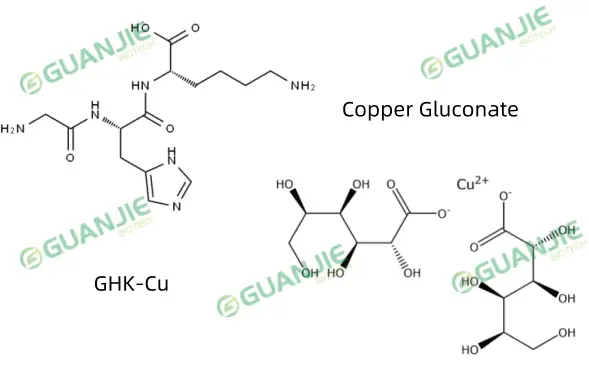
Chemical Nature and Molecular Structure
GHK-Cu powder and copper gluconate powder are two different copper-containing ingredients. Although both provide copper, they differ in chemical structure, molecular weight, bonding characteristics, and functional properties.
GHK-Cu Powder (Copper Peptide)
GHK-Cu, also known as copper tripeptide-1, has the chemical name glycyl-L-histidyl-L-lysine-copper(II). Its molecular structure consists of a tripeptide (GHK) coordinated with a copper ion through coordination bonds. The peptide contains nitrogen and oxygen donor atoms that help bind the copper ion, forming a characteristic blue complex. The molecular weight of the free GHK tripeptide is approximately 340.38 g/mol. The stability of GHK-Cu copper peptide powder depends on its coordination structure. Strongly acidic conditions or competing ligands may affect copper binding and complex stability. GHK-Cu is commonly used in cosmetic formulations and peptide ingredient research.
Copper Gluconate Powder
Copper gluconate is a copper salt formed from gluconic acid and copper ions. Its chemical formula is C₁₂H₂₂CuO₁₄, with a molecular weight of approximately 453.84 g/mol. Copper is associated with two gluconate anions through metal–oxygen coordination. Copper gluconate powder typically appears as a light blue to blue-green fine powder and is water-soluble. In aqueous solutions, copper ions interact with water molecules and gluconate ligands. Unlike GHK-Cu, copper gluconate does not contain a tripeptide structure and is primarily used as a copper source in nutritional and food-related applications.
|
Comparison Criteria |
Copper Peptide (GHK-Cu) |
Copper gluconate |
|
Chemical Nature |
Tripeptide-copper coordination complex |
Gluconate of copper |
|
Organic Ligand |
Glycyl-histidyl-lysine |
D-Gluconic acid |
|
Molecular Weight |
340.38 (tripeptide moiety) |
453.84 |
|
Copper Ion Binding Mode |
Coordination bonds (imidazole nitrogen, amino group) |
Ionic bond (carboxyl oxygen) |
|
Appearance |
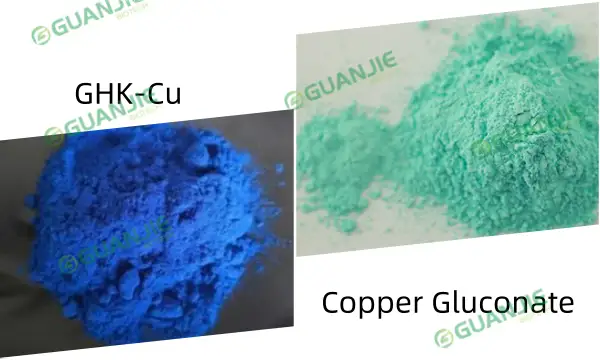
Blue crystals or powder |
Light blue fine powder |
|
Water Solubility |
Good (coordination stability requires consideration) |
Readily soluble |
Mechanism of Action and Biological Pathways
GHK-Cu (Copper Peptide)
GHK-Cu copper peptide powder is a copper peptide ingredient widely studied for its potential roles in skin health, collagen production, and tissue repair. Unlike simple copper salts, the intact GHK-Cu complex may interact with cell-surface receptors and intracellular signaling pathways. Research suggests that GHK-Cu can stimulate fibroblast activity and support the synthesis of type I and type III collagen, elastin, and glycosaminoglycans. It may also regulate gene expression associated with tissue remodeling and skin regeneration. In addition, GHK-Cu may help balance matrix metalloproteinases (MMPs) and their tissue inhibitors (TIMPs), supporting normal extracellular matrix turnover. Its potential anti-inflammatory and antioxidant properties are also being investigated.
Copper Gluconate
Copper gluconate powder is a copper mineral ingredient used in dietary supplements, cosmetics, and other formulations. After ingestion, copper gluconate dissociates into copper ions and gluconate, allowing copper to participate in normal metabolic processes. Copper acts as an essential cofactor for several enzymes, including cytochrome c oxidase, lysyl oxidase, and copper-zinc superoxide dismutase (SOD1). These enzymes contribute to mitochondrial energy production, collagen cross-linking, and antioxidant defense. Unlike GHK-Cu, copper gluconate does not contain a peptide sequence that may influence specific cellular signaling pathways. Its primary function is to provide bioavailable copper and help maintain normal copper levels.
Application Areas and Functional Differences
GHK-Cu powder and copper gluconate powder are mainly used in skincare and cosmetic formulations. Copper gluconate is an organic copper salt primarily used as a nutritional copper source.
GHK-Cu Powder Applications
GHK-Cu copper peptide powder is widely researched for its potential applications in skincare and skin repair. In cosmetic formulations, GHK-Cu copper peptide is used in anti-aging serums, skin-repair creams, scalp-care products, and skin-conditioning formulations. Research suggests that GHK-Cu may support fibroblast activity and collagen synthesis. It is also being investigated for wound-care applications, although more clinical evidence is needed to confirm its effectiveness. Due to its specialized properties and higher raw material cost, GHK-Cu powder is generally positioned as a premium cosmetic ingredient.
Copper Gluconate Powder Applications
Copper gluconate powder is mainly used in dietary supplements, food fortification, pharmaceutical preparations, and animal nutrition. It provides copper, an essential trace mineral involved in enzyme activity, energy metabolism, and connective tissue formation. Compared with GHK-Cu powder, copper gluconate is more suitable for nutritional applications.
|
Dimension |
Blue copper peptide (GHK-Cu) |
Copper Gluconate |
|
Primary Application Industries |
Functional cosmetics, wound dressings, regenerative medicine research |
Used for food fortification, dietary supplements, and feed additives |
|
Functional Attributes |
Signal-regulated bioactive substances |
A source of trace elements for nutritional supplementation |
|
Role in Cosmetics |
Core functional ingredients (anti-aging, repair) |
Rarely used as a functional active ingredient |
|
Role in Food/Nutrition |
Not applicable |
Copper fortifier (GRAS / food additive) |
|
Dependence of Function on Structural Integrity |
Yes (coordination integrity determines activity) |
No (acts via copper ions released upon dissociation) |
|
Cost |
Ten thousand yuan/kilogram level |
Price range: hundreds of RMB per kilogram |
There is virtually no direct competition between copper peptides and copper gluconate in terms of their application: the former is used in the development of functional products aimed at skin repair and anti-aging, while the latter serves the need for copper supplementation. For formulators or product developers, if the functional objective is tissue regeneration, copper peptides represent an option with a well-defined mechanism and a substantial body of supporting evidence; conversely, if the objective is copper supplementation, copper gluconate serves as a cost-effective ingredient with a clear regulatory status. The choice between the two does not depend on "which is better," but rather on the intended functional claims of the product and its regulatory classification within the target market.
Safety and Quality Control Considerations
The safety and quality of GHK-Cu copper peptide powder depend on its copper ion concentration and peptide content. A study of commercially available copper peptide cosmetics using a zebrafish model found that higher copper ion levels were associated with lower safety, while higher peptide content showed a positive correlation with skin barrier repair efficacy. This suggests that excessive free copper ions may cause unwanted reactions rather than improve product performance. Therefore, GHK-Cu raw material manufacturers and suppliers should monitor copper ion levels, peptide purity, and complex stability through strict quality control. Proper formulation strategies, such as liposomal encapsulation and pH adjustment, can help reduce copper ion dissociation in acidic environments.
For copper gluconate powder, safety assessments mainly focus on dietary exposure and copper intake. Although its reported oral LD₅₀ in rats is 1,710 mg/kg, excessive intake may cause copper accumulation in the liver, gastrointestinal irritation, and other adverse effects. Therefore, copper gluconate bulk powder should meet applicable food and supplement regulations. In cosmetic applications, formulation developers should also evaluate skin compatibility and copper ion concentration. Reliable GHK-Cu powder suppliers and copper gluconate powder manufacturers should provide COA documentation, purity testing, and consistent batch quality to support safe ingredient sourcing.
FAQs:
Q1. What is the difference between GHK-Cu and copper gluconate?
GHK-Cu copper peptide powder and copper gluconate are two different copper-containing compounds with different chemical structures and applications. GHK-Cu (Copper Tripeptide-1) is a copper peptide composed of glycine, histidine, and lysine bound to copper ions. It is commonly used in cosmetic formulations and skincare research. Copper gluconate is a copper salt formed from copper and gluconic acid. It is widely used in dietary supplements, cosmetics, and food-related applications.
Q2. Is GHK-Cu better than copper gluconate?
Neither ingredient is universally better. GHK-Cu is mainly selected for cosmetic formulations, peptide-based skincare products, and research applications. Copper gluconate is more suitable for applications requiring a conventional copper mineral source. The choice depends on the intended application, formulation requirements, copper content, and quality specifications.
Q3.Does GHK-Cu contain more copper than copper gluconate?
No. Copper gluconate generally contains a higher proportion of elemental copper than GHK-Cu.
The theoretical elemental copper content is approximately:
|
Ingredient |
Theoretical copper content |
|
GHK-Cu (Copper Tripeptide-1) |
15.0% |
|
Copper gluconate |
14.0% |
Actual specifications depend on the chemical form, hydration state, purity, and product composition. Manufacturers should verify elemental copper content through appropriate analytical testing.
Q4. Is GHK-Cu powder water-soluble?
GHK-Cu powder is generally water-soluble, making it suitable for aqueous cosmetic formulations. Its solubility and stability can vary depending on pH, concentration, temperature, and formulation ingredients.
Copper gluconate is also water-soluble and is commonly used in aqueous formulations. Both ingredients require appropriate formulation and storage conditions to maintain product quality.
Conclusion:
The main difference between GHK copper peptide powder and copper gluconate powder lies in their chemical structures and applications. GHK-Cu, also known as copper peptide, is a bioactive complex formed by the binding of a copper ion with a specific tripeptide (glycyl-L-histidyl-L-lysine). Its value comes from its peptide structure and potential applications in skincare, skin repair, and anti-aging formulations.
In contrast, copper gluconate powder is an organic copper salt commonly used as a source of dietary copper in nutritional supplements and food fortification. It provides essential copper without requiring a peptide structure.
These ingredients are not interchangeable. A simple mixture of free peptides and copper gluconate cannot automatically reproduce the structure of GHK-Cu copper peptide. For ingredient selection, bulk GHK-Cu copper peptide powder is suitable for peptide-based skincare formulations, while copper gluconate powder is a practical option for copper supplementation and nutritional applications.
Guanjie Biotech is a professional GHK copper peptide powder supplier. We provide OEM and ODM services to meet different business requirements. Customized options include particle size, packaging specifications, and product formulations. Contact Guanjie Biotech for purple yam powder wholesale and customized ingredient solutions. Welcome to enquire with us at info@gybiotech.com.
References:
[1] Pickart, L. (2008). The human tripeptide GHK and tissue remodeling. Journal of Biomaterials Science, Polymer Edition, *19*(8), 969-988.
[2] Pickart, L., & Margolina, A. (2018). Regenerative and protective actions of the GHK-Cu peptide in the light of the new gene data. International Journal of Molecular Sciences, *19*(7), 1987.
[3] Pickart, L., Vasquez-Soltero, J. M., & Margolina, A. (2015). GHK peptide as a natural modulator of multiple cellular pathways in skin regeneration. BioMed Research International, *2015*, 648108.
[4] Maquart, F. X., Pickart, L., Laurent, M., Gillery, P., Monboisse, J. C., & Borel, J. P. (1988). Stimulation of collagen synthesis in fibroblast cultures by the tripeptide-copper complex glycyl-L-histidyl-L-lysine-Cu2+. FEBS Letters, *238*(2), 343-346.
[5] Dymek, M., Olechowska, K., Hąc-Wydro, K., & Sikora, E. (2023). Liposomes as carriers of GHK-Cu tripeptide for cosmetic application. Pharmaceutics, *15*(10), 2485.
[6] Abe, M., et al. (2008). Possible carcinogenic risks of copper gluconate and their prevention by co-administered green tea catechins evaluated by a rat medium-term multi-organ carcinogenicity bioassay protocol. Food and Chemical Toxicology, *46*(5), 1760-1770.
[7] Abe, M., et al. (2008). Carcinogenic risk of copper gluconate evaluated by a rat medium-term liver carcinogenicity bioassay protocol. Archives of Toxicology, *82*(8), 563-571.