GHK-Cu is a copper peptide widely used in cosmetic and skincare formulations. However, GHK-Cu peptide stability can be affected by heat, light, pH, and chelating agents. Excessive heat or prolonged light exposure may accelerate degradation, potentially causing peptide chain breakdown, changes in copper complexation, and reduced biological activity. These changes may also result in visible color variations in GHK-Cu powder or finished cosmetic products. To maintain the quality of GHK-Cu cosmetic ingredients, manufacturers should control storage temperatures, minimize light exposure, and optimize formulation conditions. Light-protective packaging and appropriate processing methods can help preserve ingredient stability throughout its shelf life. For bulk GHK-Cu peptide procurement, buyers should evaluate product specifications, storage recommendations, and stability data to support consistent quality in cosmetic product development.
Does GHK-Cu Degrade Under Heat?
The stability of GHK-Cu Copper Tripeptide-1 Powder depends on the coordination bonds between copper ions and functional groups in the peptide structure, including the imidazole group of histidine. Temperature changes can affect these interactions and may accelerate the degradation of GHK-Cu ingredient powder under unsuitable storage or processing conditions.
Recommended Storage Conditions for GHK-Cu Powder
Proper GHK-Cu raw material storage is essential for maintaining ingredient quality. For long-term storage, follow the temperature and humidity conditions specified in the supplier's technical data sheet (TDS) and certificate of analysis (COA). Refrigerated or frozen storage may be appropriate for certain products, but the recommended conditions depend on the material's stability data and packaging.
When GHK-Cu is dissolved in water or incorporated into a cosmetic formulation, its stability may change. Therefore, manufacturers should evaluate the effects of temperature, pH, and other formulation ingredients before selecting storage and processing conditions.
Optimal Processing Temperature for GHK-Cu Cosmetic Formulations
Cosmetic manufacturing often involves heating during emulsification, with temperatures potentially reaching 70–85°C. Prolonged exposure to these temperatures may affect GHK-Cu stability and increase the risk of degradation.
For temperature-sensitive ingredients, a practical approach is to add GHK-Cu during the cooling phase, once the formulation reaches approximately 35–40°C or the temperature specified by the supplier. This method can help reduce unnecessary heat exposure. Compatibility and stability testing should confirm the appropriate addition temperature for each formulation.
Factors Influencing Copper Peptide Thermal Stability
The thermal stability of Copper Peptide GHK-Cu Powder depends on more than temperature alone. Exposure time, pH, moisture, packaging, and interactions with other ingredients can influence product stability. Repeated heating and cooling may also affect the quality of the finished formulation.
Some GHK-Cu formulation temperature technologies, including encapsulation and specialized ingredient combinations, may help improve GHK-Cu stability. However, their effectiveness must be verified through appropriate testing.
Does GHK-Cu Degrade Under Light?
Yes, GHK-Cu (copper tripeptide-1) may degrade under certain light-exposure conditions. Its stability depends on factors such as light intensity, exposure time, temperature, pH, and the overall formulation. For manufacturers developing skincare products, understanding GHK-Cu stability is important for maintaining raw material quality and finished product performance.
How Does Light Affect GHK-Cu Stability?
GHK-Cu is a copper-binding tripeptide composed of glycine, histidine, and lysine. Prolonged exposure to ultraviolet (UV) light or other environmental conditions may contribute to peptide degradation or changes in copper complex stability. Depending on the formulation, these changes may affect the ingredient's chemical integrity, appearance, and performance. However, the extent of GHK-Cu degradation under light exposure should be confirmed through appropriate stability testing rather than assumed from color changes alone.
How Should GHK-Cu Peptide Powder Be Stored?
Proper storage helps maintain the quality of GHK-Cu peptide powder. As a raw material, it should be stored in a tightly sealed container under the supplier-recommended temperature and humidity conditions. Light-resistant packaging can provide additional protection against unnecessary light exposure.
For finished cosmetic products, formulators can consider opaque pump bottles, aluminum tubes, or amber glass containers. These packaging options can reduce light exposure compared with clear packaging. Actual packaging suitability should be evaluated through formulation compatibility and stability studies.
Can Antioxidants Improve GHK-Cu Stability?
Antioxidants may help control oxidation in certain cosmetic formulations, but their effectiveness depends on the ingredient combination, concentration, and formulation environment. Vitamin E and ferulic acid should not automatically be considered compatible with every GHK-Cu copper peptide formulation. Compatibility testing is necessary before incorporating these ingredients.
How Can Manufacturers Protect GHK-Cu in Cosmetic Formulations?
To improve GHK-Cu raw material stability, manufacturers should evaluate light exposure, temperature, pH, packaging, and ingredient compatibility. Accelerated and real-time stability testing can help determine appropriate storage conditions and packaging requirements for bulk GHK-Cu peptide and finished skincare products.
Synergistic Effects of Heat and Light on GHK-Cu Stability
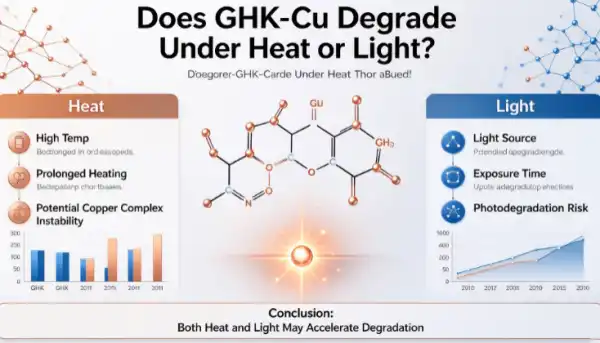
In cosmetic formulations, heat and light can work together to accelerate GHK-Cu degradation. For example, storing GHK-Cu skincare products near windows or inside vehicles may expose them to both sunlight and elevated temperatures, potentially reducing copper peptide stability faster than either factor alone.

Ingredient compatibility
Ingredient compatibility is another important consideration when developing GHK-Cu cosmetic formulations. Chelating agents can bind copper ions and potentially interfere with the coordination structure of GHK-Cu. EDTA, a common chelating agent, may affect copper peptide stability and should be evaluated carefully during formulation development. Hyaluronic acid and its salts also contain carboxyl groups that may interact with copper ions. Therefore, formulators should assess ingredient compatibility, concentrations, and molecular characteristics when combining hyaluronic acid with GHK-Cu copper peptide.
GHK-Cu pH stability
GHK-Cu pH stability is equally important. Formulation pH can influence copper peptide integrity, solubility, and compatibility with other ingredients. Rather than assuming a universal optimal pH, manufacturers should establish suitable conditions through stability testing. To improve GHK-Cu peptide stability, cosmetic developers should evaluate temperature, light exposure, pH, packaging, and ingredient interactions. These measures support better quality control and help manufacturers develop more stable copper peptide skincare products.
The table below summarizes the key factors affecting the stability of copper peptides, along with the essential control measures for their use in cosmetic applications.
|
Influencing Factors |
Effects on Copper Peptides |
Key Control Points in Cosmetic Formulations |
|
Temperature (≥40°C, prolonged) |
Acceleration of peptide chain degradation and copper ion dissociation |
Add ingredients during the cooling phase (≤35–40°C); avoid prolonged high-temperature homogenization. |
|
Light exposure (UV/visible light) |
Photocatalytic oxidation, peptide chain cleavage, and fading |
Store raw materials away from light; use opaque packaging; incorporate antioxidants into the formula. |
|
pH (<5.0 or >7.0) |
Dissociation of copper ions and destabilization of the complex |
Adjust pH to 5.0–6.5; avoid combinations involving strong acids or strong bases. |
|
Chelating agents (EDTA, hyaluronic acid, etc.) |
Competitive sequestration of copper ions, disrupting the complex |
Avoid EDTA; for hyaluronic acid, carefully select the appropriate molecular weight and ratio. |
|
Oxidizing agents (substances with strong oxidizing properties) |
Direct oxidation of peptide chains |
Avoid combinations with high concentrations of Vitamin C, peroxides, or similar substances. |
Visible Signs of GHK-Cu Degradation and Its Functional Consequences
In finished cosmetic products, GHK-Cu degradation may cause visible changes in color and potentially reduce ingredient activity. The GHK-Cu copper peptide complex has a characteristic blue color resulting from interactions between copper ions and peptide ligands. If copper dissociates from the complex or its chemical state changes, the formulation may shift from blue to pale blue, grayish-green, or colorless. These changes can serve as preliminary indicators of copper peptide stability in cosmetic formulations. However, color alone cannot confirm ingredient integrity. Peptide-chain oxidation or cleavage may occur while the blue color remains, potentially reducing the activity of the GHK-Cu peptide.
How GHK-Cu Degradation Affects Performance?
Intact GHK-Cu peptide is studied for its role in skin-related biological processes, including collagen synthesis and tissue repair signaling. When the peptide structure changes or copper dissociates, the complex may lose some of its intended functional properties. These changes can affect the ingredient's performance in cosmetic formulations designed for skin conditioning and anti-aging applications.
For manufacturers developing GHK-Cu skincare ingredients, maintaining formulation stability is essential for consistent product quality. Factors such as pH, temperature, light exposure, oxygen, and interactions with other ingredients may influence copper peptide stability. Formulators should evaluate color, appearance, and relevant chemical parameters during stability testing. Analytical methods are needed to assess GHK-Cu integrity and concentration more reliably than visual inspection alone.
GHK-Cu stability testing helps cosmetic manufacturers assess ingredient quality throughout product storage and supports more consistent formulation performance.
How To Solve GHK-Cu Degrade Under Heat or Light?
Maintaining the stability of GHK-Cu copper peptide is essential for cosmetic formulators developing high-quality skincare products. Heat, light, unsuitable pH levels, and incompatible ingredients may affect GHK-Cu peptide stability during manufacturing, storage, and transportation. The following formulation guidelines can help reduce degradation risks and maintain product quality.
Processing: Control Temperature During Manufacturing
Low-temperature addition is a practical strategy for protecting GHK-Cu from thermal degradation. After emulsification is complete and the formulation cools below 40°C, add the pre-dissolved copper peptide to the aqueous or polyol phase. Avoid exposing GHK-Cu powder or solutions to unnecessary heating.
For formulations containing oil-phase ingredients or heat-sensitive thickeners, complete all required heating steps before incorporating GHK-Cu. This approach helps preserve copper peptide stability during cosmetic manufacturing.
Packaging: Protect GHK-Cu from Light
Light-resistant packaging can help reduce GHK-Cu degradation under light exposure. Opaque airless pump bottles, aluminum-plastic laminate tubes, and amber glass bottles are practical options for copper peptide skincare products.
If transparent packaging is necessary, formulators should evaluate photostability through appropriate testing. Antioxidants may provide additional protection when compatible with the formulation, but they cannot replace effective light-blocking packaging.
Formulation: Optimize pH and Ingredient Compatibility
Maintaining a target pH of 5.0–6.5 may be a useful starting point for GHK-Cu skincare formulation development. However, the optimal pH range should be confirmed through stability testing.
Avoid assuming that all chelating agents, including EDTA, are compatible with copper peptides. Evaluate their potential interactions with the copper complex. Ingredients containing carboxyl groups, such as hyaluronic acid, should also undergo compatibility testing.
Some formulation studies describe potential compatibility between copper peptides and hyaluronic acid at specific molecular weights and mixing ratios. These conditions should be validated experimentally rather than treated as universal formulation standards. Vitamin E or ferulic acid may provide supplementary antioxidant benefits when suitable for the product system.
Storage and Transportation: Maintain Controlled Conditions
Store GHK-Cu powder and finished copper peptide skincare products in cool, dry conditions, protected from direct sunlight and excessive heat. Use suitable sealed packaging to limit exposure to moisture and environmental contaminants.
During summer shipping or long-distance transportation, temperature monitoring and controlled logistics can help maintain product quality. Establish storage specifications and shelf life based on stability data.
For cosmetic manufacturers and bulk GHK-Cu peptide buyers, controlling processing temperature, packaging, pH, ingredient compatibility, and storage conditions is essential for developing stable copper peptide formulations.
FAQs:
Q1: What temperature affects GHK-Cu powder stability?
High temperatures can accelerate the degradation of GHK-Cu powder. However, there is no single temperature threshold that applies to every formulation. Manufacturers should evaluate thermal stability through controlled testing to determine suitable processing and storage conditions.
Q2: Does sunlight damage GHK-Cu peptide?
Prolonged direct sunlight may reduce GHK-Cu stability. Light exposure can contribute to chemical changes in susceptible peptide formulations. Therefore, storing GHK-Cu powder in light-resistant, tightly sealed packaging helps minimize unnecessary exposure.
Q3: How should GHK-Cu powder be stored to prevent degradation?
Store GHK-Cu powder in a cool, dry place, away from direct sunlight and excessive heat. Keep the container tightly sealed to minimize exposure to moisture and environmental contaminants. Follow the supplier's recommended storage conditions and product-specific stability data.
Q4: Does GHK-Cu degrade during cosmetic manufacturing?
GHK-Cu raw material may lose stability during cosmetic manufacturing if exposed to unsuitable temperatures, pH conditions, or incompatible ingredients. Formulators should assess processing temperatures, mixing time, and ingredient compatibility. Adding GHK-Cu during a suitable cooling stage may help reduce thermal exposure, depending on the formulation.
Q5: Does pH affect the stability of GHK-Cu?
Yes. Formulation pH can influence bulk GHK-Cu powder stability and its interaction with other ingredients. Strongly acidic or alkaline conditions may increase the risk of chemical changes. Cosmetic manufacturers should conduct compatibility and stability tests to establish an appropriate pH range for each finished product.
Q6: Can GHK-Cu change color when it degrades?
A color change may indicate a change in product quality, but it does not necessarily confirm degradation. Cosmetic-grade copper peptides are a copper-containing peptide that may have a blue or blue-purple appearance, depending on its form and formulation. Manufacturers should investigate color changes using appropriate analytical methods rather than relying on visual inspection alone.
Q7: Is GHK-Cu stable in water-based formulations?
GHK-Cu copper peptide powder can be incorporated into water-based formulations, but its stability depends on pH, temperature, light exposure, and other ingredients. Chelating agents, competing metal ions, and certain reactive components may also affect copper-peptide interactions. Formulators should evaluate compatibility and conduct stability testing in the final formulation rather than relying solely on the stability of the raw powder.
Summary
GHK-Cu copper peptides can be sensitive to heat, light, and formulation conditions. Improper storage or processing may affect peptide integrity and copper-peptide complex stability. For cosmetic manufacturers, GHK-Cu stability is an important consideration when developing skincare products. Although degradation risks cannot be eliminated entirely, appropriate formulation strategies can help maintain ingredient quality.
Four key approaches can support copper peptide stability. First, add GHK-Cu powder during the cooling stage to minimize heat exposure. Second, use light-protective packaging to reduce exposure to light. Third, optimize and maintain the formulation's pH based on compatibility testing. Fourth, evaluate chelating agents carefully because they may interact with copper ions. Selecting a reliable GHK-Cu raw material supplier and conducting stability testing are also essential steps in product development.
Guanjie Biotech supplies GHK-Cu copper peptide powder for cosmetic and skincare manufacturers. The company offers OEM and ODM cooperation options to support different product development requirements. OEM services follow the client's formulation, specifications, and packaging requirements, while ODM services provide formulation and product development support for customized, branded products.
Businesses sourcing bulk GHK-Cu powder or developing copper peptide skincare products can contact Guanjie Biotech to discuss specifications, minimum order quantities (MOQs), packaging options, and delivery arrangements. Welcome to enquire with us at info@gybiotech.com.
References:
[1] BenchChem Technical Support Team. (2025). Identifying and minimizing GHK-Cu degradation products in experiments. BenchChem.
[2] BenchChem Technical Support Team. (2025). Long-term storage and stability of GHK-Cu stock solutions. BenchChem.
[3] Naletova, I., et al. (2025). Protective Functions of β-Alanyl-L-Histidine and Glycyl-L-Histidyl-L-Lysine Glycoconjugates and Copper in Concert. Antioxidants, *14*(12), 1512.
[4] BenchChem Technical Support Team. (2025). GHK-Cu acetate Documentation Hub - Frequently Asked Questions (FAQs). BenchChem.
[5] Research on the Application of Supramolecular Co-solution Systems Loaded with Copper Peptide Co-crystals. (2026). *China Cosmetics*, (4).
[6] A Copper Peptide Composition, Preparation Method Thereof, and Its Application. Chinese Invention Patent, CN112263505A. Guangzhou Dongfang Biotechnology Co., Ltd.
[7] Activity Testing of Copper Peptides: Ensuring Efficacy in Anti-Aging Products Throughout Their Shelf Life. (2025). CAS Testing Technical Services (Guangzhou) Co., Ltd.