Nicotinamide adenine dinucleotide NAD+ is an essential redox coenzyme involved in cellular energy metabolism, DNA repair, mitochondrial function, and epigenetic regulation. NAD+ levels may decline with age and metabolic stress, making NAD precursor ingredients an important research area in dietary supplement and functional food development. Among these ingredients, nicotinamide riboside (NR), nicotinamide mononucleotide (NMN), and reduced nicotinamide mononucleotide (NMNH) have attracted interest for their potential roles in NAD metabolism. For formulators evaluating an NMNH supplement ingredient, key considerations include purity, stability, solubility, analytical testing, and storage conditions.
Differences Between NR and NMNH in Chemical Structure and NAD+ Metabolic Pathways
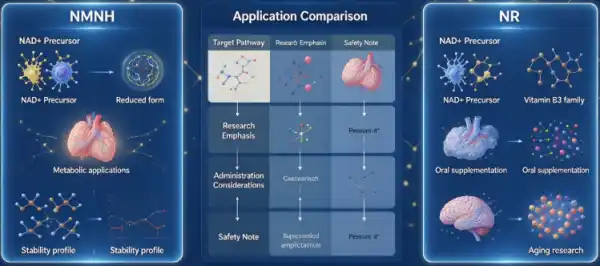
NR and NMNH are both NAD+ precursor ingredients, but they differ in chemical structure and metabolic pathways. Understanding the differences between nicotinamide riboside (NR) and reduced nicotinamide mononucleotide (NMNH) helps researchers and supplement formulators evaluate their biochemical properties.
NR: Chemical Structure and Metabolic Pathway
Nicotinamide riboside (NR) is a pyridine nucleoside consisting of nicotinamide linked to ribose through a glycosidic bond. After entering cells, NR is primarily phosphorylated into nicotinamide mononucleotide (NMN) by nicotinamide riboside kinase (NRK). NMN is then converted into NAD+ by nicotinamide mononucleotide adenylyltransferase (NMNAT). The expression and distribution of NRK may influence NR metabolism across different tissues.
NMNH: Chemical Structure and Metabolic Pathway
NMNH, the reduced form of NMN, contains a reduced nicotinamide ring with a 1,4-dihydropyridine structure. Research by Zapata-Pérez et al. (2021) identified NMNH as an NAD+ precursor and described a pathway distinct from the conventional NRK- and NAMPT-dependent pathways. These findings suggest that NMNH may support NAD+ biosynthesis through alternative metabolic routes. However, further research is needed to clarify its mechanisms, safety, and potential applications.
Comparison of Key Features of NMNH and NR Metabolic Pathways
|
Characteristic Dimension |
NMNH |
NR |
|
Chemical Nature |
Reduced nicotinamide mononucleotide |
Nicotinamide riboside |
|
Primary Entry Point into NAD+ Synthesis |
NRK/NAMPT-independent reduced precursor pathway |
NRK phosphorylation → NMN → NAD+ |
|
Dependence on Key Rate-Limiting Enzymes |
Low (NRK/NAMPT not essential) |
High (NRK expression level determines conversion efficiency) |
|
Time of Identification as an NAD+ Precursor |
2021 |
Early (systematic studies began around 2012) |
NR vs. NMNH: Comparison of Bioavailability and Pharmacokinetics
Nicotinamide riboside (NR) and reduced nicotinamide riboside (NMNH) are NAD+ precursor ingredients studied for their effects on cellular NAD+ metabolism. Although both compounds are associated with NAD+ production, their bioavailability, absorption, and pharmacokinetic profiles may differ.
Tissue Distribution and Cellular Uptake
NR and NMNH bioavailability depend on factors such as intestinal absorption, cellular transport, and intracellular metabolism. NR is an established NAD+ precursor that can be converted into NAD+ through cellular metabolic pathways. Its distribution and utilization depend on the formulation, dosage, and biological conditions.
NMNH, the reduced form of NR, has attracted research interest because preclinical studies suggest that it may increase intracellular NAD+ levels through distinct metabolic pathways. However, claims that NMNH has superior cell membrane permeability or tissue distribution require further validation in human studies.
Plasma Concentration and Duration of Action
The pharmacokinetics of NR and NMNH involve differences in absorption, metabolism, and clearance. After oral administration, NR undergoes metabolic conversion, which influences its plasma concentration and availability for NAD+ synthesis. NMNH has demonstrated promising NAD+-increasing effects in preclinical research, but its absorption, tissue retention, and duration of action in humans remain insufficiently characterized.
Implications for Supplement Formulation
For manufacturers evaluating NR vs. NMNH supplement ingredients, important considerations include ingredient purity, stability, dosage form, analytical testing, and supporting pharmacokinetic evidence. More human clinical research is needed to establish reliable comparisons of bioavailability, safety, and long-term effects.
|
Comparison Dimensions |
Nicotinamide Riboside (NR) |
Reduced Nicotinamide Mononucleotide (NMNH) |
|
Chemical Nature |
An oxidized pyridine nucleoside compound |
Reduced nucleotide monophosphate |
|
Primary Synthetic Enzyme Dependency |
Highly dependent on catalysis by NRK1/NRK2 kinases |
Characterized by multi-pathway conversion and less constrained by rate-limiting enzymes |
|
NAD+ Boosting Efficiency |
Robust, dose-dependent elevation [of NAD+ levels] |
Rapid elevation of levels with high peak concentrations |
|
Anti-Aging and Mitochondrial Support |
Activates sirtuins and improves mitochondrial function |
Significantly enhances the activity of complexes in the mitochondrial oxidative respiratory chain |
|
Metabolic Health Regulation |
Regulates glucose and lipid metabolism; enhances insulin sensitivity |
Demonstrates exceptional efficacy in models of metabolic dysfunction induced by a high-fat diet |
|
Neuroprotective Effects |
Maintains the health of neuronal axons and reduces neuroinflammation |
Reduces oxidative stress and ameliorates features of neurodegeneration |
How To Formulate NR and NMNH?
Thermal Stability and Photostability
• NR (Nicotinamide Riboside):
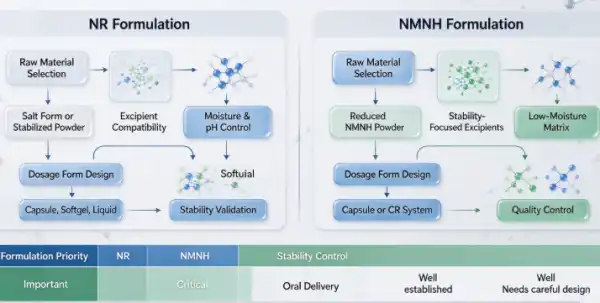
NR supplement ingredients require careful control of temperature and humidity during processing and storage. Nicotinamide riboside chloride is a commonly used form in dietary supplement formulations. Appropriate moisture control, protective packaging, and microencapsulation, where suitable, can help improve natural NR powder stability and support product quality throughout its shelf life.
• NMNH (Reduced Nicotinamide Mononucleotide):
NMNH is a reduced NAD+ precursor that requires careful evaluation of its stability under different environmental conditions. Exposure to oxygen, light, moisture, and unsuitable pH levels may affect its chemical stability. Bulk NMNH powder processing and storage should therefore involve controlled environmental conditions, appropriate humidity management, and light protection. High-barrier packaging, such as aluminum foil composite bags, may help limit exposure to oxygen and moisture.
Dosage Form Compatibility
• NR:
NR ingredients are suitable for various dietary supplement formats, including capsules, tablets, oral liquids, and powdered beverage blends. Established formulation approaches support scalable manufacturing, although moisture control and compatibility testing remain important.
• NMNH:
NMNH formulation requires particular attention to oxidation control and excipient compatibility. Potential dosage forms include hard capsules, softgels, and compressed tablets, depending on the ingredient's stability and the formulation design. Nitrogen flushing, suitable antioxidant excipients, and protective packaging may help preserve product quality when supported by stability testing.
Are NR and NMNH Safe?
NR (Nicotinamide Riboside) and NMNH (Reduced Nicotinamide Mononucleotide) are NAD+ precursor ingredients used in research and the development of dietary supplements. However, their safety profiles and regulatory status differ, making it important for supplement manufacturers to evaluate the available evidence before formulation.
NR safety:
Nicotinamide riboside has been evaluated in human clinical studies for safety and tolerability. Certain NR products have received U.S. FDA New Dietary Ingredient (NDI) notifications, and specific ingredient preparations may have Generally Recognized as Safe (GRAS) status for defined uses. However, an NDI notification is not FDA approval, and GRAS status does not automatically apply to every NR product or application. Manufacturers should verify the relevant regulatory documentation.
NMNH safety:
NMNH is a reduced form of an NAD+ precursor and has shown potential in preclinical research. However, animal toxicology findings cannot establish human safety, and comprehensive human clinical safety data remain limited. Supplement developers should assess the available toxicological evidence, purity specifications, dosage, and applicable regulatory requirements before using NMNH in formulations.
NR Vs. NMNH: How To Choose?
For supplement manufacturers, understanding the differences between NR and NMNH is essential for ingredient selection, product development, and regulatory planning.
Core Strengths and Applications of NR
NR is a well-studied NAD+ precursor supported by human clinical research on its pharmacokinetics, safety, and effects on NAD+ metabolism. For manufacturers developing dietary supplements that require human clinical evidence, NR may offer a more established scientific foundation. Its regulatory status varies by country and intended use, so suppliers and formulators should verify applicable requirements before commercialization.
However, responses to NR supplementation may vary depending on dosage, tissue type, and individual metabolic factors. Researchers continue to investigate how NR is absorbed and metabolized and how effectively it increases NAD+ levels in different tissues.
NMNH Research Potential and Product Development
NMNH, also known as reduced nicotinamide mononucleotide, has attracted research interest because of its distinct metabolic properties. Preclinical studies suggest that NMNH may increase NAD+ levels through pathways that differ from those involved in NR metabolism. These findings make NMNH an emerging ingredient for NAD+ metabolism research and innovative supplement development.
For formulators considering NMNH powder for supplements, key evaluation factors include ingredient purity, stability, formulation compatibility, and available safety data. Although preclinical findings may support further investigation, they do not establish clinical efficacy or long-term safety in humans.
Choosing Between NR and NMNH
NR may be suitable for projects that prioritize an established human research base, while NMNH may interest companies exploring emerging NAD+ precursor ingredients. Both require evidence-based claims, appropriate quality controls, and market-specific regulatory assessments. Further human clinical research on NMNH will be important for clarifying its safety, efficacy, and commercial applications.
FAQs:
Q1. What is the difference between NMNH and NR as NAD+ precursors?
NMNH (reduced nicotinamide mononucleotide) and NR (nicotinamide riboside) are distinct compounds associated with NAD+ metabolism. NR is an established NAD+ precursor that has been investigated in human clinical studies. NMNH is the reduced form of NMN and has shown potential to influence NAD+ metabolism in preclinical research. Their chemical structures, metabolic pathways, stability profiles, and available research differ, which may affect their suitability for supplement formulation.
Q2. How do NMNH and NR differ in their mechanisms of NAD+ metabolism?
NR enters the NAD+ biosynthesis pathway through conversion to NMN, followed by conversion to NAD+. NMNH has a reduced chemical structure and may undergo different metabolic transformations. Research on NMNH is less extensive, particularly in humans, so its metabolic behavior and comparative effects should not be assumed to match those of NR. Formulators should consider the strength and relevance of the available evidence.
Q3. Which is better for dietary supplements: NMNH or NR?
Neither NMNH nor NR is universally better for dietary supplements. NR may be preferable for applications that prioritize human clinical research and an established ingredient history. NMNH may interest developers exploring emerging NAD+ precursor ingredients. Selection should depend on regulatory status, intended use, ingredient stability, manufacturing requirements, target market, and available safety and efficacy data.
Q4. Are NMNH and NR equally stable in supplement formulations?
NMNH and NR should not be assumed to have equivalent stability. NMNH's reduced chemical structure makes its sensitivity to oxidation an important factor to investigate. NR stability also depends on its chemical form, moisture, temperature, pH, and packaging conditions. Manufacturers should request ingredient-specific stability data and conduct compatibility and shelf-life studies under the intended formulation and storage conditions.
Q5. Can NMNH and NR be used in the same supplement formulation?
Combining NMNH and NR may be considered during formulation development, but the combination requires scientific justification and compatibility testing. Developers should assess chemical stability, ingredient interactions, dosage uniformity, and the rationale for including two NAD+ precursor ingredients. They should also evaluate the safety evidence for the combination and confirm that the proposed product complies with applicable regulations in its target market.
Q6. How do NMNH and NR compare in terms of human clinical evidence?
NR has been evaluated in multiple human studies investigating NAD+ metabolism, safety, and related biomarkers. NMNH has a more limited evidence base, with much of its reported research focused on preclinical models. Findings from laboratory or animal studies cannot establish equivalent effects in humans. Formulators should distinguish between changes in NAD+ biomarkers and demonstrated clinical benefits when developing evidence-based supplement products.
Q7. What quality specifications should buyers compare when sourcing NMNH and NR powder?
Ingredient buyers should compare both materials using specifications appropriate to each compound. Key parameters include identity, assay or purity, related substances, residual solvents where relevant, moisture, microbial limits, heavy metals, and batch consistency. A supplier's Certificate of Analysis (COA), analytical methods, traceability records, and stability data can support supplier qualification. NMNH and NR should have separate specifications rather than being evaluated as interchangeable raw materials.
Q8. Which is easier to formulate: NMNH or NR?
The answer depends on the dosage form, ingredient grade, manufacturing process, and required shelf life. NR's more extensive formulation experience and published research may simplify some development decisions. NMNH may require additional investigation into oxidation control, excipient compatibility, and packaging requirements. Both ingredients should undergo formulation-specific testing before commercial production, including assessments of content uniformity and stability.
Conclusion:
Nicotinamide riboside (NR) and reduced nicotinamide mononucleotide (NMNH) are NAD+ precursors with distinct molecular structures and formulation characteristics. Pure NR powder is supported by human clinical research and is used in NAD+ supplements targeting cellular energy and healthy aging. Pure NMNH powder is being studied for its potential to increase intracellular NAD+ levels. When comparing NR vs. NMNH, supplement manufacturers should evaluate purity, stability, bioavailability, safety data, regulatory requirements, and intended applications. Selecting the appropriate NAD+ precursor ingredients depends on product positioning, formulation needs, and available scientific evidence.
Guanjie Biotech is a reliable bulk NMNH powder supplier and NR raw material manufacturer, providing bulk NMNH and NR bulk powders for dietary supplements, functional foods, and cosmetics. Both are NAD+ precursors available for product development. Guanjie Biotech offers OEM and ODM services, including custom manufacturing, formulation development, dosage form selection, and packaging solutions. This integrated supply model helps businesses source NMNH and NR ingredients and develop branded finished products through one partner. Technical specifications, minimum order quantities (MOQs), sample availability, and service details are subject to mutual agreement and contractual terms.
References:
[1] Zapata-Pérez, R., Tammaro, A., Schomakers, B. V., Scantlebery, A. M. L., Denis, S., Elfrink, H. L., Giroud-Gerbetant, J., Cantó, C., López-Leonardo, C., McIntyre, R. L., van Weeghel, M., Sánchez-Ferrer, Á., & Houtkooper, R. H. (2021). Reduced nicotinamide mononucleotide is a new and potent NAD⁺ precursor in mammalian cells and mice. The FASEB Journal, *35*(4), e21456. https://doi.org/10.1096/fj.202001826R
[2] Vinten, K. T., et al. (2026). Reduced Versus Oxidized NAD⁺ Precursors Drive Distinct Transcriptomic, Proteomic, and Metabolic Profiles in Hepatocytes. The FASEB Journal, *40*(4), e71582. https://doi.org/10.1096/fj.202501925R
[3] Airhart, S. E., Shireman, L. M., Risler, L. J., Anderson, G. D., Nagana Gowda, G. A., Raftery, D., Tian, R., Shen, D. D., & O'Brien, K. D. (2017). An open-label, non-randomized study of the pharmacokinetics of the nutritional supplement nicotinamide riboside (NR) and its effects on blood NAD⁺ levels in healthy volunteers. PLoS One, *12*(12), e0186459. https://doi.org/10.1371/journal.pone.0186459
[4] (2026). Safety and Exploratory Efficacy of Reduced β-Nicotinamide Mononucleotide Calcium Salt (NMNH-Ca) in Healthy Middle-Aged and Older Adults: A Randomized, Double-Blind, Placebo-Controlled Trial. medRxiv (预印本). https://doi.org/10.64898/2026.08.11.26360226