Indole-3-carbinol (I3C) powder is an indole compound with the molecular formula C₉H₉NO, a molecular weight of 147.17 g/mol, and CAS number 700-06-1. It typically appears as a white to off-white crystalline powder, with a melting point of 96–99°C. Indole-3-carbinol powder has limited water solubility but dissolves readily in organic solvents such as ethanol and dimethyl sulfoxide (DMSO).In the acidic environment of the stomach, I3C can form metabolites, including 3,3'-diindolylmethane (DIM). Researchers study these compounds for their potential biological activities and effects on estrogen metabolism and cellular processes. Although both sources can produce the same chemical compound, they may differ in impurity profiles, production costs, purity, and suitability for specific applications.
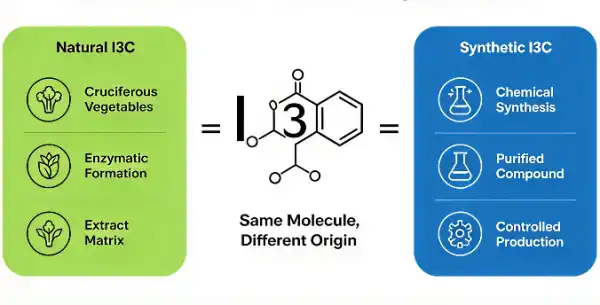
What Is Natural Indole-3-Carbinol I3C?
Natural indole-3-carbinol (I3C) is a naturally occurring compound formed when certain glucosinolates in cruciferous vegetables are broken down by enzymes. It is commonly associated with broccoli, kale, cabbage, cauliflower, and other cruciferous plants. For supplement manufacturers and ingredient formulators, understanding natural indole-3-carbinol sources, extraction methods, purity, and quality control is essential when evaluating I3C raw materials.
Natural Sources and Formation Mechanism of I3C
Natural I3C is not typically stored in intact plant tissues in large amounts. Instead, it forms from glucobrassicin, a glucosinolate precursor found in cruciferous vegetables. When plant tissues are cut, chewed, or processed, the enzyme myrosinase can hydrolyze glucobrassicin, producing unstable intermediates that can form indole-3-carbinol.
This process explains how natural indole-3-carbinol in broccoli and cabbage develops through plant tissue disruption. However, the amount formed depends on the vegetable species, processing conditions, enzyme activity, temperature, and pH. Therefore, the natural I3C content of plant materials can vary significantly.
Natural Indole-3-Carbinol Extraction Process
The traditional natural I3C extraction process involves raw material preparation, enzymatic activation, solvent extraction, concentration, and purification. During these steps, manufacturers must carefully control temperature, pH, light exposure, and processing time because I3C can degrade or undergo condensation reactions under certain conditions.
Direct extraction from cruciferous vegetables presents several industrial challenges. Glucobrassicin occurs at relatively low and variable concentrations, while the conversion and recovery of I3C may be inefficient. Consequently, producing high-purity natural indole-3-carbinol through direct plant extraction can require substantial raw materials, specialized equipment, and extensive purification.
Solvent selection is also important. Appropriate solvent recovery, worker safety, and residual solvent testing are necessary for commercial ingredient production.
Impurities and Quality Control of Natural I3C
Natural indole-3-carbinol extracts may contain residual glucosinolates, other indole derivatives, phenolic compounds, and additional plant constituents. Their presence depends on the source material and extraction conditions. Some indole derivatives can form through I3C condensation, so the final chemical profile may change during processing and storage.
For B2B buyers, natural indole-3-carbinol purity testing and batch consistency are important purchasing considerations. Relevant quality checks include HPLC analysis, identification testing, residual solvent analysis, moisture testing, and stability evaluation. A reliable Certificate of Analysis (COA) helps buyers assess whether an ingredient meets their specifications.
Technical Limitations of Natural I3C Production
Three major challenges affect natural I3C manufacturing:
• Low precursor content: Limited glucobrassicin levels can reduce extraction yields and production efficiency.
• Batch-to-batch variation: Plant variety, growing conditions, climate, and harvest timing can affect precursor concentrations.
• High production costs: Raw material consumption, extraction, solvent recovery, and chromatographic purification can increase manufacturing expenses.
What Is the Synthesis of Indole-3-Carbinol I3C?
• Industrial Synthesis Routes
Compared with natural extraction, chemical synthesis may offer better control over production capacity, purity, and process consistency.
One synthesis route involves the reaction of indole with formaldehyde under controlled catalytic conditions to produce hydroxymethylated indole-3-carbinol. Another method uses the reduction of indole-3-carboxaldehyde with reducing agents such as sodium borohydride. The selection of a synthesis route depends on reaction efficiency, purification requirements, and the desired product specifications.
• Modern Indole-3-Carbinol Manufacturing Technology
Modern indole-3-carbinol manufacturing processes focus on improving purity, reducing solvent residues, and meeting quality requirements for dietary supplement ingredients. Traditional processes may use aromatic solvents during purification, creating additional requirements for residual solvent control.
Advanced I3C synthesis technology can incorporate alternative solvent systems, optimized reaction temperatures, and controlled crystallization to improve product separation and consistency. Toluene-free processing may also help manufacturers reduce reliance on certain hazardous solvents. However, compliance with applicable quality standards must be verified through process validation and analytical testing.
For B2B buyers, key evaluation criteria include high-purity indole-3-carbinol, I3C purity testing, residual solvent analysis, batch consistency, and a Certificate of Analysis (COA).
Comparison of Key Differences Between Natural and Synthetic I3C
To clearly illustrate the fundamental differences between the two types of I3C, a systematic comparison is presented below across six dimensions: source, manufacturing process, purity, impurity profile, cost-effectiveness, and regulatory status.
|
Comparison Dimensions |
Natural indole-3-carbinol (extraction method) |
Synthesis of Indole-3-methanol (Traditional Process) |
Synthesis of Indole-3-methanol (Advanced Toluene-free Process) |
|
Raw Material Base |
Cruciferous plants (broccoli, cabbage, etc.) |
Basic chemical raw materials (indole, formaldehyde, etc.) |
Basic Chemical Raw Material (Green Route) |
|
Nominal Purity |
95% - 98% (often accompanied by trace coexistences of plant origin) |
≥98% |
≥99% Purity |
|
Residual Solvent Risk |
Presence of trace amounts of plant extract residues or conventional organic solvent residues |
Potential risk of residual aromatic hydrocarbon solvents (e.g., toluene, benzene) |
Zero toluene residue; fully compliant with ICH Q3C standards for residual solvents |
|
Batch-to-Batch Consistency |
Easily affected by agricultural climate and origin, batch fluctuations are large |
High batch-to-batch consistency |
Controllable production process with exceptional batch-to-batch consistency |
|
Appearance and Crystal Form |
Slightly yellow or off-white powder, single crystal form |
White to off-white powder; standard crystalline form |
Bright white appearance and high crystallinity; crystal forms customizable upon request |
|
Industrial Production Capacity and Cost |
Production capacity is limited by the harvest of plant raw materials, and the cost is extremely high |
Large production capacity; moderate cost |
Large-scale production capacity with superior overall cost-performance ratio |
Industrial Applications and Formulation Considerations for Indole-3-Carbinol Powder
Indole-3-carbinol (I3C) powder is used in dietary supplement formulation, including hard capsules, tablets, and functional powders. When selecting a bulk indole-3-carbinol powder supplier, manufacturers should evaluate purity, particle size, flowability, compressibility, and stability.
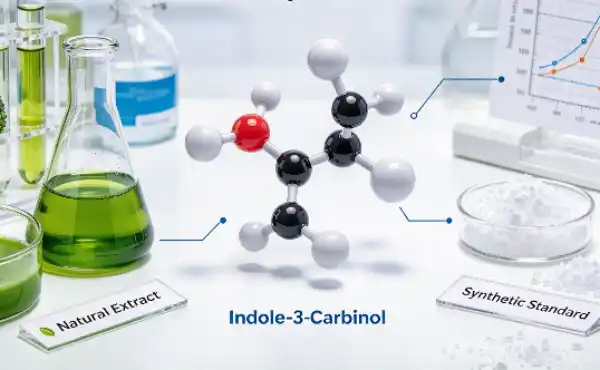
• Physical Properties and Processing
High-purity indole-3-carbinol powder with suitable particle characteristics can improve powder flow during capsule filling and tablet compression. Consistent particle size and bulk density also help reduce processing issues and support more uniform dosage units. Customized particle size distributions may be considered to meet specific formulation requirements.
• Stability and Storage
I3C is sensitive to environmental conditions, including heat, light, and acidic environments. Appropriate packaging, moisture control, and light protection are important for maintaining raw material quality. Formulators should also evaluate compatible excipients and stabilizers through stability testing to minimize degradation and support the intended shelf life of finished products.
When sourcing indole-3-carbinol powder for supplements, manufacturers should review the Certificate of Analysis (COA), purity test results, storage recommendations, and batch consistency to support quality control and formulation development.
FAQs:
Q1. What is the difference between natural indole-3-carbinol and synthetic I3C?
Natural indole-3-carbinol (I3C) is formed from glucobrassicin, a naturally occurring glucosinolate found in cruciferous vegetables such as broccoli, cabbage, and Brussels sprouts. Synthetic I3C is produced through chemical synthesis. Both forms contain the same target chemical compound, but their manufacturing processes, impurity profiles, and quality specifications may differ. Buyers should evaluate purity, identity, and analytical documentation when selecting I3C raw materials.
Q2. Is natural indole-3-carbinol better than synthetic I3C?
Natural I3C is not automatically superior to synthetic I3C. The suitability of either ingredient depends on its purity, manufacturing controls, impurity profile, stability, and intended application. For dietary supplement and nutraceutical manufacturers, a well-characterized ingredient with consistent specifications and reliable analytical testing is generally more important than the natural or synthetic label alone.
Q3. What are the main sources of natural indole-3-carbinol?
Natural indole-3-carbinol originates from glucobrassicin in cruciferous vegetables, including broccoli, cabbage, cauliflower, kale, and Brussels sprouts. When plant tissue is cut or crushed, the enzyme myrosinase can help convert glucobrassicin into unstable intermediates that form I3C under suitable conditions. Commercial I3C ingredients may be obtained through specialized extraction or other manufacturing processes, so buyers should verify the actual source and production method with the supplier.
Q4. What is synthetic indole-3-carbinol made from?
Synthetic indole-3-carbinol is manufactured through controlled chemical reactions using appropriate starting materials and processing steps. The specific synthesis route can vary by manufacturer. For bulk I3C procurement, buyers should review the manufacturing process, residual solvents, related substances, and other potential impurities. A documented specification and validated analytical methods help determine whether the material is suitable for the intended application.
Q5. How can manufacturers identify natural versus synthetic I3C?
Manufacturers should not rely on appearance alone to distinguish natural I3C from synthetic I3C because both may appear as white to off-white powders. Routine analytical techniques, such as HPLC, can help confirm identity and assess purity, but they may not independently establish the ingredient's origin. Buyers should request source declarations, manufacturing information, traceability records, and supporting documentation. Additional origin-verification testing may be necessary when required.
Q6. Are the purity requirements for natural and synthetic I3C different?
Purity requirements depend on the intended use, applicable regulations, and the purchaser's quality specifications rather than the ingredient's origin alone. Both natural and synthetic I3C should be evaluated for identity, assay, related substances, residual solvents where relevant, and potential contaminants. For supplement manufacturing, buyers should establish acceptance criteria and confirm that each batch complies with the agreed Certificate of Analysis (COA).
Q7. Is natural I3C more stable than synthetic indole-3-carbinol?
Natural origin does not necessarily make I3C more stable. The stability of natural and synthetic I3C depends on the chemical composition, purity, processing history, moisture, temperature, light exposure, and packaging conditions. I3C can also undergo chemical changes under acidic conditions. Manufacturers should request stability data, conduct compatibility studies, and establish appropriate storage conditions for their specific formulation.
Q8. What should supplement formulators consider when choosing natural or synthetic I3C?
Formulators should evaluate several technical and commercial factors before selecting an I3C ingredient:
- Source and manufacturing method: Confirm whether the ingredient is plant-derived or chemically synthesized.
- Purity and identity: Review validated analytical results.
- Impurity profile: Assess related substances, residual solvents, and relevant contaminants.
- Stability: Evaluate sensitivity to temperature, moisture, light, and formulation conditions.
- Regulatory compliance: Confirm suitability for the target market and intended use.
- Documentation and traceability: Request COA, technical specifications, and relevant manufacturing records.
These criteria support consistent raw material qualification and formulation development.
Q9. Can natural and synthetic I3C be used in the same supplement formulations?
Both forms may be considered for supplement formulations, provided they meet applicable regulatory requirements and the manufacturer's specifications. However, formulators should not assume that different sources will have identical impurity profiles or stability characteristics. Compatibility, content uniformity, and finished-product stability should be evaluated using the actual ingredient grade selected for production.
Conclusion:
In summary, natural and synthetic indole-3-carbinol (I3C) share the same molecular structure but differ in production methods, purity, batch consistency, supply reliability, and cost-effectiveness. Natural indole-3-carbinol powder appeals to buyers seeking plant-derived ingredients but may involve higher costs and greater batch variability. In contrast, synthetic indole-3-carbinol powder produced through an advanced toluene-free process offers scalable production, consistent quality, high purity, and a white appearance. These properties make it suitable for use as functional food ingredients and pharmaceutical intermediates, subject to regulatory requirements. Guanjie Biotech is an indole-3-carbinol powder supplier offering synthetic I3C manufactured using a toluene-free process. Our product features high crystallinity, a whiter appearance, and customizable crystal morphology. We also provide OEM and ODM services for B2B customers.
References:
[1] Centofanti, F., et al. (2023). Synthetic Methodologies and Therapeutic Potential of Indole-3-Carbinol (I3C) and Its Derivatives. Pharmaceuticals, *16*(2), 240.
[2] Williams, D. E. (2021). Indoles Derived From Glucobrassicin: Cancer Chemoprevention by Indole-3-Carbinol and 3,3'-Diindolylmethane. Frontiers in Nutrition, *8*, 734334.
[3] Broadbent, T. A., & Broadbent, H. S. (1998). The chemistry and pharmacology of indole-3-carbinol (indole-3-methanol) and 3-(methoxymethyl)indole. Current Medicinal Chemistry, *5*(5), 337-352.
[4] Grose, K. R., & Bjeldanes, L. F. (1992). Oligomerization of indole-3-carbinol in aqueous acid. Chemical Research in Toxicology, *5*(2), 188-193.
[5] National Toxicology Program. (2017). NTP Technical Report on the Toxicology Studies of Indole-3-carbinol (CASRN 700-06-1) in F344/N Rats and B6C3F1/N Mice. NTP TR 584.
[6] Preobrazhenskaia, M. N., et al. (2000). Indole derivatives in vegetables of the family Cruciferae. Bioorganicheskaia Khimiia, *26*(2), 97-111.
[7] Moraes, R. S. M., et al. (2025). Chemistry, Applications, and Synthesis Methods of Indole Derivatives: A Comprehensive Review. The Chemical Record, *25*(12), e202500121.
[8] Li Zhansheng, Liu Yumei, Fang Zhiyuan, Yang Limei, Zhuang Mu, Zhang Yangyong, Zhao Wen, & Sun Peitian. (2011). Determination of the anti-cancer active component indole-3-carbinol in cabbage heads by reversed-phase high-performance liquid chromatography. Abstracts of the 2011 Annual Academic Meeting of the Chinese Society for Horticultural Science.