Latest Products

Contact Us
-
6th Floor, 2nd Building, Xijing NO.3, XiJing Industrial Park, DianZi Western Street, Xi'an, Shaanxi, China
-
+86-2988253271


Bromelain Enzyme Powder
Appearance:Light gray powder
Mesh: 98% pass 80 mesh
Analytical Method:GDU
Two Factories & Three production lines
GMP standard workshop & two independent laboratories
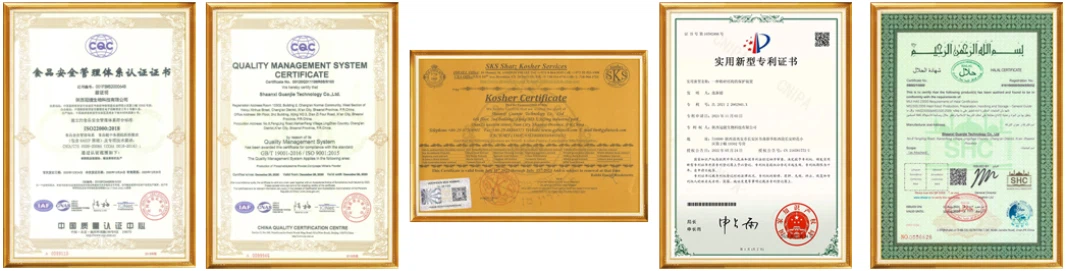
Certifications: Halal,ISO9001,PAHS Free,NON-GMO,KOSHER,SC
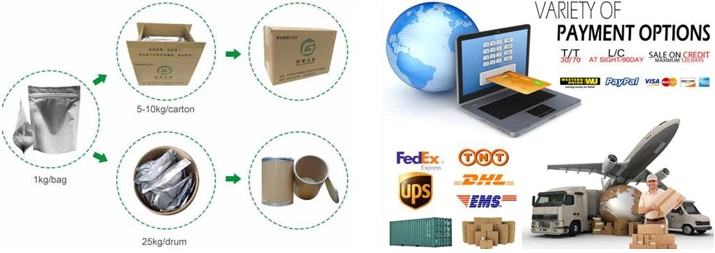
Delivery term: DHL, FEDEX, Air freight,Sea freight
Provide Free Sample
MOQ: 1KG
Not for Private Person Sale
Description
Bromelain Enzyme Powder Supplier:
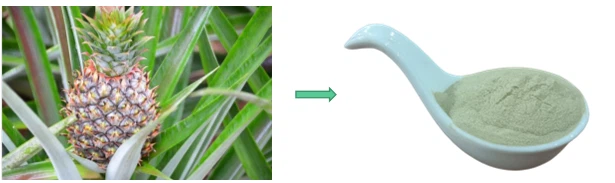
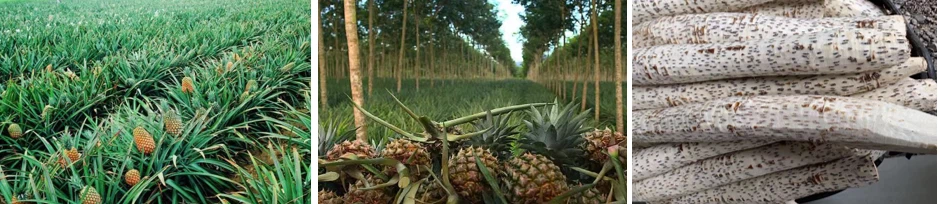
Bromelain also known as pineapple bromelain enzyme powder or pineapple enzyme, is a plant protease extracted from pineapple fruit, skin, leaves and stems, refined, purified, concentrated and spray dried. Our pineapple is from Prachuap Khiri Khan, Thailand. Its appearance is a light gray powder. It has a molecular weight of 33,000 and an isoelectric point of 9.55. The highest quality pineapple protease is obtained by processing the middle stem of the pineapple, concentrating it through ultrafiltration filtration, and then freeze-drying it at a low temperature. Our products must be come out of best raw materials. High quality and competitive price, our products all can be tested by our testing center or the third party testing center. Welcome to enquiry us.
Why Choose Guanjie Biotech?
● We use the best raw materials.
● We have our factories.
● cGMP qualified.
● Have Strong R&D center. Continuous Innovation is our strength.
Product Introduction:
Bromelain Powder is a protein hydrolase containing a sulfhydryl group, derived from pineapple roots, stems, leaves, and fruits. Bromelain powder bulk is present in all parts of the pineapple. This natural, non-toxic protein has no side effects. As a sulfhydryl hydrolase, it can perform protein hydrolysis by breaking down protein molecules into peptide chains to generate peptides or amino acids. This process of bromelain enzyme powder creates a protein hydrolysate with a unique flavor.
COA:
|
Analysis |
Specifications |
Results |
Method |
|
Appearance |
Light grey powder |
Conforms |
Visual |
|
Odor |
Characteristic |
Conforms |
Sensory |
|
Bromelain activity |
≥2400GDU/g |
2460GDU/g |
GDU method |
|
Loss on drying |
≤10.0g/100g |
Conforms |
USP39<731> |
|
Residue of lgnition |
≤6.0g/100g |
Conforms |
USP39<281> |
|
As |
<3.0mg/kg |
Conforms |
USP39<233>ICP-MS |
|
Pb |
≤5.0mg/kg |
Conforms |
USP39<233>ICP-MS |
|
Hg |
≤1.5mg/kg |
Conforms |
USP39<233>ICP-MS |
|
Cd |
≤1.0mg/kg |
Conforms |
USP39<233>ICP-MS |
|
Total Plate Count |
≤10000CFU/g |
Conforms |
USP39<61> |
|
Yeasts&Moulds Cou |
<100CFU/g |
Conforms |
USP39<61> |
|
E.Coli |
Negative |
Negative |
USP39<62> |
|
Salmonella |
Negative |
Negative |
USP39<62> |
|
S.aureus |
Negative |
Negative |
USP39<62> |
|
No allergens |
|||
|
Conclusion:Meet the standard requirements Storage conditions: Bromelain enzyme powder should be sealed and store in cool and dry place.For long time storage, please seal and store at/below 5℃ to keep the enzyme activity. |
|||
Plant Base:
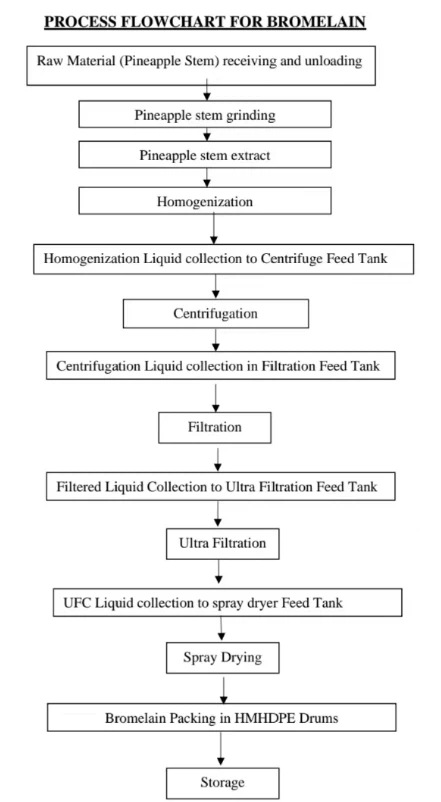
Flow Chart:
Fresh and clean pineapple peels, spines, cores, and other off-cuts with a juice yield of 45% or more were taken, pressed, and the juice was extracted and filtered to remove fruit debris. The filtrate was then mixed with 0.025-0.05% benzoic acid and 5% kaolin clay for adsorption. After adjusting the pH to 6.7-7.0 with a saturated sodium carbonate solution, 5% sodium chloride was added and stirred before being filtered. The filtrate was then adjusted to pH 4.8-5.1 with hydrochloric acid, added ammonium sulfate, and left to precipitate. The precipitate was then dried under pressure, resulting in pineapple protease. The yield is 0.054-0.103% for pineapple scraps.
The bromelain enzyme powder production method involves obtaining materials from pineapple (Ananas comosos and A. bracteatus) fruits and stems, mainly using the outer skin. These materials were pressed and extracted, salted (or subjected to acetone and ethanol precipitation), separated, and then dried.
Gelatin Digestion Sigestion Unit Analytical Method(GDU)
A. Purpose:
This procedure is used to determine the proteolytic activity of Bromelain Enzyme Powder.
B. Equipment:
1. pH Meter
2. Constant Temperature Water Bath at 45.0° ± 0.1°C
3. Analytical Balance
4. Volumetric flasks
5. Volumetric pipettes
6. Timer
7. Digital Burette (Accuracy of 0.1 ml)
8. Fume hood
9. Automatic Pipetters
C. Safety Precautions: This test must be performed in the fume hood.
1. Utilize standard laboratory safety practices.
2. Formaldehyde: Prepare and keep in a fume hood at all times. Known carcinogen and teratogen.
3. Peroxide: Strong oxidizer
D. Reagents and Reagent preparations:
1. Distilled water: approximately 500 ml: adjust to a pH of 4.5 with 0.1 N HCI.
2. Gelatin substrate:
a. Dissolve 25 grams of gelatin (Mikrobiologie. 1.04070) in 375 ml hot water, bring to a boil. Cool to 45°C.
b. Adjust the pH to 4.5 with 0.1 N HCI and dilute to 500 ml pH 4.5 distilled water.
c. Keep the gelatin substrate at 45°C.
3. Buffer Solution:
a. Add 15 gm NaCl slowly to 40-50 ml water in a 150ml beaker and stir to dissolve.
b. Add 0.570 ml acetic acid.
c. Adjust the pH to 4.5 with 0.2N HCL (volume will be greater than 100ml.)
4. 3 % Hydrogen peroxide:
a. Pipette 2.5 ml of 30% Hydrogen peroxide (stock solution) into a 25 ml volumetric
flask and dilute to volume with pH 4.5 distilled water
5. 37 % Formaldehyde pH 9.0:
a. Adjust a sufficient volume (100 ml) of formaldehyde to pH 9.0 with 0.1 N NaOH (approximately 20 ml bromelain enzyme powder of formaldehyde per sample prior to pH adjustment.)
6. 0.100 N NaOH: (Purchased standardized)
a. Stock solution: standardized at 0.100 N

E. Procedure:
1. Enzyme Preparation:
a. Calculating Enzyme Preparation
Weight = 100/Target activity (approximately 0.05 g or 50 mg)
A. Weigh the enzyme precisely into 50 ml volumetric flask
B. Add 8.3 ml of buffer solution.
b. Let stand for 30 minutes at room temperature.
c. Dilute to 50 ml using pH 4.5 distilled water, add a small stir bar and stir for an
additional 10 to 15 minutes
2. Enzyme Procedure:
a. Pipette 25 ml of Gelatin substrate into each of two 100 ml beakers containing stir bars and place them in a water bath at 45°C for 5 minutes, one for the Test Solution and the other for the Blank Solution.
b. Test Solution:
1) Add 1.0 ml of Bromelain Enzyme Powder solution into the beaker designated for the test solution, start timing and swirl.
2) After exactly 20 minutes of incubation at 45°C, add 0.1 ml of 3 % hydrogen peroxide and swirl.
3) Incubate for an additional 5 minutes.
4) Remove the beaker from the water bath and with constant stirring insert the pH probe.
5) Record the pH after 10 seconds (Initial pH)
6) Adjust to pH 6.0 with 0.1 N NaOH. (Approximately 2-4 ml)
*Note: When adjusting the pH to 6.0 be cautious at pH 5.8; the pH increases slowly and minute additions of NaOH at this point will significantly increase the pH.
7) Continuing constant stirring, add 10 ml of 37 % formaldehyde pH 9.0.
8) Record the pH after 10 seconds and 1 minute.
9) Titrate to pH 9.0 with 0.1 N NaOH.
10) Record the titration volume. This is the test titer, T.

c. Blank Solution:
The Blank Solution should be run concurrently with the Test solution. This is accomplished by starting the Blank Solution determination 12 minutes after the Test Solution is started. That gives you time to complete the assay on the Test Solution before having to proceed with the Blank Solution.
1) Add 0.1 ml of 3 % hydrogen peroxide to the beaker designated for the blank solution and swirl.
2) After exactly 20 minutes of incubation at 45°C add 1.0 ml of bromelain enzyme powder solution and swirl.
3) Incubate for an additional 5 minutes.
4) Remove the beaker from the water bath and with constant stirring insert the pH probe.
5) Record the pH after 10 seconds (Initial pH)
6) Adjust to pH 6.0 with 0.1 N NaOH. (Approximately 2-4 ml)*See Note above.
7) Continuing constant stirring, add 10 ml of 37 % formaldehyde pH 9.0.
8) Record the pH after 10 seconds and 1 minute.
9) Titrate to pH 9.0 with 0.1 N NaOH.
10) Record the titration volume. This is the blank titer, B.
F. Calculation:
1. Definition: One Gelatin Digestion Unit is that amount of enzyme which will liberate, after 20 minutes digestion at 45°C, 1 mg of amino nitrogen from a standard gelatin solution at pH 4.5 or pH 5.5(GDU pH 4.5 or pH 5.5).

Where:
T = Test titer (ml 0.1 N NaOH)
B = Blank titer (ml 0.1 N NaOH)
N = Normality of standardizedNaOH (i.e. 0. 100)
Wt (g) = Initial weight of enzyme
G. Testing Parameters:
1. Enzyme preparations are diluted to a concentration of approximately 0.001 g/ml (1 mg/ml) or for Bromelain Enzyme Powder concentrate approximately 1-2 GDU/ml. A Reference Material is assayed with each run to ensure method accuracy.
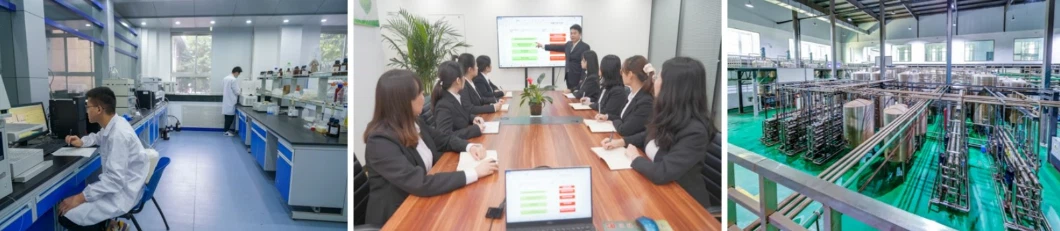
Factory&Team:
Certification
Package & Shipment
Hot Tags: bromelain enzyme powder, China bromelain enzyme powder manufacturers, suppliers, factory, Phosphatidylcholine Powder, pure bulk fisetin, bulk fisetin, L Arginine Base Powder, Garcinia Extract Powder, Plant Extract
You Might Also Like