Latest Products


Contact Us
-
6th Floor, 2nd Building, Xijing NO.3, XiJing Industrial Park, DianZi Western Street, Xi'an, Shaanxi, China
-
+86-2988253271




Bulk Inulin
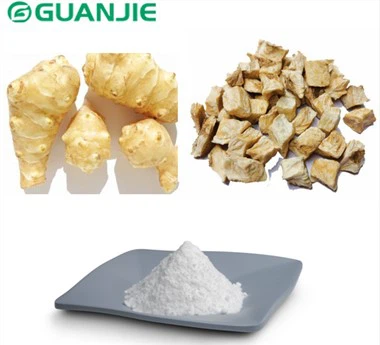
Botanical source: Helianthus tuberosus L, Cichorium intybus L.
Specifications:90%,95%
Appearance:White powder
CAS: 9005-80-5
Published in:FCC 10 1S,FCC 10 2S
First Published: FCC 6
Two Factories & Three production lines
GMP standard workshop & two independent laboratories
FDA Cert.
Certifications: Halal,ISO9001,PAHS Free,NON-GMO,KOSHER,SC
Overseas warehouse(NJ,USA)
Delivery term: DHL, FEDEX, Air freight,Sea freight
Provide Free Sample
MOQ: 1KG
Not for Private Person Sale
Description
Bulk Inulin Suppliers:
Guanjie Biotech specializes in bulk Inulin (inulin bulk powders) research, production, and export. Our inulin bulk powder products are from two sources. One is from Helianthus tuberosus L and the other is Cichorium intybus L (Jerusalem artichoke inulin powder and chicory inulin powder). The content of it can reach to 90% and 95%. You can choose which specification you need. High quality and competitive price. We can provide a testing report. As an inulin supplier, Guanjie Biotech is your best choice.

Why Choose Guanjie Biotech?
● We have focused on plant extract for 20 years, and we acquired 16 patents.
● Independent research and development center.
● Certifications: Halal, ISO9001, PAHS Free, NON-GMO, KOSHER, SC
What Is Inulin?
Natural inulin powder is a naturally occurring dietary fiber made of fructose polymers. It belongs to a group of carbohydrates called fructans and is widely found in many plants. Small amounts are also present in some fungi and bacteria, but plants are the primary commercial source. At Guanjie Biotech, our bulk inulin powder is extracted from two natural raw materials: chicory root and Jerusalem artichoke. Although these plants grow in different regions, they provide inulin with the same chemical composition and functional benefits.
Chicory is native to Europe and produces attractive blue-purple flowers from May to August. Jerusalem artichoke is native to North America and blooms with bright golden flowers from September to October. Despite their different appearance and origin, both plants contain high-quality inulin suitable for food, beverage, dietary supplement, and nutritional applications.
Our bulk inulin powder meets strict quality standards. It contains more than 90.0% inulin, with a polymerization degree ranging from 2 to 60. The total content of fructose, glucose, and sucrose is less than 10.0%. In addition, the moisture content is no more than 4.5%, and the ash content is below 0.2%, ensuring excellent purity, stability, and consistent product quality.
Specification from Chicory and Jerusalem Artichoke
|
|
Inulin 90% from Chicory |
Inulin 95% from Chicory |
Inulin 90% from JA |
Inulin 95% from JA |
|
Color and luster |
White powder |
|||
|
Savour |
Little sweet no peculiar smell |
|||
|
Impurity |
Fine powder free from foreign impurities |
|||
|
Moisture |
NMT 4.5 |
|||
|
Ash |
NMT 0.2 |
|||
|
Ph |
5-7 |
|||
|
Inulin(DM%) |
NLT 90 |
NLT 95 |
NLT 90 |
NLT 95 |
|
Fructose+Glucose+Sucrose (DM%) |
NMT 10 |
NMT 5 |
NMT 10 |
NMT 5 |
|
Arsenic |
NMT100PPB |
|||
|
Inorganic arsenic |
NMT 75 PPB |
|||
|
Lead |
NMT 50 PPB |
|||
|
Mercury |
NMT10 PPB |
|||
|
Cadmium |
NMT10 PPB |
|||
|
Aerobic plate count |
NMT1000 at 30℃ |
|||
|
Aerobic plate count |
NMT1000 at 55℃ |
|||
|
Mould& yeast |
NMT 25 |
|||
How is Inulin Produced?

Differences Between Chicory and Jerusalem Artichoke
1. The polymerization degree of Jerusalem artichoke inulin is lower than that of chicory inulin, and it is absorbed quickly in the intestinal process.
2. Due to the characteristics of different raw materials, chicory inulin cannot be organic, but Jerusalem artichoke inulin can be organic.
3. Chicory inulin and Jerusalem artichoke inulin have appropriate differences in application fields. For example, Jerusalem artichoke inulin is suitable for improving the intestinal tract, and chicory inulin is suitable for fat replacement.
Comparison of indexes

Atlas
● Jerusalem Artichoke Extract Inulin

● Chicory root inulin powder

What Is The Origin of Inulin?
|
Plant name |
Inulin content(g/100g) |
Plant name |
Inulin content(g/100g) |
|
Wheat |
1~4 |
Jerusalem artichoke |
14~17 |
|
Onion |
2~6 |
Banana |
0.3~0.7 |
|
Leek |
3~10 |
Dandelion |
12~15 |
|
Burdock |
3.5~4.0 |
Brahman ginseng |
4~11 |
|
Chicory |
13~18 |
Artichoke |
3~10 |
What is the comparison of prebiotics?
|
Product |
Inulin |
FOS |
GOS |
IMO |
XOS |
|
Source |
Chicory and Jerusalem Artichoke Extract |
Inulinase hydrolysis and sucrase conversion |
Lactase hydrolysis |
Amylase hydrolysis |
Enzymatic hydrolysis of corncob |
|
Calorie |
1.5 Kcal/g |
1 Kcal/g |
1 Kcal/g |
2 Kcal/g |
1.5 Kcal/g |
|
Acid-base stability |
PH≤3, Easy to hydrolyze |
PH≤3, Easy to hydrolyze |
Acid stabilization |
Acid stabilization |
Acid stabilization |
|
Temperature stability |
Thermal stability |
Relatively stable |
High temperature resistance |
High temperature resistance |
Thermal stability |
|
Food category |
New resource food |
New resource food |
New resource food |
Common food ingredients |
New food ingredients |
Relevant regulations of Inulin
|
China |
The Ministry of Health of China identified bulk inulin as a new resource food on March 25, 2009. |
|
European union |
In April 2016, Article 13.5 of the EU Law on the Administration of Nutrition and Health Claims stipulates that compared with sugary food and drink, the intake of food and drink containing inulin can slow down the rise of blood sugar. In addition to Article 13.5, Article 10.3 of the General Health Claim Regulation can also use similar claims: reduce blood sugar rise and maintain blood sugar balance. The European Health Commission approved inulin as a new resource functional food in 1987 to improve the increasingly serious chronic disease and obesity population |
|
Japan |
The Ministry of Health and Welfare of Japan approved inulin as "special health food FOSHU)" in 1991. |
|
US |
The National Food and Drug Administration (FDA) issued a notice GRN000044 on November 22, 2000, which recognized the status of inulin and clearly pointed out that it is a recognized GRAS functional food. |
What Are The physical and chemical properties Of Bulk inulin?
Inulin is a polymer of fructose and glucose with a standard degree of polymerization of 2 to 60 and an average degree of polymerization of 10 to 12. It is a white amorphous powder that is strongly hygroscopic. Bulk inulin is odorless and slightly sweet without an aftertaste. Long-chain inulin is slightly soluble in cold water and easily soluble in hot water. Its solubility increases with the increase in temperature.
● If the pH value of inulin is greater than 4.00, inulin will not be hydrolyzed by any mammalian enzymes;
● Solutions of standard inulin greater than 25%, or of long-chain inulin greater than 15%, form gels that can be used to replace fat.
● Wholesale inulin is very stable in the gel state;
● When used together with gelatin and carrageenan gel, inulin gel has a synergistic effect, enabling less to be used.
● When used together with aspartame, acesulfame, or other high-intensity sweeteners, inulin can also have a synergistic effect, reducing the amount needed while masking or removing the aftertaste of the high-intensity sweetener;
● Using inulin powder bulk as a raw material, the Company can also produce high-quality oligofructose, fructose syrup, nectar sugar alcohols, and other products.
FAQs:
1. What specifications of inulin powder are available?
We supply 90% and 95% inulin powder from both chicory and Jerusalem artichoke. Our bulk inulin products feature low moisture (≤4.5%), low ash (≤0.2%), excellent purity, and stable quality. Different specifications are suitable for dietary supplements, beverages, dairy products, bakery products, and functional foods.
2. What is the difference between chicory inulin and Jerusalem artichoke inulin?
Chicory inulin generally has a higher degree of polymerization, making it suitable for fat replacement and texture improvement in foods. Jerusalem artichoke inulin has a lower degree of polymerization, making it more suitable for digestive health and prebiotic formulations. In addition, organic certification is available for Jerusalem artichoke inulin.
3. Can Guanjie Biotech provide quality certificates and testing reports?
Yes. Every batch of bulk inulin is produced under a strict quality management system and can be supplied with a Certificate of Analysis (COA) and other testing reports upon request. We also support third-party testing to ensure product quality and compliance with customer requirements.
4. What industries use bulk inulin powder?
Bulk inulin is widely used in the food, beverage, dietary supplement, dairy, bakery, nutrition, and functional food industries. It is commonly added to protein powders, nutrition bars, yogurt, beverages, meal replacement products, and fiber supplements to improve nutritional value and product functionality.
5. Does Guanjie Biotech support Inulin OEM and customized orders?
Yes. We provide OEM and customized solutions for global customers. Different specifications, packaging sizes, labeling, and bulk inulin quantities are available according to your business requirements. We also support sample orders before large-scale purchasing.
6. What packaging and storage conditions are recommended?
Bulk inulin powder is typically packed in 1 kg aluminum foil bags or 25 kg fiber drums with inner food-grade plastic bags. It should be stored in a cool, dry place away from moisture, direct sunlight, and strong odors. Under proper storage conditions, the shelf life is generally 24 months.
Our factory:

Product Qualification

Testing Center:
Both the production processes of manufacture and the product itself meet all international standards. And if you need our testing report, we can provide you.

Certification

Package & Shipment

Hot Tags: bulk inulin, China bulk inulin manufacturers, suppliers, factory, Hydroxytyrosol Powder, Daidzein Powder, Garlic Extract Powder, pure bulk fisetin, bulk fisetin, L Arginine Base Powder
You Might Also Like