


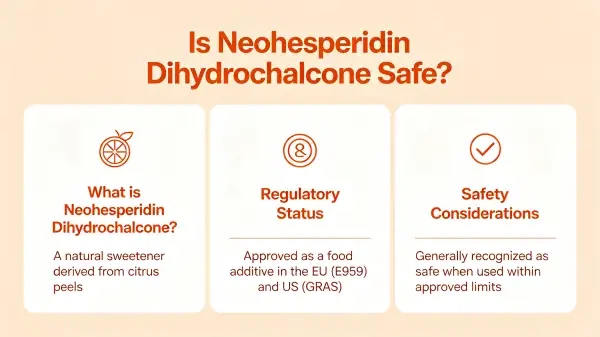
NHDC's Toxicological Assessment System
Assessment Conclusions of the European Food Safety Authority (EFSA)
The European Food Safety Authority (EFSA) is one of the most authoritative organizations for assessing the safety of Neohesperidin Dihydrochalcone powder. The EFSA Food Additives and Flavorings Panel (FAF Panel) and the Feed Additives and Products Panel (FEEDAP Panel) have conducted systematic evaluations of NHDC as a food additive and feed additive, respectively.
• Use as a Food Additive (E 959)
In 2022, the EFSA FAF Panel completed a reassessment of NHDC as a sweetener (E 959). The evaluation was based on a 13-week rat toxicity study (Lina et al., 1990). No toxicologically significant adverse effects were observed in the highest-dose group (4000 mg/kg bw/day). Based on these findings, the FAF Panel established an acceptable daily intake (ADI) of 20 mg/kg Neohesperidin Dihydrochalcone powder bw/day. This value was calculated using 4000 mg/kg bw/day as the reference point. A 100-fold interspecies and intraspecies uncertainty factor and a 2-fold extrapolation factor for subchronic-to-chronic effects were applied.
The Joint FAO/WHO Expert Committee on Food Additives (JECFA) evaluated the same study in 2012. It identified a no-observed-adverse-effect level (NOAEL) of 760 mg/kg Neohesperidin Dihydrochalcone powder bw/day from the medium-dose group. The difference between the two assessments mainly resulted from different interpretations of the toxicological relevance of changes observed in the high-dose group. These changes included reduced body weight, elevated plasma alkaline phosphatase levels, and increased bilirubin concentrations.
• Use as a Feed Additive
Neohesperidin Dihydrochalcone powder has been authorized in the European Union as a sensory feed additive under the flavoring category. It is approved for use in feed for piglets, finishing pigs, calves, sheep, fish, and dogs.
In 2025, the EFSA FEEDAP Panel completed an updated authorization assessment of NHDC. The panel concluded that Neohesperidin Dihydrochalcone NHDC remains safe for target animal species, consumers, and the environment. NHDC was also found to be non-irritating to the skin and eyes and not a skin sensitizer. The maximum authorized concentration is 35 mg/kg of complete feed.
Genotoxicity Assessment
Genotoxicity is a key indicator in food additive safety assessments. In its FGE.420 evaluation, EFSA concluded that Neohesperidin Dihydrochalcone powder and its structural analogues do not raise genotoxicity concerns. This conclusion was based on a comprehensive review of mutagenicity data for NHDC and related flavonoids.
JECFA reached a similar conclusion. It reported that NHDC showed negative results in several in vitro and in vivo genotoxicity studies.
Metabolism and Excretion
The metabolic pathway of Neohesperidin Dihydrochalcone powder has been clearly characterized. According to EFSA assessment reports, NHDC is rapidly metabolized and excreted in mammals. It does not accumulate in tissues.
Studies on aquatic animals, including fish, have shown similar metabolic patterns. NHDC follows pathways comparable to those observed in mammals and does not accumulate in edible tissues. Therefore, its use as a feed additive is not expected to significantly increase consumer exposure.
Hesperetin dihydrochalcone, the aglycone form of Neohesperidin Dihydrochalcone NHDC, follows a similar metabolic fate in vivo. It is metabolized into harmless products only.
Latest security research progress
Cytotoxicity Study
A study published in Food Bioscience in March 2026 systematically evaluated the cellular safety of NHDCs in vitro. The study used the human hepatocellular carcinoma cell line Hep3B and human umbilical vein endothelial cells (HUVECs) as models to assess the cytotoxic effects of NHDCs. Key findings included:
• Effects on healthy cells:
In the HUVEC model, Neohesperidin Dihydrochalcone powder caused only mild cytotoxicity. No typical signs of apoptosis were observed. These signs include loss of mitochondrial membrane potential and changes in nuclear morphology. The results suggest that NHDCs have low toxicity toward normal human cells within the tested concentration range.
• Effects on cancer cells:
Neohesperidin Dihydrochalcone NHDC did not show significant anticancer activity against Hep3B hepatocellular carcinoma cells. At the highest tested concentration (300 μg/mL), the inhibition rate was only 25.47%. This did not reach the 50% inhibition (IC50) threshold. The study concluded that NHDCs do not have significant anticancer activity but show low toxicity toward healthy cells. The authors stated that "NHDC appears to be a safe compound lacking strong anticancer activity."
• Regulation of cell migration:
Studies found that Neohesperidin Dihydrochalcone powder significantly reduced the migration ability of HUVEC cells. This suggests that their biological activity may involve non-apoptotic pathways related to cell movement. The toxicological significance of this finding remains unclear. However, this effect has not been classified as adverse.
Discussion of Changes in Thyroid Hormone Levels
In a 90-day toxicity study of hesperidin dihydrochalcone, an aglycone of NHDC, changes in thyroid hormone levels were observed in all tested dose groups (100–1000 mg/kg bw/day). The EFSA FAF Panel carefully evaluated these findings. The panel concluded that the hormonal changes were not accompanied by signs of hypothyroidism. No histopathological changes or clinical symptoms were observed. Therefore, these hormonal effects were not considered adverse. This conclusion is important for understanding the endocrine safety of Neohesperidin Dihydrochalcone powder and related compounds.
Embryonic Developmental Toxicity
No maternal or fetal toxicity was observed in prenatal developmental toxicity studies. These findings indicate that Neohesperidin Dihydrochalcone powder does not pose a detectable risk to fetal development under pregnancy exposure conditions. This supports the overall safety profile of NHDC in the general population.
Exposure assessment and safety boundary
Exposure Assessment for Food Use
EFSA used the Added Portions Exposure Technique (APET) and the Single Portion Exposure Technique (SPET) in its FGE.420 assessment to estimate dietary exposure to Neohesperidin Dihydrochalcone powder and related substances. Based on a reference point of 1000 mg/kg bw/day, the margin of exposure (MOE) for both adults and children was within an acceptable range. This indicates that the exposure level under actual use conditions is far below the harmful dose.
For hesperidin dihydrochalcone, JECFA calculated an MOE of 15,000. This calculation was based on a NOAEL of 750 mg/kg bw/day for the structurally related substance NHDC and an estimated dietary exposure of 3000 μg/day using SPET. This value is much higher than the generally accepted safety threshold of 100.
Exposure Assessment for Feed Use
For feed applications, the EFSA FEEDAP Panel confirmed that the authorized use of NHDC in animal feed does not lead to additional significant exposure for consumers. This conclusion is based on two factors. First, Neohesperidin Dihydrochalcone powder is rapidly excreted by animals. Second, NHDC does not accumulate in the edible tissues of aquatic animals.
Conclusion:
Neohesperidin Dihydrochalcone powder is a sweetener and flavor modifier that has undergone decades of toxicological research and regulatory evaluation. There is no evidence that Neohesperidin Dihydrochalcone NHDC causes genotoxicity, mutagenicity, or carcinogenicity. It is non-irritating to the skin and eyes and shows extremely low toxicity in healthy cells. The EFSA has established an acceptable daily intake (ADI) of 20 mg/kg body weight/day and a maximum authorized concentration of 35 mg/kg for feed applications. Recent studies published in 2026 further support its favorable safety profile.
NHDC has been approved for use in food, feed, and pharmaceutical applications in multiple countries and regions. Information released by the National Health Commission of China regarding its applications in 2025 shows that the regulatory process for NHDC is progressing steadily.
Guanjie Biotech is a professional Neohesperidin Dihydrochalcone supplier. The company provides compliant NHDC products to global customers through strict quality control systems and international compliance standards. Under approved usage conditions, Neohesperidin Dihydrochalcone powder has a well-established safety profile and can be considered a compliant ingredient option for formulation development.
References:
[1] EFSA FEEDAP Panel (2011). Scientific Opinion on the safety and efficacy of neohesperidine dihydrochalcone as a feed additive for piglets, pigs for fattening, calves, sheep, fish and dogs.
[2] EFSA FEEDAP Panel (2014). Statement on the safety of neohesperidine dihydrochalcone for fish.
[3] EFSA FAF Panel (2022). Re-evaluation of neohesperidine dihydrochalcone (E 959) as a food additive.
[4] EFSA FEEDAP Panel (2025). Assessment of the feed additive neohesperidine dihydrochalcone (2b959) for piglets, pigs for fattening, calves, sheep, fish and dogs for the renewal of its authorisation. EFSA Journal, 23(10): e9681.
[5] EFSA FAF Panel (2024). Flavouring group evaluation 420 (FGE.420): Hesperetin dihydrochalcone. EFSA Journal, 22(12): e9091.
[6] Neohesperidine dihydrochalcone shows no significant anticancer effect on Hep3B cells but demonstrates a favorable safety profile due to low toxicity in HUVEC cells and Artemia salina. Food Bioscience, 2026, 108736.
[7] Wei Jing, Song Ruolan, Chen Xiang, et al. Research progress on the pharmacological effects of Neomethylhesperidin dihydrochalcone and its synthetic precursors [J]. Food Industry Technology, 2022, 43(23): 436-449.
[8] JECFA (2012, 2021, 2022). Specifications for flavouring substances.
[9] National Health Commission Government Service Platform. Announcement of Acceptance of New Food Additive Varieties (November 26, 2025; December 12, 2025).


