


Curcumin is a natural polyphenol with significant bioactivity. Its broad bioactivity has garnered significant attention in the food, dietary supplement, and cosmetic industries. However, standard curcumin raw materials suffer from physicochemical drawbacks such as poor water solubility, low chemical stability, and poor oral bioavailability. Liposome curcumin is an upgraded product that modifies curcumin using liposome encapsulation technology. They differ in molecular structure, in vivo absorption pathway, stability, technical parameters, and commercial applications.
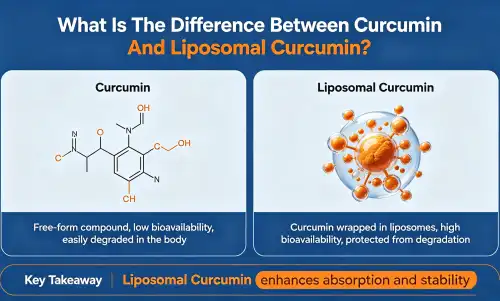
Liposomal Curcumin vs Regular Curcumin: Which Works Better?
Curcumin and liposomal curcumin differ in molecular structure, in vivo absorption pathway, stability, technical parameters, and commercial applications.
Molecular State and Physical Form
Regular curcumin and liposomal curcumin have the same active ingredient. However, their physical forms are very different.
Regular curcumin usually exists in a crystalline form. It appears as a yellow or orange-yellow powder. It is highly hydrophobic and does not dissolve well in water. Its water solubility is only about 11 ng/mL. This low solubility limits its use in many applications.
Liposomal curcumin is not a new chemical substance. It is a delivery system that uses natural phospholipids as carriers. Curcumin is enclosed inside tiny vesicles made of phospholipid bilayers. The final product can be a liquid suspension or a spray-dried powder.
At the microstructural level, liposomes are closed spherical vesicles. Their particle size is usually between 50 nanometers and 1 micrometer. Curcumin is enclosed within the hydrophobic region of the phospholipid bilayer. This prevents direct contact with the surrounding water environment. As a result, the dispersion and stability of curcumin are improved.
Solubility and Dispersibility
One of the biggest differences between regular curcumin and liposomal curcumin is their behavior in water.
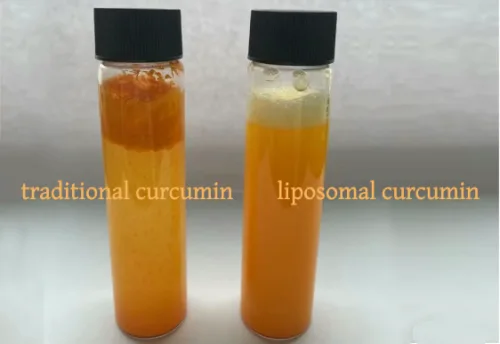
Regular curcumin is almost insoluble in water. When mixed with water, it tends to clump together and settle quickly. Poor dispersibility can reduce product uniformity and limit utilization efficiency.
Liposomal curcumin performs differently. The outer phospholipid layer has good hydrophilic properties. This allows liposomes to form a stable dispersion in water. Even after drying, the powder can be redispersed easily.
Liposome technology greatly improves the apparent water solubility of curcumin. Curcumin can be distributed more evenly throughout the system. It is also less likely to precipitate or aggregate. Better dispersibility improves product stability and supports better absorption and utilization.
Therefore, liposomal curcumin shows clear advantages over regular curcumin in physical structure, water dispersibility, and solubility. These improvements create more opportunities for curcumin applications in foods, dietary supplements, and nutritional products.
Differences in In Vivo Metabolism and Absorption
This is the key difference that many B2B customers focus on. It directly affects the performance of the final product.
Absorption Pathway
Regular Curcumin
Standard curcumin is absorbed mainly through passive diffusion. Because of its poor water solubility, it dissolves poorly in gastrointestinal fluids. As a result, a large portion is excreted before absorption.
Liposomal Curcumin
Liposomal curcumin uses a different absorption mechanism.
Protection Effect
The phospholipid bilayer acts as a protective barrier. It helps shield curcumin from stomach acid and digestive enzymes. This reduces degradation during digestion.
Bioavailability
Bioavailability is the most important and commercially valuable difference between the two forms.
• Regular Curcumin
Regular curcumin has very low bioavailability. In human studies, blood concentrations are often only at the ng/mL level.
• Liposomal Curcumin
Liposomal curcumin shows clear pharmacokinetic advantages. Studies indicate that liposome encapsulation can increase the half-life of curcumin by about three times. Relative bioavailability can increase by more than four times.
These improvements are reflected in several ways:
Higher peak plasma concentration.
Faster time to reach peak concentration.
Longer retention time in the body.
These benefits help improve the overall utilization of curcumin and enhance its application value in functional foods and dietary supplements.
Chemical Stability and Formulation Compatibility
Chemical stability and formulation compatibility are two different concepts when evaluating curcumin products. Both affect product quality, but they focus on different aspects.
Chemical Stability
Regular curcumin is relatively sensitive to environmental conditions. It can degrade under alkaline conditions. It can also undergo photodegradation when exposed to light. However, this does not mean regular curcumin is unstable in all situations. In fact, curcumin powder shows good stability under dry and light-protected storage conditions. Most degradation issues occur after it is dissolved in liquid systems.
Liposomal curcumin is different. It contains phospholipids, so its storage requirements are stricter. Liposome structures may oxidize, aggregate, or fuse in liquid form. These changes can damage the liposome membrane. They may also cause the encapsulated curcumin to leak out. This reduces overall product stability and quality.
Formulation Compatibility
Standard curcumin is oil-soluble. It has poor water solubility. In water-based systems such as transparent beverages and gels, it can easily precipitate. It may also cause layering or staining on container walls. These issues affect standard curcumin appearance and consumer experience. Because of this, its use in clear or high-end beverage systems is limited.
Liposomal curcumin has better formulation compatibility. Liposome encapsulation surrounds curcumin with a phospholipid bilayer. This reduces direct interaction with other ingredients. It also improves dispersion in water-based systems.
In functional beverages, oral liquids, and gels, liposomal curcumin can distribute more evenly. The final product can appear clear or slightly milky without obvious precipitation. In addition, liposomes can reduce the bitterness of curcumin. This improves overall sensory quality.
Quality control indicators for industrial production:
For suppliers, there are key differences in the quality standards (Specifications) between the two.
|
Testing Indicators |
Common Curcumin Raw Material |
Liposome curcumin |
|
Core Indicators |
Curcumin Content (e.g., 95%), Heavy Metals, Residual Solvents |
Encapsulation efficiency, drug loading, particle size distribution (PDI), leakage rate |
|
Physical Testing |
Mesh Size, Bulk Density |
ζ-potential (for assessing physical stability), phospholipid oxidation index |
|
Stability Assessment |
Loss on Conventional Drying |
Encapsulation efficiency maintenance time under accelerated testing |
Key Quality Control Points Analysis:
For liposomal curcumin, encapsulation efficiency (i.e., the percentage of curcumin successfully encapsulated out of the total content) is the most critical parameter for measuring product quality. Standard Curcumin only requires testing the total content, while liposomal products must distinguish between "free curcumin" and "encapsulated curcumin," because only the encapsulated portion possesses high bioavailability.
How to Choose: Regular Curcumin or Liposomal Curcumin?
When developing a new product, choosing the right form of curcumin is important. Different applications have different requirements for cost, bioavailability, stability, and consumer experience.
Choose Regular Curcumin
Regular curcumin is suitable for products that focus on basic functionality and cost efficiency. It is widely used in tablet candies, baked foods, animal feed additives, and natural coloring applications.
The main advantage of standard curcumin is its lower production cost. It can provide natural color and antioxidant properties while helping manufacturers control formulation expenses. For products that do not require high absorption rates or rapid effects, regular curcumin is often a practical choice.
It is especially suitable for large-volume products where affordability is a key factor. Food manufacturers and feed producers commonly select regular curcumin for this reason.
Choose Liposomal Curcumin
Liposomal curcumin is designed for applications that require improved absorption and enhanced performance. It is commonly used in premium dietary supplements, functional gummies, beverages, pharmaceutical excipients, and products targeting liver health, inflammation management, and joint support.
The phospholipid structure of liposomal curcumin helps protect the active ingredient and improves its delivery in the body. This allows more curcumin to reach target tissues and cells.
As a result, liposomal curcumin may achieve desired effects at lower dosages. It is also useful for formulations that require faster action and better ingredient utilization.
Another advantage is improved taste masking. Curcumin naturally has a strong flavor and color. Liposomal technology can help reduce these formulation challenges and improve the overall consumer experience.
Conclusion:
The difference between regular curcumin and liposomal curcumin is essentially a difference in raw materials and formulation technologies.
Although they share the same chemical formula, they belong to different product classes in terms of physical properties (solubility), biopharmaceutical properties (absorption pathways and bioavailability), and industrial processing performance (compatibility). Lipoosomal curcumin, through phospholipid encapsulation technology, effectively solves the industry pain point of poor absorption of regular curcumin, providing a feasible commercialization path for upgrading the efficacy of functional foods and pharmaceuticals.
Guanjie Biotech is a curcumin and liposomal curcumin supplier. We recommend that clients rationally evaluate the application value of both raw materials based on end-user testing standards and market claims. For formulations pursuing high bioactivity and user experience, liposomal curcumin has irreplaceable technological advantages. If you are unsure how to choose, please contact our expert team. We will provide you with suitable products. For inquiries, please contact us at info@gybiotech.com.
References:
[1] Tønnesen, H. H., Masson, M., & Loftsson, T. (2002). Studies of curcumin and curcuminoids. XXVII. Cyclodextrin complexation: solubility, chemical and photochemical stability. International Journal of Pharmaceutics, 244(1-2), 127–135.
[2] For enhanced bioavailability and stability of liposomal curcumin:
Ren, D., & Zheng, C. (2025). Development of high-efficiency curcumin-loaded liposome microcapsule powder and investigation of its absorption performance. ACS Digital Meeting. (Reported 8.1-fold increase in AUC compared to raw curcumin).
[3] Chen, Y., & Lu, Y., et al. (2014). Increasing the stability of curcumin in serum with liposomes or hybrid drug-in-cyclodextrin-in-liposome systems: A comparative study. International Journal of Pharmaceutics, 476(1-2), 15–23.
[4] Cheng, X., Han, X., Si, J., et al. (2024). Cationic Curcumin Nanocrystals Liposomes for Improved Oral Bioavailability: Formulation Development, Optimization, In Vitro and In Vivo Evaluation. Pharmaceutics, 16(9). (Reports 5.4-fold increase in bioavailability compared to crude powder).
[5] Li, Z., & Wang, H., et al. (2024). Improvement in Curcumin's Stability and Release by Formulation in Flexible Nano-Liposomes. Nanomaterials, 14(22), 1836.


