Glutathione is an antioxidant. This has been conclusively established in the fields of biochemistry and medicine. Moreover, due to its strong oxidizing properties, pure glutathione is widely utilized in the health supplement and cosmetic industries. So why is glutathione an antioxidant?
Why Is Glutathione an Antioxidant?
Natural glutathione powder has powerful antioxidant properties due to its unique molecular structure and chemical characteristics.
First, glutathione contains an active sulfhydryl group.
Glutathione is a tripeptide composed of glutamic acid, cysteine, and glycine. The sulfhydryl group (-SH) on the cysteine residue is the key active site of the molecule. This group has strong reducing properties and can donate electrons or hydrogen atoms to neutralize unstable molecules.
Second, glutathione can directly scavenge reactive oxygen species (ROS).
During cellular metabolism, free radicals, hydrogen peroxide, and other ROS are continuously generated. The sulfhydryl group in glutathione reacts with these oxidizing substances, reducing them to water or alcohols. During this process, two molecules of reduced glutathione powder are oxidized to form one molecule of oxidized glutathione (GSSG), in which the two cysteine residues are linked by a disulfide bond.
Third, glutathione serves as an essential cofactor for glutathione peroxidase (GPx).
Glutathione peroxidase is an important intracellular antioxidant enzyme. It uses glutathione as an electron donor to convert harmful hydrogen peroxide (H₂O₂) into water (H₂O) and reduce lipid peroxides to their corresponding alcohols. Without natural glutathione powder, this enzyme cannot carry out its physiological antioxidant function.
Fourth, glutathione helps maintain the activity of other antioxidants.
Glutathione bulk powder can regenerate the oxidized forms of vitamins C and E back to their active states through direct chemical or enzyme-mediated reactions. This makes glutathione a central component of the body's antioxidant defense network.
Fifth, glutathione protects protein sulfhydryl groups from oxidation.
The activity of many intracellular proteins depends on cysteine residues remaining in a reduced state. As the primary intracellular thiol buffer, glutathione bulk helps maintain these sulfhydryl groups, thereby preserving the proteins' natural structure and biological function.
Sixth, glutathione inhibits lipid peroxidation.
Cell membranes are rich in polyunsaturated fatty acids, which are highly susceptible to free radical attack and lipid peroxidation chain reactions. Studies have shown that pure glutathione can partially inhibit mitochondrial lipid peroxidation, reduce malondialdehyde (MDA) levels, and protect the integrity of cell membrane structures.
Seventh, the intracellular GSH/GSSG ratio is a key indicator of oxidative stress.
In healthy resting cells, the concentration of reduced glutathione GSH is much higher than that of oxidized glutathione (GSSG), typically with a ratio of approximately 100:1. Under oxidative stress, GSH is rapidly consumed while GSSG accumulates, causing the ratio to decrease to between 1:1 and 10:1. The dynamic changes in this ratio directly reflect the cell's redox status.
How Many Forms Does Glutathione Have?
Glutathione exists in two forms under physiological conditions: reduced glutathione (GSH) and oxidized glutathione (GSSG). Reduced glutathione, which contains a free sulfhydryl group, is the active form responsible for its antioxidant function. Oxidized glutathione is a dimer formed when two reduced glutathione molecules are linked by a disulfide bond.
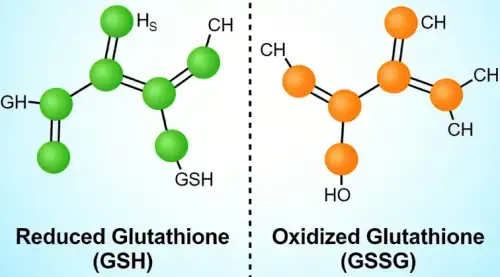
The interconversion between these two forms is catalyzed by glutathione reductase. The coenzyme required for this enzyme is NADPH, which is supplied through the pentose phosphate pathway. In healthy resting cells, the GSH/GSSG ratio is typically around 100:1. Under oxidative stress, GSH is extensively consumed to neutralize free radicals and is converted into GSSG, resulting in a decrease in the GSH/GSSG ratio. In such conditions, the ratio may drop to between 1:1 and 10:1. Therefore, the GSH/GSSG ratio is widely recognized as a reliable indicator of cellular oxidative stress.
The antioxidant role of natural glutathione powder is further demonstrated through specific biochemical reactions. Taking hydrogen peroxide (H₂O₂) as an example, glutathione, under the catalytic action of glutathione peroxidase, reduces H₂O₂ to water (H₂O). During this process, glutathione itself is oxidized to GSSG. Subsequently, glutathione reductase uses the reducing power provided by NADPH to convert GSSG back into GSH. This redox cycle allows glutathione to continuously scavenge free radicals and protect cells from oxidative damage.
Does Glutathione Need To Be Refrigerated?
Natural glutathione powder requires refrigerated storage, and the specific storage conditions depend on its physical form and intended application.
Storage Conditions for Solid Glutathione
Solid glutathione powder should be stored in a refrigerated environment at 2–8°C. In its solid form, the chemical activity of glutathione is significantly reduced, which helps maintain its stability. Under these conditions, the shelf life of glutathione standards can reach up to 24 months.
Stability of Glutathione Solutions
The stability of glutathione solutions is influenced by several factors. Studies have shown that aqueous glutathione solutions are most stable within a pH range of 2.0 to 4.0. At temperatures below 30°C, the degree of self-oxidation remains low within 24 hours.
The effect of temperature on natural glutathione powder stability has also been experimentally confirmed. Research indicates that the total concentration of glutathione in blood samples remains highly consistent whether stored at -20°C or -80°C. However, its stability decreases significantly when stored at room temperature. This reduction is mainly due to the spontaneous oxidation of GSH and the enzymatic degradation of both GSH and GSSG.
Sensitivity to Light and Humidity
Natural glutathione powder is highly sensitive to both light and moisture.
This compound is hygroscopic, meaning it readily absorbs moisture when exposed to humid environments. The presence of moisture can accelerate its oxidative degradation, especially in aqueous solutions. In addition, exposure to light further reduces its stability.
For this reason, glutathione bulk powder is typically packaged in amber glass bottles to protect it from light. The packaging is often filled with an inert gas to remove oxygen and minimize the risk of oxidation.
Practical Storage Recommendations
For laboratory use, bulk glutathione powder should be stored in a tightly sealed container at 2–8°C. After each use, the container should be returned immediately to refrigerated storage and resealed properly to prevent moisture absorption.
Glutathione solutions are best prepared fresh before use. For short-term storage, they should be prepared in an acidic buffer solution (pH 3.0–4.0) and kept on ice or refrigerated.
All forms of glutathione should be stored away from direct light.
Transportation Conditions
Transportation conditions differ from long-term storage conditions.
Natural glutathione powder can be transported at room temperature for short periods, such as several days, because brief exposure does not cause significant degradation. However, once it arrives at its destination, it should be immediately transferred to a refrigerated environment.
Conclusion:
Glutathione is a good antioxidant known for its powerful protective effects against oxidative stress. Its antioxidant activity is primarily attributed to the active sulfhydryl (-SH) group located on the cysteine residue. This sulfhydryl group can scavenge reactive oxygen species through both direct chemical interactions and enzyme-mediated reactions, thereby protecting protein structures and maintaining cell membrane integrity. In addition, the intracellular GSH/GSSG ratio is a critical parameter for evaluating cellular oxidative stress levels and redox balance.
With regard to storage conditions, pure glutathione powder should be kept under refrigeration at 2–8°C. Low temperatures help slow its spontaneous oxidation rate and preserve its stability. Furthermore, it is essential to protect glutathione from light, moisture, and air exposure by using airtight packaging during storage. Glutathione solutions generally exhibit optimal stability under acidic pH conditions and should not be left at room temperature for prolonged periods. Proper storage practices are crucial for maintaining both the chemical stability and biological activity of glutathione.
Guanjie Biotech is a bulk glutathione powder supplier, providing high-quality glutathione powder to manufacturers and formulators worldwide. As a powerful antioxidant, glutathione is expected to remain a key ingredient in health and wellness innovations for years to come. We produce high-purity glutathione powder using both chemical synthesis and microbial fermentation technologies to meet diverse application needs. For product inquiries and bulk glutathione powder purchasing information, please feel free to contact us at info@gybiotech.com.
References:
[1] Stability study of reduced glutathione [J]. Modern Food Science and Technology, 2011(8).
[2] Wang Wei's research group. Novel function of stress granules in achieving intracellular redox heterogeneity [R]. School of Life Sciences, Peking University, 2025.
[3] Gao Shujuan, Liu Ximeng, Gao Gui, et al. Anti-mitochondrial lipid peroxidation effect of glutathione [J]. Chinese Journal of Biochemistry and Molecular Biology, 1997(3): 287-291.
[4] Forman HJ, Zhang H, Rinna A. Glutathione: overview of its protective roles, measurement, and biosynthesis. Molecular Aspects of Medicine. 2009;30(1–2):1–12.
[5] Aquilano K, Baldelli S, Ciriolo MR. Glutathione: new roles in redox signaling for an old antioxidant. Frontiers in Pharmacology. 2014;5:196.
[6] Kelly FJ, Mudway I, Blomberg A, Frew A, Sandström T. Altered lung antioxidant status in patients with mild asthma. Lancet. 1999;354(9177):482–483.
[7] Emekli-Alturfan E, Kasikci E, Alturfan AA, Pisiriciler R, Yarat A. Effect of sample storage on stability of salivary glutathione, lipid peroxidation levels, and tissue factor activity. Journal of Clinical Laboratory Analysis. 2009;23(2):93–98.