


In the food, health supplement, and feed industries, bulk lecithin is a strong natural emulsifier and nutritional supplement. For B2B buyers, the choice between granular and powdered lecithin directly impacts production costs, warehousing and logistics, and the quality of the final product. Today, let's look at which natural lecithin form is needed for which uses.
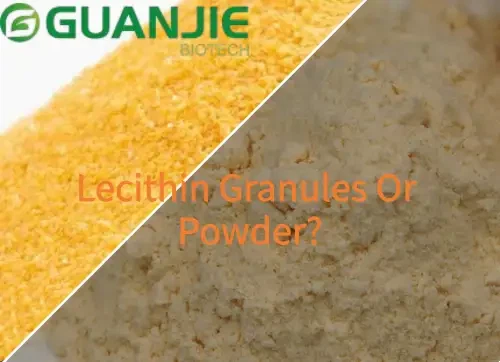
Which Is Better, Lecithin Granules Or Powder?
To understand which is better, we must make a judgment based on the specific production process and application scenario.
Physical Form and Flowability:
In commercial production lines, such as tableting and filling, material flowability is a key performance indicator.
• Flowability Advantages of Lecithin Granules:
Granular bulk lecithin typically has a larger particle size (approximately 5–20 mesh) and an irregular, loose structure, which provides excellent flowability. During high-speed mixing, granulation, or tableting, granular lecithin is less likely to clog screens, ensuring uniform automatic feeding. This is especially important in modern, automated pharmaceutical and health food production lines, as it reduces equipment cleaning frequency and increases output per unit of time.
• Risks of Adhesion in Lecithin Powder:
By contrast, high-purity lecithin powder is highly hygroscopic. Its large specific surface area makes it prone to clumping, sticking, and adhering to equipment surfaces under high-humidity conditions. This can lead to uneven feeding, higher material loss, and increased labor for cleaning. Unless processed in tightly controlled temperature and humidity conditions, handling powdered lecithin during dispensing and mixing is significantly more challenging than handling granules.
For production lines that prioritize high-speed automation and minimal material loss, bulk lecithin granules are the preferred choice.
Purity and Ingredients

High Purity of Granules
Granular lecithin is usually produced through spray drying or dry granulation. To preserve the granule shape, bulk lecithin manufacturers often remove excess oil and impurities, resulting in an acetone-insoluble content of 95%-98%. In formulations, a smaller quantity of granules can achieve the desired emulsification or nutritional effect.

Concentration Differences in Powders
Powdered lecithin is available in two types: ordinary powder, with a concentration of approximately 70%-75%, which has higher oil content and poorer flowability; and high-purity powder, with concentrations over 90%. Ordinary powder is less expensive but contains more impurities, such as residual oil and carbohydrates. High-purity powder is more challenging to process, and some suppliers provide powders that are slightly ground granules, which can compromise physical structure and increase moisture absorption.
As a professional bulk lecithin supplier, Guanjie Biotech offers a wide range of products, including powders and granules from various sources (soybean, sunflower, egg yolk) with purities ranging from PC 20%-98%. For instance, liquid lecithin bulk is recommended for soft capsules, while granules are ideal for dry-mixed, direct-compression tablets due to their superior flowability, ensuring smooth production line operation.
Applications
The choice of bulk lecithin form depends on the intended end product.
• Scenario A: Health Supplements, Solid Beverages, and Tablets
For health supplements produced as directly compressed tablets or packaged powders, lecithin granules are preferred. Granules dissolve quickly and have an attractive appearance, giving consumers a perception of "high purity" and "additive-free." They are also less prone to pulverization or dust formation during transportation and handling.
• Scenario B: Baking and Feed Premixes
In flour improvers or feed additives, where formulations include large amounts of powdered carriers (e.g., corn flour or starch), powdered lecithin ensures more even mixing. However, due to risks of static electricity and dust explosions, many large feed mills still favor granular lecithin treated with adsorption. Granules have low dust dispersion and better meet workshop safety standards.
• Scenario C: Special Emulsification Systems
In industrial applications requiring rapid emulsification of oil and water phases, such as chocolate or margarine production, liquid or powdered lecithin disperses faster than granules. Granules need time to break down, which may lead to incomplete emulsification in some areas. Here, the fast-dissolving properties of powders offer a clear advantage.
Storage and Transportation Stability
This is a hidden cost that is easily overlooked in commercial selection.
• Environmental Resistance
Bulk Lecithin granules are more resistant to temperature and humidity. Due to their dense structure, moisture and oxygen have difficulty penetrating the granules. Therefore, their rate of oxidative rancidity (producing a rancid odor) is slower than that of powder. For traders who need to export to high-temperature and high-humidity regions by sea, granular lecithin has a longer shelf life.
• Storage Disadvantages of Powder
Bulk lecithin Powder is prone to clumping and forming hard lumps during storage, rendering it unusable. Studies have compared the impact of different granulation methods on lecithin quality. The results show that products produced using dry granulation (a common method for producing granules) exhibit the most stable quality in cold chain stability tests. This further confirms the advantage of granular form in terms of physical stability.
If your supply chain has a long cycle or your storage conditions are not constant temperature and humidity, granules can effectively reduce the rate of after-sales complaints.
Frequently Asked Questions
What Is The Difference Between Lecithin Powder And Lecithin Granules?
+
-
Lecithin powder is finely ground with a large surface area, making it fast-dissolving but prone to clumping and sticking under high humidity. Granules have larger, irregular particles, offering better flowability, reduced dust, and easier handling in automated production lines. The choice depends on the end product and production process.
Which Form Is Better For Tablets And Solid Health Supplements?
+
-
Granular lecithin is generally preferred for tablets and solid supplements. Its excellent flowability ensures uniform automatic feeding during tableting, reduces dust and material loss, and provides a visually appealing product. Powdered lecithin is more difficult to handle in these applications due to adhesion and clumping.
Can Lecithin Powder Or Granules Be Used In Baking And Feed Premixes?
+
-
Yes, both can be used, but the choice depends on the formulation. Powdered lecithin mixes more evenly with large amounts of dry carriers like flour or starch. Granules are safer in large-scale feed production due to lower dust dispersion and better workshop safety, especially in high-speed mixers.
How Does Storage Affect Lecithin Powder Vs Granules?
+
-
Lecithin granules are more resistant to temperature and humidity, with slower rates of oxidative rancidity. Powdered lecithin is prone to clumping, forming hard lumps, and quality deterioration if not stored in controlled conditions. For long supply chains or high-humidity environments, granules are recommended.
Does The Purity Differ Between Lecithin Powder And Granules?
+
-
Yes. Granules are often produced with higher acetone-insoluble content (95%-98%) due to oil removal during granulation, offering concentrated emulsification and nutritional effects. Powdered lecithin comes in ordinary (70%-75%) or high-purity (>90%) forms, with ordinary powder containing more residual oil and impurities.
Lecithin Granules Vs Powder
For most mid-to-high-end manufacturers seeking high quality, stability, and low overall operating costs, high-purity lecithin granules are often the superior commercial choice. Its physical properties determine its irreplaceable role in the production line. When making purchasing decisions, it is recommended to have in-depth technical discussions with reliable bulk lecithin suppliers to recommend the most suitable form based on your specific equipment parameters, achieving the best balance between production efficiency and raw material costs. Guanjie Biotech offers lecithin in various forms, including powder, liquid, granules, and wax. Our products are HALAL, HACCP, ISO9001, KOSHER, and other certifications. Feel free to consult our expert team: info@gybiotech.com. We can provide you with the suitable lecithin form.
References:
[1] Smith, J., & Lee, A. (2023). Flowability and Stability of Bulk Lecithin in Tablet and Powder Formulations. Journal of Food Engineering, 320, 111123.
[2] Zhang, H., et al. (2022). Impact of Particle Size and Granulation Methods on Lecithin Oxidative Stability. Food Chemistry, 370, 131101.
[3] Wang, Y., & Chen, L. (2021). Comparison of Lecithin Granules and Powder in Industrial Production Lines: Flow, Emulsification, and Storage. International Journal of Food Science & Technology, 56(4), 2103–2115.
[4] Miller, R., & Thompson, P. (2020). Lecithin Stability under High Humidity and Temperature Conditions: Granules vs Powder. Food Additives & Contaminants, 37(9), 1674–1683.
[5] Zhao, L., & Wang, F. Powder Flow and Hygroscopicity of High-Purity Lecithin in Automated Production Lines. International Journal of Pharmaceutical Manufacturing, 2021; 15(3): 77–88.
[6] Food Industry Research Institute. Lecithin as a Natural Emulsifier: Comparing Forms and Applications. 2020.


