


Quick Summary for Formulators & Buyers :
GHK-Cu Copper Tripeptide-1 powder maintains maximum stability for 24–36 months when vacuum-sealed under nitrogen, protected from light, and stored at 2°C–8°C. In aqueous skincare formulations, optimal stability requires a strictly maintained pH of 5.5–6.5, addition below 40°C, and complete exclusion of strong chelators (like EDTA) and strong reducing agents (like L-Ascorbic Acid).
GHK-Cu (Copper Tripeptide-1, CAS No. 49557-75-7) is a copper-binding tripeptide complex composed of Glycine, Histidine, and Lysine. In the cosmetics industry, it serves primarily as an active ingredient in anti-aging, skin repair, and firming formulations.
Within the cosmetics supply chain, the shelf life of GHK-Cu raw powder and finished cosmetics depends on chemical stability and external factors, including production processes, purity levels, packaging, transportation cold chains, and formulation environments. For cosmetic brands, ODM/OEM manufacturers, and R&D chemists, understanding these factors minimizes material waste and prevents product degradation.
Analysis of the Chemical Structure and Degradation Mechanisms of GHK-Cu
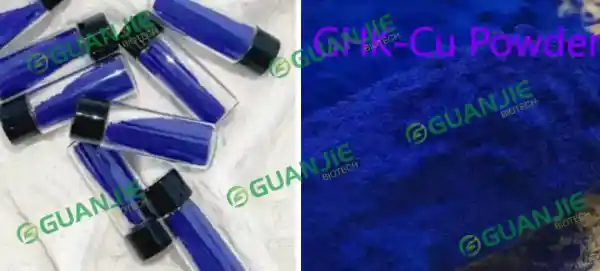
GHK-Cu (Copper Tripeptide-1) is a copper-binding tripeptide complex composed of glycine, histidine, and lysine, with the molecular formula C₁₄H₂₄N₆O₄Cu. Copper Tripeptide-1 Stability relies primarily on the coordination bond formed between the tripeptide structure and the copper ion. In its stable state, the copper ion binds to specific functional groups within the peptide chain, creating an active blue complex.
During storage, transportation, and formulation, the stability of GHK-Cu can be compromised by environmental factors, leading to degradation through several mechanisms. These primarily include the following three aspects:
• First, the dissociation of copper ions is a critical factor affecting activity.
If the coordination structure is disrupted, copper ions may be released from the tripeptide backbone; this alters the complex's structure, reduces its biological activity, and may lead to precipitation.
• Second, hydrolysis of peptide bonds causes the GHK-Cu molecular structure to break down.
In environments characterized by high temperatures, strong acids, or strong alkalis, the amide bonds within the peptide chain can undergo hydrolysis, yielding smaller amino acid fragments and diminishing the molecule's original functionality.
• Furthermore, oxidative degradation is a significant pathway affecting GHK-Cu stability.
Reactive oxygen species (ROS) can attack histidine residues or lysine side chains, inducing structural changes and resulting in a loss of the active ingredient. Consequently, maintaining the stability of GHK-Cu during production and storage requires the careful control of temperature, moisture, oxygen exposure, and light conditions.
What Factors Affect the Shelf Life of GHK-Cu?
The stability and active shelf life of GHK-Cu Copper Tripeptide-1 are primarily governed by temperature, pH levels, UV light exposure, metal chelators, redox environments, and ambient humidity. To preserve its characteristic blue coordination complex and bioactivity in cosmetic formulations and raw material storage, strict environmental control and ingredient compatibility testing are essential.
|
Stability Factor |
Ideal Range / Condition |
Instability Risks & Hazard Drivers |
|
System pH |
5.5 – 6.5 (Mildly Acidic) |
< 5.0: Cu²⁺ dissociation |
|
Powder Storage |
2°C – 8°C (Cool, Dry, Dark) |
> 25°C: Accelerated hydrolysis, blue-to-yellow color shift |
|
Light & UV |
Light-Shielding (Amber/Opaque) |
Free radical attacks on the Histidine imidazole ring |
|
Incompatible Actives |
Strong Chelators (EDTA), Pure Vit C, Strong Oxidizers |
Copper stripping, reduction of Cu²⁺ to Cu⁺, phase separation |
Key Environmental & Formulation Factors
1. Temperature Management
Temperature directly impacts the molecular motion and chemical reaction kinetics of the copper-tripeptide complex.
• High-Temperature Degradation:
Elevated temperatures accelerate peptide bond hydrolysis and weaken the coordination bond between Cu²⁺ and the tripeptide. In aqueous systems, this manifests visually as a distinct color shift-from vibrant blue to blue-green or yellow-indicating a reduction in the concentration of active GHK-Cu raw material.
• Low-Temperature Storage:
For lyophilized raw GHK-Cu powder, lower temperatures reduce molecular movement and stabilize the coordination bonds.
• Supply Chain Action:
Avoid high-temperature exposure during international freight, summer container transport, and non-climate-controlled warehousing. Keep raw powders cold (2°C–8°C) for long-term storage.
2. System pH Sensitivity
GHK-Cu is a metal-peptide complex that is highly sensitive to the concentrations of hydrogen (H⁺) and hydroxide (OH⁻) ions.
• Acidic Environment (pH < 5.0):
High concentrations of H⁺ ions compete for active binding sites on the GHK molecule (specifically the Histidine imidazole ring), causing copper ions to dissociate from the complex.
• Alkaline Environment (pH > 7.5):
Hydroxide ions react with copper to form insoluble copper salts or precipitates, while high alkalinity accelerates peptide chain cleavage.
• Optimal Formulation Range:
Formulate aqueous serums, creams, and lotions within pH 5.5–6.5.
3. Light and UV Radiation
Ultraviolet (UV) radiation triggers photo-oxidation, generating reactive species that attack sensitive regions of the GHK-Cu structure.
• Photo-Degradation Indicator:
Prolonged light exposure destabilizes the copper coordination state, leading to color fading or discoloration (fading from blue to clear/light green).
• Packaging Solutions:
Use opaque HDPE containers, aluminum foil bags, or amber glass with UV-blocking properties.
4. Metal Ions & Chelating Agents
The stability of GHK-Cu relies on its complexation equilibrium; competitive molecules can strip the copper ion away.
• Strong Chelating Agents (EDTA-2Na / EDTA-4Na):
High concentrations of strong chelators competitively bind Cu²⁺, stripping it from the GHK backbone and forming inactive complexes.
• Multivalent Metal Ions (Fe³⁺, Zn²⁺, Al³⁺):
Competing ions in the system can shift the complexation equilibrium, altering product stability.
5. Oxidizing & Reducing Agents (Redox Environment)
• Oxidizing Agents (Peroxides, Persulfates): Highly reactive oxidizing systems attack the tripeptide backbone. Additionally, free Cu²⁺ can act as an oxidation catalyst, accelerating formula degradation.
• Reducing Agents (e.g., L-Ascorbic Acid / Pure Vitamin C): Strong reducing agents reduce Cu²⁺ to Cu⁺, destroying the geometry of the coordination complex and causing rapid discoloration or precipitation.
6. Ambient Moisture & Hygroscopicity
Pure GHK-Cu lyophilized powder is highly hygroscopic. Unsealed powder rapidly absorbs atmospheric moisture, forming a surface liquid film that transitions solid-state bonds into an active aqueous hydrolysis phase-significantly shortening raw material shelf life.
Comparison of Data on GHK-Cu Stability and Storage Conditions
To clarify the impact of various factors on GHK-Cu, the following summarizes industry-standard stability testing criteria and shelf-life assessment data.
Key Variables and Control Parameters Affecting GHK-Cu Stability
|
Variable factors |
Stability Thresholds / Conditions |
Degradation behavior |
Industrial Control Standards |
|
Temperature |
Raw powder: 2°C – 8°C |
High temperatures cause peptide bond hydrolysis and the solution to turn green or yellow |
Avoid temperatures exceeding 60°C during processing; transport raw materials via cold chain |
|
pH value |
Aqueous solution: < 25°C |
pH > 7.5: Formation of copper precipitates |
Strictly control the final product pH within the 5.5–6.5 range |
|
Light |
pH 5.5 – 6.5 |
Photo-oxidation of the imidazole ring; fading of the blue-red color |
Use amber glass bottles, aluminum foil bags, or light-shielding containers |
|
Chelating agents |
Protect from light; UV-free environment |
Forced removal of copper ions, resulting in the loss of characteristic color and activity |
Strictly prohibit the use of high-stability-constant chelating agents (such as EDTA) in the formula |
|
Moisture (powder) |
Incompatible with EDTA and its salts |
Caking, deliquescence, and accelerated localized hydrolysis |
Vacuum-seal using double-layer PE bags plus aluminum foil bags; include a desiccant |
Comparison of shelf life for GHK-Cu products in different forms under standard conditions
|
Product Forms |
Packaging and Storage Conditions |
Expected shelf life |
Critical Quality Control Points (QCP) |
|
Pure raw material powder (purity ≥ 98%) |
Sealed aluminum foil bag; 2°C–8°C; store in a dry place, protected from light |
24 – 36 months |
HPLC purity, copper content determination, moisture control |
|
Lyophilized GHK-Cu powder |
Sterile vial; 2°C–8°C; sealed |
24 – 36 months |
Residual moisture, reconstitution clarity |
|
Aqueous stock solution (e.g., 1% concentration) |
Light-protected container; 2°C–8°C; stored under nitrogen |
12 – 18 months |
Absorbance (λ = 600–640 nm), pH stability |
|
Finished cosmetic formulation |
Light-shielding packaging; 25°C (ambient temperature); protected from light |
12 – 24 months |
Review of formulation incompatibilities, stability of preservative system |
Industrial Formulation Strategies to Extend GHK-Cu Shelf Life
Cold-Chain & Nitrogen Packaging:
Bulk raw powders and stock solutions should be sealed under an inert nitrogen (N₂) headspace to eliminate oxygen and prevent photo-oxidative fading.
Low-Temperature Addition Protocol:
GHK-Cu is thermolabile. Never introduce it during the hot-emulsification phase. Add GHK-Cu solutions strictly below 40°C (104°F) during the cooling phase.
Alternative Chelating Strategy:
Eliminate EDTA. Use mild chelators with lower stability constants for copper, such as Sodium Phytate, or rely on non-ionic preservative systems.
pH Buffer Systems:
Incorporate a mild Citric Acid / Sodium Citrate buffer system to lock formulation pH between 5.8 and 6.2 over extended storage periods.
Frequently Asked Questions (FAQ)
Q1: Can I formulate GHK-Cu with pure Vitamin C (L-Ascorbic Acid)?
A: No. Pure Vitamin C is a strong reducing agent that reduces Cu²⁺ to Cu⁺, destroying the GHK-Cu structure, reducing efficacy, and causing discoloration. Use stable Vitamin C derivatives or package them separately.
Q2: What is the optimal pH for a GHK-Cu serum?
A: The target pH range for maximum GHK-Cu serum stability is 5.5 to 6.5. Avoid dropping below pH 5.0 or rising above pH 7.5.
Q3: What is the best way to store bulk GHK-Cu powder?
A: Store GHK-Cu powder in hermetically sealed, light-shielding aluminum foil bags with desiccants at 2°C–8°C in a cool, dark environment.
Q4: At what stage of the formulation process should GHK-Cu be added?
A: GHK-Cu must be added during the cool-down phase of emulsification when the temperature drops below 40°C (104°F). Because Copper Tripeptide-1 is highly heat-sensitive, exposing it to high-temperature emulsification phases (60°C–80°C) causes rapid thermal hydrolysis of peptide bonds and loss of biological activity.
Q5: Can a discolored or green GHK-Cu serum be restored to its original blue color?
A: No, the color change is irreversible. A shift from vibrant blue to light green, yellow, or clear indicates that the Cu²⁺ coordination complex has collapsed, or the peptide chain has undergone hydrolysis/oxidation. Once the bond is broken, the active GHK-Cu molecule cannot be chemically reconstituted within the finished formulation.
Q6: Is GHK-Cu compatible with Niacinamide or Salicylic Acid?
A: Niacinamide (Vitamin B3): Highly compatible within a shared pH range of 5.5 to 6.5.
• Salicylic Acid & Alpha Hydroxy Acids (AHAs): Incompatible. Direct formulation with strong organic acids lowers system pH below 5.0, forcing Cu²⁺ ion dissociation and deactivating the peptide complex. Use encapsulated acids or separate them into different product routines.
Q7: Why did my GHK-Cu serum turn cloudy or form a precipitate over time?
A: Precipitation usually occurs due to two main formulation errors:
• High System pH (pH > 7.5):
Excess hydroxide ions cause Cu²⁺ to drop out of solution as insoluble copper salts.
• Incompatible Polymeric Thickeners/Anionic Surfactants:
Strong anionic polymers or electrolytes can destabilize the cationic peptide complex, causing phase separation and physical precipitation.
Conclusion:
In conclusion, optimizing GHK-Cu shelf life requires strict control over temperature, pH, light exposure, and ingredient compatibility throughout the supply chain. Maintaining raw powder at 2°C–8°C, formulating within a stable pH range of 5.5–6.5, and introducing the peptide below 40°C prevents irreversible hydrolysis, oxidation, and copper dissociation. By eliminating incompatible chelators and strong reducing agents, manufacturers and formulators can maximize biological potency, prevent discoloration, and ensure long-term product stability and effectiveness.
Guanjie Biotech is a leading manufacturer specializing in high-purity bulk GHK-Cu powder (Copper Tripeptide-1). Focused on innovation and standardized production, the company provides high-stability, batch-consistent bioactive peptide ingredients for global customers, including cosmetic manufacturers, biotechnology firms, and skincare OEM factories. Replacing traditional extraction with advanced synthesis technology, Guanjie guarantees a reliable, scalable supply for wholesale Copper Tripeptide orders. Partner with an industry-trusted GHK-Cu supplier to elevate your formulations. Contact info@gybiotech.com today for technical specifications, wholesale quotes, and sample requests.
References:
[1] Zajda, J., Wadych, E., Ogórek, K., Drozd, M., & Matczuk, M. (2024). Novel applications of CE-ICP-MS/MS: Monitoring of antiaging GHK-Cu cosmetic component encapsulation in liposomes. Electrophoresis. https://doi.org/10.1002/elps.202400047
[2] Mortazavi, S. M., Mohammadi Vadoud, S. A., & Moghimi, H. R. (2025). Skin permeation enhancement of GHK and its derivatives: A review. BioImpacts, *15*, 30071.
[3] Pickart, L., & Margolina, A. (2018). Regenerative and protective actions of the GHK-Cu peptide in the light of the new gene data. International Journal of Molecular Sciences, *19*(7), 1987.
[4] Maquart, F. X., Pickart, L., Laurent, M., Gillery, P., Monboisse, J. C., & Borel, J. P. (1988). Stimulation of collagen synthesis in fibroblast cultures by the tripeptide-copper complex GHK-Cu. FEBS Letters, *238*(2), 343-346.
[5] Cosmetic Ingredient Review (CIR) Expert Panel. (2015). Final report on the safety assessment of copper tripeptide-1. International Journal of Toxicology, *34*(Suppl 1), 5S-15S.


