In the fields of modern bio-cosmetology and functional skincare development, GHK-Cu (Copper Tripeptide-1) and EGF (Epidermal Growth Factor) stand out as two key active ingredients with high biological activity. While both demonstrate significant capabilities in anti-aging, tissue repair, and skin barrier improvement in clinical applications, they differ fundamentally in terms of molecular structure, target receptors, biological mechanisms, and formulation usage.
Comparison of Basic Biological Properties and Structural Characteristics
The structural differences between copper peptide GHK-Cu and EGF are therefore significant. These differences influence their formulation characteristics, delivery considerations, and biological mechanisms.
GHK-Cu
GHK-Cu (Copper Tripeptide-1) is a small peptide-copper complex formed by the tripeptide Gly-His-Lys (glycine-histidine-lysine) and a divalent copper ion (Cu²⁺). With a molecular weight of approximately 400 Da, the GHK-Cu peptide is an endogenous small-molecule complex naturally found in human plasma, saliva, and urine. Its concentration is reported to decrease with age. The relatively low molecular weight of GHK-Cu supports its ability to interact with skin structures and makes it an important ingredient for skincare formulations. Its structure combines the biological properties of the tripeptide with the coordination characteristics of copper.
EGF
In comparison, EGF (Epidermal Growth Factor) is a single-chain polypeptide consisting of 53 amino acid residues, with a molecular weight of approximately 6,000 Da. It contains three pairs of disulfide bonds that help maintain its three-dimensional structure. As a larger growth-factor molecule, EGF primarily functions through binding to specific epidermal growth factor receptors (EGFR) on cell membranes. Its biological activity depends on receptor recognition and the subsequent activation of intracellular signaling pathways.
Differences in Mechanisms of Action and Target Cells
GHK-Cu and EGF differ significantly in their mechanisms of action, target cells, and signaling pathways. Understanding these differences is important when evaluating GHK-Cu peptide, copper tripeptide-1, and EGF for skincare, skin repair, and formulation applications.
GHK-Cu: Copper-Dependent and Gene-Regulatory Mechanisms
GHK-Cu, also known as GHK-Cu copper peptide or copper tripeptide-1, functions partly as a copper-binding peptide. It can facilitate the local availability of copper ions, which are important cofactors for several copper-dependent enzymes. One relevant enzyme is lysyl oxidase (LOX), which participates in collagen and elastin cross-linking and extracellular matrix remodeling.
The GHK-Cu mechanism of action also involves regulation of gene expression and cellular processes associated with inflammation, oxidative stress, tissue repair, and extracellular matrix metabolism. GHK-Cu may influence the balance between matrix metalloproteinases (MMPs) and tissue inhibitors of metalloproteinases (TIMPs), helping regulate extracellular matrix turnover.
Unlike EGF, GHK-Cu does not depend on one well-defined cell-surface receptor to produce all of its biological effects. Its activity is associated with copper availability, enzyme activity, and broader cellular and gene-expression responses. These characteristics explain why GHK-Cu for skin repair and GHK-Cu collagen synthesis are common areas of interest in cosmetic ingredient research.
EGF: Receptor-Mediated Signaling
EGF primarily acts by binding to the epidermal growth factor receptor (EGFR), a receptor tyrosine kinase located on the cell surface. EGF binding promotes receptor dimerization and autophosphorylation, which activates downstream signaling pathways, including MAPK/ERK and PI3K/Akt.
These pathways regulate cellular processes such as proliferation, migration, and gene transcription. Therefore, EGF signaling is characterized by clear receptor specificity and phosphorylation-dependent signaling cascades.
Differences in Target Cells
The target-cell distribution of GHK-Cu and EGF also differs. GHK-Cu primarily affects dermal fibroblasts while also interacting with keratinocytes, macrophages, and endothelial cells. Its functional focus is associated with dermal extracellular matrix remodeling and tissue repair.
EGF primarily targets epidermal keratinocytes and can also affect basal cells and fibroblasts. Its major biological effects are concentrated in the epidermis, particularly processes associated with cell proliferation, migration, and re-epithelialization after injury.
Comparison of Core Skincare Functions
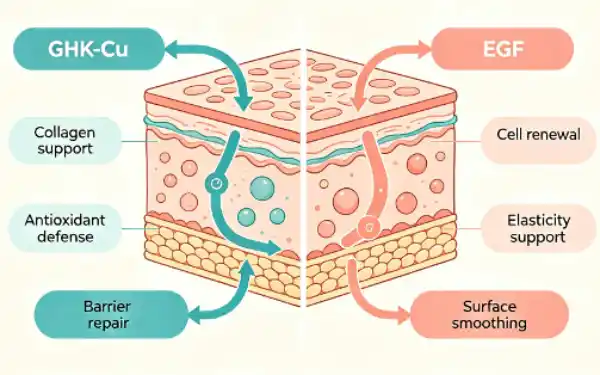
GHK-Cu (copper peptide) and EGF (Epidermal Growth Factor) have different primary roles in skin repair. GHK-Cu is mainly associated with dermal matrix remodeling, collagen synthesis, and antioxidant and anti-inflammatory activity. EGF primarily supports keratinocyte proliferation, migration, and re-epithelialization during epidermal repair. Therefore, the choice between GHK-Cu vs EGF depends on the skin condition, treatment stage, and formulation objectives.
Collagen and Extracellular Matrix Remodeling
GHK-Cu and EGF differ in their effects on the dermal extracellular matrix. As a GHK-Cu peptide, GHK-Cu is used in cosmetic formulations targeting collagen and matrix-related skin functions.
• GHK-Cu:
GHK-Cu is associated with the synthesis of Type I and Type III collagen, elastin, and glycosaminoglycans, including hyaluronic acid. It may also influence the balance between matrix metalloproteinases (MMPs) and tissue inhibitors of metalloproteinases (TIMPs). These activities are relevant to dermal matrix turnover and structural remodeling. This makes GHK-Cu for skin repair and skin-regeneration formulations an important area of cosmetic ingredient development.
• EGF:
EGF primarily supports collagen production indirectly by stimulating fibroblast activity and proliferation. Compared with GHK-Cu, its role is more strongly associated with epidermal cell proliferation and wound re-epithelialization than direct regulation of dermal matrix turnover.
Barrier Repair and Wound Healing
The two ingredients also differ in their roles in epidermal barrier repair and wound healing.
• GHK-Cu:
GHK-Cu skincare formulations may use the peptide for its collagen-related, antioxidant, and anti-inflammatory properties. GHK-Cu has been studied for its potential to influence reactive oxygen species (ROS), inflammatory responses, and skin repair processes. Its potential activity extends across inflammatory, proliferative, and remodeling stages, although its direct effects on keratinocyte migration and proliferation are generally less prominent than those associated with EGF.
• EGF:
EGF is primarily associated with early epidermal repair. By promoting keratinocyte proliferation and migration, EGF can support re-epithelialization and restoration of epidermal barrier continuity. This makes EGF particularly relevant to formulations designed for post-procedure skin recovery.
Core Parameters and Application Characteristics Comparison Table
|
Comparison Dimension |
GHK-Cu (Blue Copper Peptide) |
EGF (Epidermal Growth Factor) |
|
Chemical Nature |
Tripeptide-1 Copper complex |
Macromolecular polypeptide (53 amino acids) |
|
Relative Molecular Mass |
~400 Da |
~6,000 Da |
|
Transdermal Absorption Capacity |
Extremely small molecule; easily penetrates the skin to reach the dermis |
Large molecule; typically remains in the epidermis (requires microneedles or a delivery vehicle for transdermal penetration) |
|
Primary Target Site |
Dermis (fibroblasts, extracellular matrix) |
Epidermis (keratinocytes, basal cells) |
|
Core Efficacy |
Anti-aging and firming; matrix remodeling; anti-inflammatory and antioxidant; improves skin laxity |
Rapid epidermal repair, accelerated wound healing, skin brightening, promotion of epidermal turnover |
|
Typical Inclusion Concentration |
0.05% – 0.5% (500 ppm – 5000 ppm) |
1 ppm – 10 ppm (often specified in activity units, IU/mL) |
|
Formulation Incompatibilities |
Do not combine with strong acids (e.g., AHAs, salicylic acid), strong reducing agents (e.g., Vitamin C), or chelating agents (e.g., EDTA) |
Incompatible with strong acids, strong bases, high concentrations of alcohol, or proteases |
|
Thermal and pH Stability |
Sensitive to pH in solution; requires storage in a neutral environment (pH 5.5 – 7.5) |
Highly prone to denaturation; poor thermal stability; requires low-temperature storage or freeze-drying |
|
Long-term Safety |
Highly gentle, non-irritating, and well-tolerated; suitable for long-term anti-aging use |
Long-term use at high concentrations may increase the risk of excessive cell proliferation; phased use for repair is recommended |
Comparison of Formulation Development and Application Scenarios
GHK-Cu (Copper Tripeptide-1)
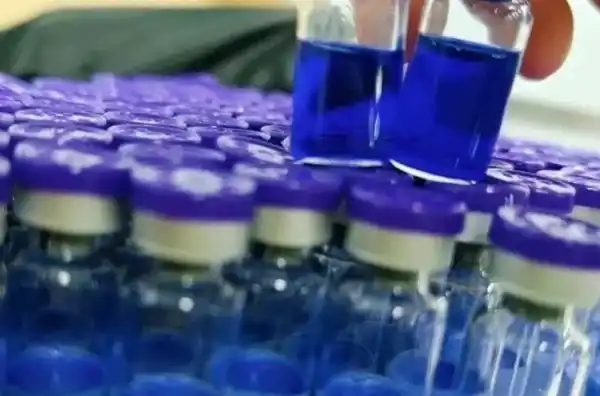
GHK-Cu (Copper Tripeptide-1) requires careful formulation control because its activity can be affected by copper-ion dissociation or precipitation. For GHK-Cu formulations, the pH should generally be controlled within the 5.5–7.5 range. Strongly acidic ingredients may promote copper-ion release, while strong chelating agents such as EDTA may competitively bind copper ions and disrupt the GHK-Cu complex. Therefore, formulation compatibility should be evaluated carefully. A natural blue color can indicate the presence of the copper-peptide complex. During processing, excessive electrolytes and unwanted metal ions should also be avoided to reduce the risk of precipitation or copper displacement. These considerations are important when developing GHK-Cu powder or liquid GHK-Cu cosmetic ingredients.
EGF
EGF depends on its higher-order protein structure and disulfide bonds, making it sensitive to heat, pH, and oxidation. In aqueous formulations, EGF may undergo structural unfolding or aggregation, reducing biological activity. Common stabilization approaches include lyophilization, the use of suitable protein stabilizers such as sugars, polyols, or amino acids, and microencapsulation. Temperature, shear, and sterilization conditions should be carefully controlled, with high-temperature terminal sterilization generally avoided.
Recommended Application Scenarios and Product Positioning
GHK-Cu Application Scenarios and Product Positioning
GHK-Cu, also known as copper tripeptide-1, is suitable for daily GHK-Cu skincare formulations, including anti-aging serums and creams. It is commonly positioned for products targeting the appearance of fine lines, wrinkles, and reduced skin elasticity. In sensitive-skin and GHK-Cu skin repair formulations, the ingredient can be positioned for barrier-support applications and products addressing visible redness.
GHK-Cu serum formulations are also suitable for eye-care products targeting the appearance of fine lines and skin thinning around the eyes. In scalp-care formulations, including GHK-Cu hair growth serum products, GHK-Cu can be positioned for scalp and hair-follicle support. For cosmetic manufacturers, GHK-Cu peptide and copper peptide are therefore relevant ingredients for anti-aging, skin-care, and scalp-care product development.
EGF Application Scenarios and Product Positioning
EGF is suitable for post-aesthetic-procedure skincare, including products formulated for recovery following microneedling, IPL, and ablative laser treatments. It can also be positioned for products designed to support skin recovery after sun exposure and acute peeling.
In lyophilized powder formulations for acne-mark care, EGF may be used in products targeting epidermal recovery and skin-condition improvement. These applications provide different positioning options for cosmetic brands developing professional skincare and post-procedure care products.
FAQs:
Q1. What is the difference between GHK-Cu and EGF in skincare?
A:GHK-Cu, also called Copper Tripeptide-1, is a copper-binding peptide commonly used in skincare formulations for skin repair and conditioning. EGF, or epidermal growth factor, is a signaling protein associated primarily with epidermal cell proliferation and migration. Their mechanisms and formulation roles are different.
Q2. Is GHK-Cu better than EGF for skin repair?
A:GHK-Cu and EGF support skin repair through different biological pathways, so neither is universally better. GHK-Cu is commonly formulated for skin conditioning, extracellular matrix support, and anti-aging applications, while EGF is mainly associated with epidermal regeneration and wound-repair processes.
Q3. Can GHK-Cu and EGF be used together in skincare formulations?
A:Yes. GHK-Cu and EGF can be combined in some skincare formulations when their different functional roles are desired. GHK-Cu may support skin conditioning and matrix-related processes, while EGF primarily targets epidermal cell signaling. Formulators should evaluate compatibility, stability, pH, concentration, and delivery systems.
Q4. What is GHK-Cu used for in skincare products?
A:GHK-Cu is used in skincare products including anti-aging serums, skin-repair creams, moisturizers, and cosmetic formulations designed to improve the appearance and condition of mature or stressed skin. As a Copper Tripeptide-1 ingredient, it is valued for its peptide-based formulation properties.
Q5. What is EGF used for in skincare formulations?
A:EGF is primarily used in cosmetic formulations focused on epidermal skin renewal and appearance. It is commonly incorporated into serums, creams, and other topical products. Because EGF is a protein, formulation developers need to consider factors such as temperature, pH, proteolytic degradation, and storage stability.
Q6. Which is more stable, GHK-Cu or EGF?
A: Stability depends on the specific ingredient grade and formulation system. GHK-Cu is generally formulated as a relatively small peptide, whereas EGF is a larger protein with greater sensitivity to formulation conditions. Both require appropriate pH, temperature, packaging, and storage controls to maintain ingredient quality.
Q7: What should formulators consider when choosing GHK-Cu vs EGF?
A:Formulators should compare the intended skincare function, ingredient purity, concentration, pH compatibility, solubility, stability, delivery system, preservative system, packaging, and regulatory requirements. For GHK-Cu vs EGF, the selection should be based on the desired formulation objective rather than treating the ingredients as direct substitutes.
Conclusion
GHK-Cu and EGF are not direct substitutes in skincare formulations. Instead, these two active ingredients have different functional roles and can be considered complementary ingredients when developing advanced cosmetic and skin-repair formulations.
Functional Perspective
EGF primarily acts on the epidermis by supporting keratinocyte proliferation and migration. It is therefore commonly considered for formulations focused on epidermal recovery and skin barrier support. GHK-Cu, also known as Copper Tripeptide-1, is a copper peptide widely used in cosmetic formulations targeting skin aging and dermal matrix support. GHK-Cu research focuses on its potential to support fibroblast activity, collagen and elastin synthesis, and the regulation of matrix metalloproteinases (MMPs) and inflammatory pathways.
Combined Application
In post-procedure skincare or intensive anti-aging formulations, EGF and GHK-Cu may be incorporated according to different formulation objectives. EGF can be positioned for early-stage epidermal support, while GHK-Cu for skincare can be used in subsequent or ongoing formulations targeting dermal matrix maintenance and skin structure. This approach allows formulators to address different layers and stages of skin recovery.
GHK-Cu vs EGF: Which Ingredient Is Better?
There is no universal answer to which ingredient is better. GHK-Cu is more relevant when the formulation focuses on collagen, extracellular matrix remodeling, antioxidant support, and longer-term skin regeneration. EGF is more focused on epidermal proliferation and early barrier repair. For cosmetic formulators, selecting a GHK-Cu cosmetic ingredient or EGF depends on the desired mechanism, product positioning, formulation compatibility, and regulatory requirements.
For brands developing GHK-Cu formulations, selecting a reliable GHK-Cu powder supplier is important for quality and consistency. Guanjie Biotech supplies high-purity bulk GHK-Cu powder and provides OEM and ODM services for cosmetic formulation development and commercial production.
References:
[1] Pickart, L., & Margolina, A. (2018). Regenerative and Protective Actions of the GHK-Cu Peptide in the Light of the New Gene Data. International Journal of Molecular Sciences, *19*(7), 1987.
[2] Maquart, F. X., Pickart, L., Laurent, M., Gillery, P., Monboisse, J. C., & Borel, J. P. (1988). Stimulation of collagen synthesis in fibroblast cultures by the tripeptide-copper complex GHK-Cu. FEBS Letters, *238*(2), 343-346.
[3] Yoo, Y. H., et al. (2014). YAC tripeptide of epidermal growth factor promotes the proliferation of HaCaT keratinocytes through activation of EGFR. BMB Reports, *47*(10), 581-586.
[4] Sivamani, R., Jagdeo, J., Elsner, P., & Maibach, H. I. (2016). Cosmeceuticals and Active Cosmetics (3rd ed.). CRC Press.
[5] UL Prospector. (2025). Peptides and Growth Factors: Advanced Actives in Skin Care.
[6] Redaelli, A. (2025). Signaling molecules to modulate aesthetic procedure results. IMCAS World Congress 2025.
[7] AMCOL Health & Beauty Solutions. (2026). GHK-Cu Copper Peptide Delivery System MSN702CU. Personal Care Magazine.
[8] Samson, S., Basri, M., Fard Masoumi, H. R., Abedi Karjiban, R., & Abdul Malek, E. (2016). Design and development of a nanoemulsion system containing copper peptide by D-optimal mixture design. RSC Advances.