Inonotus obliquus extract powder, also known as Chaga mushroom extract powder, contains naturally occurring polysaccharides, triterpenoids, phenolic compounds, and pigments. Incorporating Chaga extract powder into modern beverage formulations requires careful consideration of food processing and formulation parameters. R&D teams should evaluate raw material quality, solubility, dispersion, flavor compatibility, processing stability, and storage conditions. For manufacturers sourcing bulk Chaga extract, consistent quality and standardized specifications are essential. A reliable Chaga extract supplier can provide suitable Inonotus obliquus extract for functional beverages, powdered drinks, and other food applications.
Influence of Raw Material Properties and Chemical Composition on Formulation
The physicochemical properties of Chaga extract powder directly determine its performance in liquid matrices. Process development requires the selection of an appropriate extract type based on the product positioning of the target beverage.
Classification by Active Ingredients and Purification Process
Inonotus Obliquus Extract Powder, also known as Chaga Mushroom Extract Powder, can be classified according to its active ingredients and extraction process.
• Water Extract
Water Extract is primarily enriched with water-soluble polysaccharides and polyphenols, providing good water dispersibility and minimal insoluble residue. This makes it suitable for clear beverages, instant drinks, and ready-to-drink (RTD) tea.
• Alcohol/Dual Extract
Alcohol or Dual Extract contains higher levels of fat-soluble compounds, particularly Chaga triterpenes. Because triterpenes have low polarity, this type of Chaga Extract Powder has limited solubility in water-based formulations and may cause turbidity or sedimentation. Solubilizers or dispersing agents may therefore be required.
• Chromogenic Complex
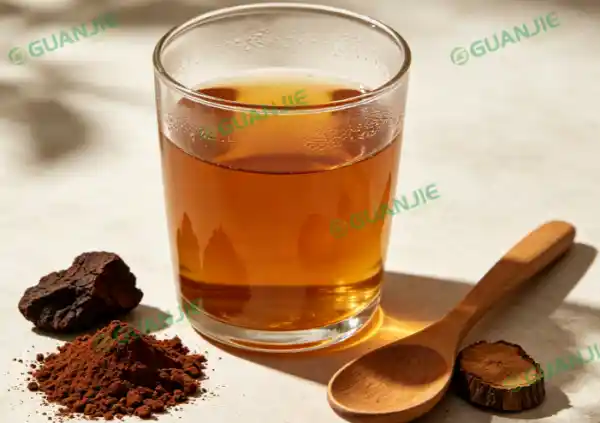
Complex Extract contains concentrated polyphenol-pigment complexes, giving Inonotus Obliquus Extract a dark brown to nearly black appearance. This characteristic should be considered when developing beverages, supplements, and other formulations requiring specific color and appearance.
Technical Indicators for Powders Produced by Different Extraction Processes in Beverage Formulations
|
Technical indicators |
Hot-water extract powder |
Ethanol extract / Dual-extract powder |
Micronized whole-cell powder |
|
Main active ingredient |
Water-soluble polysaccharides, phenolic acids |
Triterpenes (betulin, betulinic acid); mixture of water-soluble and fat-soluble components |
Whole-cell components, dietary fiber, natural minerals |
|
water solubility |
High (high water-solubility purity) |
Moderate (fat-soluble components tend to separate out) |
Insoluble (forms a suspension) |
|
Transmittance/turbidity |
Clear to slightly turbid (depending on concentration) |
Visibly cloudy; prone to emulsification or sedimentation |
Very high turbidity; prone to rapid sedimentation |
|
Flavor characteristics |
Earthy, slightly bitter, woody |
Strongly bitter and astringent taste; deep, woody aroma |
Earthy/woody flavor, gritty texture |
|
Applicable beverage types |
Ready-to-drink tea, functional sparkling water, clear sugar-free beverages |
Concentrated functional beverages, plant-based protein drinks, coffee substitutes |
Powder for reconstitution, thick meal-replacement shake |
Control of Water Solubility, Sedimentation, and Physical Stability
For liquid beverages, common quality defects include phase separation, sedimentation, and precipitation of suspended particles. During reconstitution, Inonotus obliquus extract powder, also known as Chaga extract powder, may present challenges related to the aggregation of high-molecular-weight polysaccharides and the limited water solubility of fat-soluble triterpenes.
Solubility and Sedimentation Mechanisms
• High-molecular-weight polysaccharide aggregation:
Long-chain polysaccharides in Chaga mushroom extract may aggregate through hydrogen bonding in aqueous systems, reducing physical stability and increasing sedimentation.
• Triterpene precipitation:
Fat-soluble triterpenes in dual-extracted Inonotus obliquus extract have limited solubility in water. During storage at ambient or low temperatures, they may form fine suspended particles that gradually aggregate and settle.
• Macromolecular complexation:
Natural polyphenols may interact with proteins or multivalent metal ions, including Ca²⁺ and Mg²⁺, potentially forming insoluble complexes and precipitates.
Strategies for Improving Physical Stability
• Micronization and nano-emulsification:
High-pressure homogenization or microfluidization can reduce particle size and improve dispersion. For Chaga extract for beverages, MCT oil combined with food-grade emulsifiers such as soy lecithin may help disperse fat-soluble components.
• Hydrocolloid stabilization:
Gellan gum, gum arabic, or xanthan gum can form a weak stabilizing network that helps suspend insoluble particles without substantially increasing beverage viscosity.
• Chelating agents:
In hard-water production systems, sodium citrate or EDTA-2Na may sequester multivalent metal ions and help reduce polyphenol-metal complex formation.
Flavor Profile and Sensory Modification
Inonotus obliquus extract powder, also known as Chaga extract powder, has a naturally earthy, woody, bitter, and slightly astringent flavor. Managing these sensory characteristics is important when developing beverages and other food formulations containing Chaga mushroom extract powder.

Masking Bitterness and Astringency
• Flavor modification
Flavor modification can help improve the sensory profile of Chaga extract for functional beverages. Molecular inclusion with gamma-cyclodextrin or alpha-cyclodextrin may encapsulate certain bitter compounds, reducing their direct interaction with bitter taste receptors and helping moderate perceived bitterness.
• Flavor pairing
Flavor pairing is another practical approach. Chaga extract powder can complement coffee, cocoa, oats, roasted malt, and dark fruit flavors such as blackcurrant, elderberry, and blueberry. In coffee-based drinks and meal-replacement beverages, these combinations can integrate Chaga's earthy characteristics into a richer overall flavor profile.
pH and Sensory Adjustment
Chaga extract may have a mildly acidic pH, commonly around 4.5–5.5. In highly acidic beverages, astringency may become more noticeable. Sweeteners such as erythritol, monk fruit, or steviol glycosides, together with citric or malic acid, can help balance sweetness, acidity, and mouthfeel.
Industrial Processing and Stability Technology
During factory-scale mixing, sterilization, and filling, Chaga extract powder is subjected to mechanical shear and heat treatment; consequently, the degradation of active ingredients and changes in color must be controlled throughout the process.
Impact of Thermal Pasteurization on Active Ingredients and Physical Properties
Pasteurization can affect the stability of Inonotus obliquus extract powder and its bioactive compounds.
• LTLT / HTST
During LTLT or HTST processing at 85–95°C for 15–30 seconds, water-soluble Chaga polysaccharides generally show limited degradation. However, prolonged heating may promote thermal changes in high-molecular-weight polyphenols, potentially causing darker color and increased turbidity.
• UHT
UHT treatment at 135–140°C for 4–6 seconds provides a brief thermal shock that may better preserve key compounds, including polysaccharides and Chaga triterpenes, while limiting heat-related caramelization and off-flavors. For formulations using Chaga mushroom extract, processing conditions should therefore be carefully controlled.
• Packaging and Light Stability
Melanin and polyphenols in Inonotus obliquus extract can be sensitive to light and oxidation. Long-term exposure in transparent PET packaging may contribute to color changes or flocculent sediment formation. For bulk Chaga extract powder and finished products, light-protective packaging such as amber glass, aluminum containers, or high-barrier PET is recommended.
Process Flowchart for the Preparation of a Typical Beverage Formulation
[Deionized Water / Base Liquid]
↓
[Water Softening & Temperature Adjustment (50–60°C)]
↓
[Chaga Extract Powder + Hydrocolloids / Shear Pre-dispersion] ──(High-shear Rehydration: 15–20 mins)
↓
[Addition of Excipients (Sweeteners / Acidulants / Flavorings)]
↓
[Volume Adjustment & pH Correction]
↓
[High-Pressure Homogenization (20–30 MPa)] ──(Break down particle aggregates; enhance suspension stability)
↓
[Degassing (Vacuum Level: -0.08 MPa)] ──(Remove micro-bubbles; prevent high-temperature oxidation)
↓
[UHT Sterilization (138°C, 5 seconds)]
↓
[Aseptic Filling / Sealed Packaging]
Examples of Formulation Parameters and Quality Indicators
To ensure production repeatability and batch-to-batch consistency, specific ranges for technical parameters should be established during the R&D process.
Formulation Control Parameters
|
Control Parameters |
Technical Specifications |
Notes/Control Targets |
|
Extract dosage |
0.1% – 0.5% (w/v) |
Depends on extract specifications and target active ingredient content |
|
Final system pH |
0.1% – 0.5% (w/v) 3.8 – 4.2 (acidic beverages) |
Address potential precipitation in acidic systems; enhance microbial control in neutral systems |
|
Homogenization pressure |
First-stage pressure: 25 MPa Second-stage pressure: 5 MPa |
Reduce particle size to improve mouthfeel and smoothness |
|
Free metal ions |
Ca2+ < 10ppm, Fe3+ < 1ppm |
Prevent precipitation caused by complexation between polyphenols and metal ions |
|
Microbiological control standards |
Total plate count < 100 CFU/mL Coliforms: Negative/100 mL |
Commercial sterility standards (for UHT ready-to-drink products) |
FAQs:
Q1: How does Inonotus obliquus extract powder affect the final color and turbidity of beverage formulations?
Due to its natural melanin and chromogenic complexes, Inonotus obliquus imparts a deep amber to dark brown hue. At concentrations above 500 mg per serving, it produces a visual appearance similar to black tea or dark coffee. Formulators desiring clear or light-colored beverages should opt for de-colored or highly purified polysaccharide fractions, though standard full-spectrum water extracts inherently add significant visual opacity and color depth.
Q2: What dosage of Inonotus obliquus extract powder is recommended for functional beverages?
The typical commercial dosage ranges between 250 mg and 1,000 mg (1 gram) per single-serving beverage (8 to 12 fl. oz). Lower doses (250–500 mg) are preferred for RTD teas, coffees, and sparkling water to minimize impact on flavor and clarity. Higher doses (500–1,000 mg) are used in concentrated 2 oz functional wellness shots, where taste intensity is acceptable to the consumer.
Q3: Does Inonotus obliquus extract interact with other functional ingredients or hydrocolloids in a formula?
Yes. Inonotus obliquus extract contains negatively charged polyphenols and complex polysaccharides that can interact with positively charged proteins (e.g., dairy or whey proteins), leading to astringency, protein haze, or precipitation. To maintain clarity and stability:
Pair with non-ionic or anionic hydrocolloids (e.g., xanthan gum, pectin).
Formulate plant-based protein beverages using emulsifiers to prevent protein-polyphenol binding.
Q4:How To Choose Inonotus Obliquus Extract For Drinks?
Choose a 100% hot-water-soluble, spray-dried Inonotus obliquus (Chaga) extract standardized to >30% beta-glucans. Ensure particle size is fine (80+ mesh) for rapid dissolution without sedimentation, and select instantized grades to minimize earthy off-flavors and cloudiness in liquid drinks.
Conclusion:
Successful use of Inonotus obliquus extract powder in beverage formulations requires careful consideration of rehydration, dispersion, turbidity, flavor, and sterilization compatibility. Selecting a high-quality Chaga extract powder with consistent physicochemical properties and suitable specifications is essential for reliable large-scale production. Guanjie Biotech is a Chaga mushroom extract supplier offering natural Chaga extract in various specifications for food and beverage applications. As an experienced Chaga extract manufacturer, we provide customized OEM and ODM services to support formulation development, product specifications, packaging, and bulk supply requirements for global customers. Welcome to enquire with us at info@gybiotech.com.
References:
[1] Li, Y. N., Zhu, Y. L., Chen, H. W., et al. (2022). Formulation optimization and antioxidant capacity evaluation of Inonotus obliquus compound beverage. Agricultural Engineering, *12*(9), 78-84. DOI: 10.19998/j.cnki.2095-1795.2022.09.015
[2] Ma, L. S., Chen, H. X., Dong, P., et al. (2013). Anti-inflammatory and anticancer activities of extracts and compounds from the mushroom Inonotus obliquus. Food Chemistry, *139*, 503-508. DOI: 10.1016/j.foodchem.2013.01.030
[3] Yang, H., Yi, S., Min, Y., et al. (2016). Antioxidant activity of Inonotus obliquus polysaccharide and its amelioration for chronic pancreatitis in mice. International Journal of Biological Macromolecules, *87*. DOI: 10.1016/j.ijbiomac.2016.03.006
[4] Hwang, B. S., Lee, I. K., & Yun, B. S. (2016). Phenolic compounds from the fungus Inonotus obliquus and their antioxidant properties. The Journal of Antibiotics, *69*(2).
[5] Park, D. H., Hwang, J. H., & Jeong, Y. J. (2021). Functional constituents and quality stability according to storage conditions of chaga mushroom extract. Food Science and Preservation (한국식품저장유통학회지), *28*(1), 23.
[6] Inonotus obliquus beverage electuary and preparation method thereof. (2016). CN105707635A. Google Patents.
[7] Inonotus obliquus multigrain compound beverage. (2021). CN113016968A. NIH PubChem.
[8] Li Yanan, Zhu Yunlan, Chen Hongwei, et al. (2022). Formula optimization and antioxidant capacity evaluation of *Inonotus obliquus* compound beverage. *Agricultural Engineering*, *12*(9), 78-84. DOI: 10.19998/j.cnki.2095-1795.2022.09.015
[9] Huang Nianlai. (2002). A mysterious Russian medicinal fungus: *Inonotus obliquus*. *Edible Fungi of China*, *21*(4). DOI: 10.3969/j.issn.10...