In modern dermatology, life sciences, and cosmetic formulation, active ingredient selection influences product performance and market positioning. GHK-Cu powder (copper peptide) and hyaluronic acid powder (HA) are widely used ingredients for anti-aging skincare, skin barrier support, and moisture retention. However, these ingredients differ in chemical structure, biological targets, mechanisms of action, and formulation properties. GHK-Cu peptide powder is commonly studied for skin repair and collagen-related applications, while hyaluronic acid powder is valued for its water-binding and moisturizing properties.
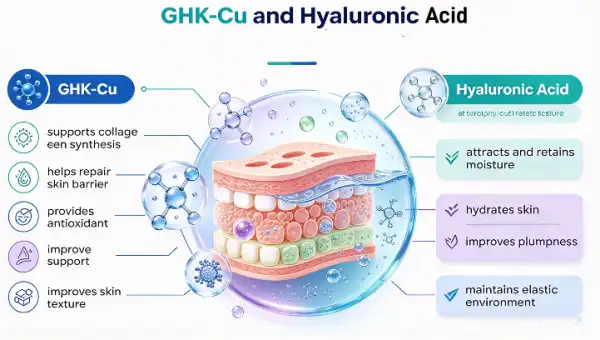
Chemical Nature and Molecular Characteristics
GHK-Cu (copper peptide) is a complex formed by the coordination of the tripeptide glycyl-L-histidyl-L-lysine (GHK) with copper ions (Cu²⁺). GHK occurs naturally in human plasma, saliva, and urine and has a strong affinity for copper ions. GHK-Cu powder is a small-molecule peptide complex with the molecular formula C₁₄H₂₁CuN₆O₄. It typically appears blue and is highly hydrophilic, with a log D of approximately −2.38 to −2.49 at pH 4.5–7.4.
Hyaluronic acid (HA) is a linear glycosaminoglycan composed of repeating units of D-glucuronic acid and N-acetyl-D-glucosamine. Hyaluronic acid powder is available in different molecular weights, ranging from several thousand to several million Daltons. Based on molecular weight, low molecular weight hyaluronic acid (LMW HA) and high molecular weight hyaluronic acid (HMW HA) exhibit different physicochemical properties and formulation applications.
Comparison of Key Characteristics Between GHK-Cu and Hyaluronic Acid
|
Comparison Criteria |
GHK-Cu |
Hyaluronic acid |
|
Chemical Classification |
Copper-binding tripeptide complex |
Linear polysaccharide (glycosaminoglycan) |
|
Molecular Formula/Structure |
C₁₄H₂₁CuN₆O₄ |
(C₁₄H₂₁NO₁₁)ₙ |
|
Molecular Weight Range |
Approximately 340 Da (complex) |
Thousands to millions of Da |
|
Appearance |
Blue powder |
White powder |
|
Solubility |
Highly hydrophilic |
Highly hydrophilic |
|
Natural Occurrence |
Plasma, saliva, urine |
Extracellular matrix, synovial fluid, skin |
Comparison of the Mechanisms of Action of GHK-Cu and Hyaluronic Acid
Mechanism of Action of GHK-Cu
GHK-Cu, also known as copper tripeptide-1, is a copper-binding peptide widely studied for its potential role in tissue remodeling, skin repair, and extracellular matrix regulation. GHK-Cu powder is commonly used as a raw material in cosmetic and personal-care formulations.
• Chemotaxis and inflammatory regulation:
GHK-Cu has been reported to support the migration of repair-related cells, including macrophages, mast cells, and cells involved in capillary formation, toward damaged tissues. Research has also investigated its effects on inflammatory mediators and oxidative stress. Studies suggest that GHK-Cu may influence levels of TNF-α and IL-6 while supporting antioxidant defense mechanisms such as superoxide dismutase activity. These findings provide a basis for further research into GHK-Cu peptide applications for skin-repair formulations.
• Extracellular matrix regulation:
A major research focus of GHK-Cu is its relationship with extracellular matrix components. Studies indicate that GHK-Cu may promote the synthesis or regulation of collagen, elastin, metalloproteinases, and their inhibitors. It has also been investigated for effects on vascular endothelial growth factor (VEGF) and fibroblast growth factor-2 (FGF-2). In keratinocytes, GHK-Cu may influence markers associated with cell proliferation and differentiation, including integrins α6 and β1, p63, and PCNA.
• Gene-expression regulation:
GHK has been studied for its ability to modulate the expression of genes involved in tissue repair, inflammation, oxidative stress, and other biological processes. Therefore, the mechanism of GHK-Cu powder is broader than a single pathway and involves multiple cellular and molecular responses.
Mechanism of Action of Hyaluronic Acid
Hyaluronic acid (HA) primarily functions through hydration, extracellular matrix support, and receptor-mediated signaling. Hyaluronic acid powder and sodium hyaluronate powder are widely used ingredients in skincare and cosmetic formulations.
• Hydration and space-filling:
HA is a highly hydrophilic polysaccharide that can bind and retain water. High molecular weight hyaluronic acid contributes to extracellular matrix structure, helping maintain tissue hydration and providing a matrix environment for other biomolecules.
• Molecular-weight-dependent signaling:
The biological activity of HA varies according to molecular weight. High molecular weight hyaluronic acid is mainly associated with hydration and structural functions, whereas low molecular weight hyaluronic acid and HA fragments have been investigated for their effects on cell signaling through receptors such as CD44.
• Inflammatory and barrier-related effects:
Different HA molecular-weight fractions may influence inflammatory and immune-related pathways. Studies of mixed high- and low-molecular-weight HA complexes have reported effects on inflammatory biomarkers and skin repair processes. These properties make hyaluronic acid powder a versatile raw material for hydration-focused and skin-care formulations.
Comparison of Stability and Formulation Characteristics
Stability Characteristics of GHK-Cu
GHK-Cu stability is strongly affected by pH and oxidative conditions. Pre-formulation studies indicate that GHK-Cu peptide may undergo hydrolytic cleavage under alkaline and oxidative conditions. However, GHK-Cu powder can remain relatively stable for at least two weeks at 60°C in water and buffers with pH 4.5–7.4. In accelerated aging tests at 50°C for one month, degradation can be limited to below 5% when the formulation pH is maintained at 5.5–6.5. Compatibility with other formulation components is also important. GHK-Cu is compatible with Span 60-based liposome-like systems but shows reduced stability with negatively charged dicetyl phosphate.
Stability Characteristics of Hyaluronic Acid
Hyaluronic acid powder generally has good stability in conventional cosmetic formulations, although molecular-weight degradation remains a key concern. High temperatures and extreme pH may cause chain scission, reducing molecular weight and changing functional properties. Sodium hyaluronate powder and other hyaluronic acid formulations can be stabilized through cross-linking or composite strategies, supporting controlled delivery in advanced skincare formulations.
Comparison of Stability and Formulation Characteristics of GHK-Cu and Hyaluronic Acid
|
Characteristics |
GHK-Cu |
Hyaluronic acid |
|
Optimal pH range |
5.5–6.5 |
Neutral to slightly acidic |
|
Thermal stability |
Stable for two weeks at 60°C (in water/buffer) |
Degrades easily at high temperatures |
|
Primary degradation pathways |
Hydrolytic cleavage, oxidation |
Chain scission (reduction in molecular weight) |
|
Formulation compatibility limitations |
Anionic lipids reduce stability |
May form complexes with cationic ingredients |
|
Common stabilization strategies |
pH control, liposomal encapsulation |
Cross-linking, complex formation |
Synergy Research
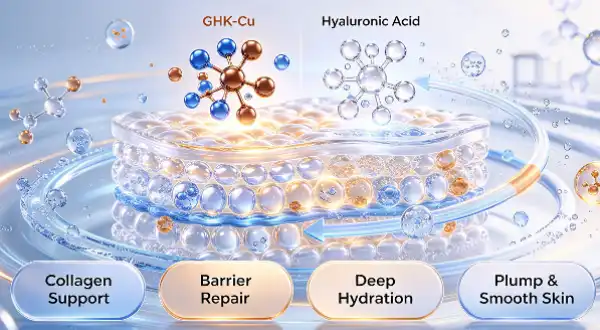
Research on the combined use of GHK-Cu and hyaluronic acid indicates potential synergistic effects in skincare formulations. A study published in the Journal of Cosmetic Dermatology investigated GHK-Cu peptide combined with hyaluronic acid powder of different molecular weights.
Molecular Weight-Dependent Effects
The study reported that hyaluronic acid molecular weight influenced its interaction with GHK-Cu. High-molecular-weight hyaluronic acid showed stronger binding with GHK-Cu as molecular weight increased, although excessive binding may affect GHK-Cu receptor interactions. Low-molecular-weight hyaluronic acid demonstrated greater antioxidant activity and helped neutralize reactive oxygen species. In fibroblast experiments, the reported strongest synergistic response occurred when GHK-Cu powder and low-molecular-weight hyaluronic acid were combined at a 1:9 ratio.
Collagen IV Upregulation
In ex vivo skin models, the combination of GHK-Cu and hyaluronic acid increased Collagen IV levels by 2.03-fold, compared with 1.56-fold for GHK-Cu alone and 1.49-fold for hyaluronic acid alone. Collagen IV is an important structural component of the dermo-epidermal junction (DEJ), which can become thinner with skin aging.
Formulation Challenges
Although cellular and ex vivo studies indicate potential synergy, practical GHK-Cu and hyaluronic acid formulations require careful delivery design. Different diffusion rates may alter the effective ratio at fibroblasts. Encapsulation approaches, including liposomal GHK-Cu, may help improve ingredient delivery and formulation consistency.
GHK-Cu and Hyaluronic Acid Uses
GHK-Cu Uses
GHK-Cu, also known as copper tripeptide-1, is mainly studied for applications related to skin repair, tissue remodeling, and anti-aging skincare. Research suggests that GHK-Cu powder may support skin firmness and elasticity while helping improve the appearance of fine lines, wrinkles, and photodamaged skin. In hair and scalp applications, GHK-Cu has also been investigated for its potential effects on hair follicles and tissue recovery. In wound-healing research, GHK-Cu has been associated with processes such as collagen synthesis, angiogenesis, and tissue regeneration.
Hyaluronic Acid Uses
Hyaluronic acid powder is primarily used for hydration, moisture retention, and extracellular matrix support. As a humectant, hyaluronic acid helps maintain skin moisture and may support the skin barrier. In biomaterial and wound-care research, hyaluronic acid-based hydrogels can provide a hydrated matrix that supports cell migration, re-epithelialization, collagen deposition, and tissue repair.
Combined Application of GHK-Cu and Hyaluronic Acid
The combination of GHK-Cu and hyaluronic acid has been investigated in advanced biomaterial systems. For example, GHK-Cu-containing hyaluronic acid hydrogels have shown potential in experimental wound-healing models. The rationale is complementary: hyaluronic acid provides hydration and matrix support, while GHK-Cu may provide biological signals associated with tissue remodeling and repair.
FAQs:
Q1.What is the difference between GHK-Cu and hyaluronic acid?
GHK-Cu is a copper-binding peptide commonly used in skincare formulations, while hyaluronic acid is a polysaccharide known for its water-binding and moisturizing properties. GHK-Cu is often selected for peptide-based formulations, whereas hyaluronic acid is primarily used as a humectant.
Q2. Is GHK-Cu better than hyaluronic acid?
GHK-Cu and hyaluronic acid have different functions, so they should not be considered direct substitutes. GHK-Cu is mainly used in peptide-focused formulations, while hyaluronic acid is widely used for hydration and moisture retention.
Q3. Can GHK-Cu and hyaluronic acid be used together?
Yes. GHK-Cu and hyaluronic acid can be incorporated into the same skincare formulation when the formulation's pH, concentration, compatibility, and stability requirements are properly evaluated.
Q4. Which is better for skin hydration, GHK-Cu or hyaluronic acid?
Hyaluronic acid is generally the more direct choice for skin hydration because it can bind and retain water. GHK-Cu is not primarily used as a moisturizing ingredient and serves a different formulation purpose.
Q5. What is GHK-Cu powder used for?
GHK-Cu powder is a copper peptide raw material used in cosmetic and personal-care formulations. Buyers may specify parameters such as purity, GHK content, copper content, particle size, packaging, and testing documentation.
Q6. What is hyaluronic acid powder used for?
Hyaluronic acid powder is commonly used as a raw material in skincare, cosmetics, and personal-care formulations. Its molecular weight and concentration can affect viscosity, hydration performance, and formulation characteristics.
Q7. Does GHK-Cu contain copper?
Yes. GHK-Cu is a copper-peptide complex in which copper is associated with the GHK peptide. For bulk GHK-Cu powder, suppliers may provide copper content and purity data on the specification sheet or COA.
Q8. Does hyaluronic acid contain copper?
No. Hyaluronic acid itself is not a copper peptide. It is a naturally occurring polysaccharide composed of repeating sugar units and does not have the copper component characteristic of GHK-Cu.
Q9. What is the difference between GHK-Cu peptide and hyaluronic acid in skincare?
GHK-Cu is a peptide-based active ingredient, while hyaluronic acid is a polysaccharide-based moisturizing ingredient. They differ in chemical structure, formulation function, analytical testing, and typical applications.
Q10. Can GHK-Cu and hyaluronic acid be combined in a serum?
Yes. A serum can contain both GHK-Cu and hyaluronic acid, provided the formulation is designed for their compatibility and stability. Manufacturers should evaluate pH, preservative systems, processing conditions, packaging, and shelf-life stability.
Summary
GHK-Cu and hyaluronic acid are distinct but complementary skin care ingredients widely used in skin repair and anti-aging formulations. GHK-Cu powder, also known as copper peptide GHK-Cu, supports tissue remodeling through cellular signaling and extracellular matrix synthesis. Hyaluronic acid powder, including sodium hyaluronate powder and low molecular weight hyaluronic acid, primarily supports skin hydration, structure, and moisture retention.
Key differences include molecular weight, formulation stability, and application requirements. GHK-Cu stability generally requires a controlled pH, while hyaluronic acid performance strongly depends on molecular weight selection. Research indicates that combining GHK-Cu with low-molecular-weight hyaluronic acid may support collagen IV expression. However, formulation stability and skin delivery remain important technical considerations. Guanjie Biotech supplies GHK-Cu powder and hyaluronic acid powder, with OEM and ODM services available.
References:
[1] Jiang, F., Wu, Y., Liu, Z., Hong, M., & Huang, Y. (2023). Synergy of GHK-Cu and hyaluronic acid on collagen IV upregulation via fibroblast and ex-vivo skin tests. Journal of Cosmetic Dermatology, *22*(9), 2598-2606. https://doi.org/10.1111/jocd.15763
[2] Pickart, L. (2008). The human tripeptide GHK and tissue remodeling. Journal of Biomaterials Science, Polymer Edition, *19*(8), 969-988. https://doi.org/10.1163/156856208784909435
[3] Kang, Y. A., Choi, H. R., Na, J. I., Huh, C. H., Kim, M. J., Youn, S. W., & Park, K. C. (2009). Copper-GHK increases integrin expression and p63 positivity by keratinocytes. Archives of Dermatological Research, *301*(4), 301-306. https://doi.org/10.1007/s00403-009-0942-x
[4] Kaya, G., Tran, C., Sorg, O., Hotz, R., Grand, D., Carraux, P., ... & Saurat, J. H. (2006). Hyaluronate fragments reverse skin atrophy by a CD44-dependent mechanism. PLoS Medicine, *3*(12), e493. https://doi.org/10.1371/journal.pmed.0030493
[5] Lee, S., Lee, S. M., Lee, S. H., Choi, W. K., Park, S. J., Kim, D. Y., ... & Chung, W. J. (2023). In situ photo-crosslinkable hyaluronic acid-based hydrogel embedded with GHK peptide nanofibers for bioactive wound healing. Acta Biomaterialia, *172*, 159-174. https://doi.org/10.1016/j.actbio.2023.10.011
[6] Functional differences of hyaluronic acid with varying relative molecular weights and progress in its application in cosmetics. (2026). *Chinese Journal of Cosmetic Science*, *1*, 82-89.
[7] Study on the transdermal permeability and anti-aging effects of copper peptide in facial masks. (2024). *Central South Pharmacy*, *22*(9).
[8] Application study of supramolecular co-solution liquids loaded with copper peptide co-crystals. (2026). *China Cosmetics*, (4).