High-purity indole-3-carbinol powder, typically ≥99.0%, is widely used as a dietary supplement ingredient and nutritional raw material. Indole-3-carbinol supports cellular health and balanced estrogen metabolism. Due to its chemical reactivity and sensitivity to hydrolysis, light, and heat, industrial production of I3C powder requires strict control of raw materials, formulation, processing, stability, and quality testing to ensure consistent purity, product stability, and regulatory compliance for dietary supplement applications.

Physicochemical Properties and Suitability for Production
Before production, high-purity indole-3-carbinol (I3C) powder should undergo comprehensive physicochemical evaluation and standardized pretreatment. These steps help ensure material uniformity, stability, and consistent performance during blending, encapsulation, and filling of indole-3-carbinol supplements.
Physicochemical Property Analysis and Quality Control
• Purity and Impurity Control:
For production-grade indole-3-carbinol powder, purity is commonly specified at 98.0%–99.5%, typically determined by HPLC. Manufacturers should also control residual solvents, including toluene and dichloromethane, according to applicable USP or EP requirements. Heavy metals, microbial limits, and other relevant contaminants should be tested according to the target market's quality standards.
• Appearance and Crystallinity:
High-quality I3C powder generally appears as a colorless to white crystalline powder. Crystallinity can affect hygroscopicity, powder flow, and storage stability. Higher crystallinity may reduce moisture uptake and help maintain indole-3-carbinol stability during processing and storage.
• Flowability and Bulk Density:
The bulk density of indole-3-carbinol raw material may typically range from 0.35 to 0.55 g/cm³, depending on particle morphology and processing conditions. Fine I3C particles may develop static electricity and agglomerate. Therefore, Carr's Index and the Hausner Ratio should be evaluated to determine I3C powder flowability and support reliable capsule or tablet manufacturing.
Formulation Process for Dietary Supplement Production
The production of dietary supplements using high-purity indole-3-carbinol powder (I3C powder) requires careful control of raw material handling, formulation, processing, packaging, and storage. The following steps provide a practical framework for manufacturers using indole-3-carbinol raw material in capsule, tablet, or other supplement formulations.
Raw Material Pre-Treatment and Weighing
Upon receipt, indole-3-carbinol powder should undergo identity verification, such as IR spectroscopy, and purity testing by HPLC. Because I3C is sensitive to light and moisture, weighing should be performed under controlled environmental conditions. Relative humidity below 45% can help reduce moisture absorption and powder clumping. After weighing, unused bulk indole-3-carbinol powder should be tightly sealed, preferably under nitrogen or argon, and stored in accordance with validated stability requirements.
Selection of Dosage Form
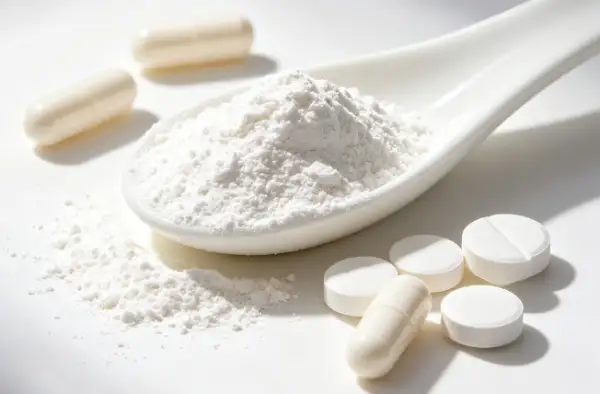
Common dosage forms for indole-3-carbinol dietary supplements include hard capsules and tablets. Hard capsules can be filled directly or after blending with suitable excipients and generally involve limited heat exposure. Tablets can be produced through direct compression or dry granulation, although processing conditions should be controlled to minimize heat and mechanical stress. Soft capsules may require an oil-based suspension, making suspension stability and formulation compatibility important considerations.
|
Dosage form |
Key Processing Points |
Suitability Assessment |
|
Hard capsules |
Direct filling of powder, or filling after mixing with excipients |
Preferred option; simple process, minimizing exposure to heat and solvents. |
|
Tablets |
Dry granulation or direct compression |
Feasible, but requires control of localized temperature rise during tableting. |
|
Soft capsules |
Filling as a suspension in an oil-based vehicle |
Suspension stability and bioavailability need to be verified. |
For many I3C supplements, hard capsules provide a straightforward manufacturing option. High-purity I3C powder can be blended with suitable fillers, such as microcrystalline cellulose, and lubricants, such as magnesium stearate, before capsule filling.
Mixing and Homogenization
Low-shear equipment, including V-type or 3D mixers, can be used to promote uniform distribution while limiting excessive heat generation. Mixing time should be established through process validation, with blend uniformity verified according to the manufacturer's specifications. If antioxidants are included, their compatibility and sequence of addition should also be evaluated.
Capsule Filling and Sealing
For indole-3-carbinol capsules, controlled humidity during filling can help maintain powder flow and reduce moisture-related problems. Capsules may be sealed using suitable methods to improve protection against oxygen and moisture. Compatibility between the capsule shell, formulation, and I3C powder should be confirmed through stability testing.
Packaging and Storage
Finished indole-3-carbinol supplements should use light- and moisture-resistant packaging. Amber containers or high-barrier blister packaging with appropriate desiccants may be considered. Storage conditions should be established according to stability data, with products generally kept in a cool, dry place away from direct light.
Key Quality Control Indicators for I3C
When high-purity I3C powder is used in the production of dietary supplements, a comprehensive quality control system must be established from raw materials to finished products. Key testing indicators include:
|
Test Items |
method |
Specification Limits |
Basis |
|
Appearance |
Visually |
White to off-white crystalline powder |
Product specifications |
|
Identification |
IR/HPLC retention time |
Conforms to reference standard |
Pharmacopoeia general chapters |
|
Purity (Assay) |
HPLC |
≥97.0% (or per specification) |
|
|
Related Substances |
HPLC |
Individual impurity ≤0.5%, total impurities ≤2.0% |
In-house standards |
|
Loss on Drying |
Drying method |
≤0.5% |
Pharmacopoeia general chapters |
|
Residue on Ignition |
incandescence |
≤0.1% |
Pharmacopoeia general chapters |
|
Heavy Metals |
ICP-MS / Colorimetry |
≤10 ppm |
Dietary supplement standards |
|
Residual Solvents |
GC |
Complies with ICH Q3C limits |
If applicable |
|
Particle Size Distribution |
laser diffraction |
Defined according to process requirements |
Process validation |
Finished product quality control also requires the addition of dosage-form-specific tests, such as uniformity of dosage units, disintegration time (for tablets), or mass variation (for capsules).
Safety and Compliance Requirements for Production
Safety and regulatory compliance are essential for pure indole-3-carbinol powder production. According to the applicable MSDS/SDS, I3C may cause skin and eye irritation and respiratory irritation if inhaled. Production facilities should use local exhaust ventilation, dust-control systems, and adequate general ventilation. Operators should wear suitable dust masks, chemical-resistant gloves, and safety goggles.
Manufacturers should minimize I3C powder dust generation, prevent accumulation, and store the material away from ignition sources and strong oxidizing agents.
For indole-3-carbinol dietary supplement manufacturing, regulatory requirements vary by market. U.S. facilities should follow applicable FDA requirements, including 21 CFR Part 111 GMP requirements. Manufacturers should maintain batch records, specifications, change-control procedures, deviation management, and quality testing to support consistent high-purity indole-3-carbinol powder production and regulatory compliance.
FAQs:
Q1: Why do supplement manufacturers choose high-purity Indole-3-Carbinol powder?
High-purity Indole-3-Carbinol powder provides better batch consistency, accurate dosing, and reliable quality control for dietary supplement production. Manufacturers often require I3C with high assay purity, low impurities, and complete documentation, including COA, MSDS, and third-party testing reports.
Q2: What dosage forms can be made with I3C powder?
I3C powder can be used to manufacture various supplement forms, including hard capsules, tablets, sachets, powders, and customized blends. The choice of dosage form depends on the product concept, target market, serving size, and compatibility with other active ingredients.
Q3: How is Indole-3-Carbinol powder incorporated into supplement formulas?
During dietary supplement manufacturing, Indole-3-Carbinol bulk powder is accurately weighed and blended with other ingredients such as vitamins, minerals, herbal extracts, or excipients. Proper mixing processes help achieve uniform distribution and consistent dosage in each capsule or tablet.
Q4: Is I3C powder suitable for OEM and ODM supplement production?
Yes. High-quality I3C powder is commonly used in OEM and ODM dietary supplement projects. Ingredient suppliers can provide customized solutions, including different specifications, packaging options, private label services, and formulation support based on customer requirements.
Q5: How should I3C Indole-3-Carbinol powder be stored?
Bulk Indole-3-Carbinol powder should generally be stored in a cool, dry place away from moisture, heat, and direct light. Proper packaging, such as sealed bags or containers with moisture protection, helps maintain stability and extend shelf life during storage and transportation.
Q6: Can I3C powder be combined with other nutraceutical ingredients?
Yes. Pure indole-3-Carbinol I3C powder is often combined with complementary nutraceutical ingredients, including DIM, vitamins, minerals, and botanical extracts. Manufacturers should evaluate ingredient compatibility, stability, and regulatory requirements when developing multi-ingredient dietary supplements.
Q7: What factors should buyers consider when sourcing I3C Indole-3-Carbinol powder?
Buyers should evaluate the bulk indole-3-Carbinol supplier's manufacturing capabilities, quality control system, testing methods, certifications, documentation support, and customization services. Consistent supply capacity and transparent quality information are important for long-term dietary supplement production.
Conclusion
Producing high-purity indole-3-carbinol powder requires a dry-processing approach that protects the raw material from air, light, and heat. Hard capsule filling can reduce processing risks, while quality control should monitor purity, related substances, dosage accuracy, and finished-product performance. Controlled temperature, oxygen and light protection, dust control, and suitable packaging are important throughout the supply chain. Guanjie Biotech is an indole-3-carbinol powder supplier offering OEM and ODM services for dietary supplement manufacturers. Our I3C powder is produced using an advanced toluene-free process, featuring higher crystallinity and a whiter appearance than standard products. Customizable crystal morphology is also available to meet different formulation and manufacturing requirements for bulk indole-3-carbinol applications. Welcome to enquire with us at info@gybiotech.com.
References:
[1] Broadbent, T. A., & Broadbent, H. S. (1998). The chemistry and pharmacology of indole-3-carbinol (indole-3-methanol) and 3-(methoxymethyl)indole. [Part I]. Current Medicinal Chemistry, *5*(5), 337-352.
[2] Auborn, K. J., Fan, S., Rosen, E. M., Goodwin, L., Chandraskaren, A., Williams, D. E., Chen, D., & Carter, T. H. (2003). Indole-3-carbinol is a negative regulator of estrogen. The Journal of Nutrition, *133*(7 Suppl), 2470S-2475S.
[3] Anderton, M. J., Jukes, R., Lamb, J. H., Manson, M. M., Gescher, A., & Steward, W. P. (2003). Liquid chromatographic assay for the simultaneous determination of indole-3-carbinol and its acid condensation products in plasma. Journal of Chromatography B, *787*(2), 281-291.
[4] Luo, Y., Wang, T. T. Y., Teng, Z., Chen, P., Sun, J., & Wang, Q. (2013). Encapsulation of indole-3-carbinol and 3,3′-diindolylmethane in zein/carboxymethyl chitosan nanoparticles with controlled release property and improved stability. Food Chemistry, *139*(1-4), 224-230.
[5] Gehrcke, M., Giuliani, L. M., Ferreira, L. M., Barbieri, A. V., Sari, M. H. M., da Silveira, E. F., & Cruz, L. (2017). Enhanced photostability, radical scavenging and antitumor activity of indole-3-carbinol-loaded rose hip oil nanocapsules. Materials Science and Engineering: C, *74*, 279-286.
[6] National Toxicology Program. (2014). NTP Technical Report on the Toxicology Studies of Indole-3-carbinol (CASRN 700-06-1) in F344/N Rats and B6C3F1/N Mice (TR-584). National Institutes of Health.
[7] U.S. Food and Drug Administration. (2026). Current Good Manufacturing Practice in Manufacturing, Packaging, Labeling, or Holding Operations for Dietary Supplements. *21 CFR Part 111*.
[8] International Council for Harmonisation. (2024). ICH Q3C(R9): Guideline for Residual Solvents. European Medicines Agency.