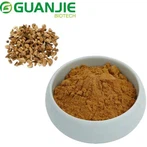
Spermidine is a naturally occurring polyamine widely found in animal, plant, and microbial cells. It has attracted growing attention in the nutraceutical industry due to its potential roles in supporting autophagy, healthy aging, and cardiovascular wellness. As demand for spermidine ingredients for supplements continues to increase, formulation selection has become an important consideration for manufacturers and consumers. Spermidine powder and spermidine capsules are the two major product forms, with differences in dosage flexibility, stability, bioavailability, processing requirements, and application scenarios. Understanding these factors helps optimize nutraceutical spermidine ingredient supplement development.
Physicochemical Properties of Spermidine and Dosage Form Design Considerations
Spermidine (C₇H₁₉N₃, molecular weight 145.2) is a polyamine compound with unique physicochemical properties that influence its formulation development. The free-base form is a liquid at room temperature, with a melting point of approximately 22–25°C and high water solubility. Due to its hygroscopic characteristics and limited stability in liquid form, commercial spermidine products commonly use spermidine trihydrochloride powder as a stable raw material with purity above 98%.
For spermidine powder formulations, manufacturers can combine the ingredient with suitable excipients to improve flowability, stability, and processing performance. However, moisture control and protective packaging are essential during production and storage. Spermidine capsules provide convenient dosing and additional protection from environmental humidity through the capsule shell. Both dosage forms require careful evaluation of ingredient compatibility, moisture resistance, and quality control to ensure consistent performance in nutraceutical and supplement applications.
Differences in Bioavailability Across Spermidine Dosage Forms: Current Evidence and Research Gaps
Spermidine bioavailability is a key factor when selecting suitable dosage forms for nutraceutical applications. Current pharmacokinetic research shows that orally consumed spermidine undergoes complex metabolism. A randomized, placebo-controlled, triple-blind crossover study found that a daily intake of 15 mg spermidine in healthy volunteers did not significantly increase plasma spermidine levels, while spermine levels increased substantially, suggesting metabolic conversion before systemic circulation.
For spermidine powder and spermidine capsules, differences in absorption may depend on formulation characteristics. Powder forms may disperse faster in gastrointestinal fluids, while capsule performance is affected by shell materials, fill density, and disintegration time. However, direct clinical comparisons between bulk spermidine powder and capsules remain limited. Further studies evaluating Cmax, Tmax, half-life, and AUC are needed to clarify how dosage forms influence spermidine absorption and bioavailability.
Spermidine Stability and Storage: Powder vs Capsule Formulations
Spermidine powder stability is strongly affected by hygroscopicity and oxidation risks. Due to its high surface area, bulk spermidine powder can easily absorb moisture from the environment if packaging is insufficient, leading to caking, reduced flowability, and inconsistent dosage accuracy. Proper moisture-resistant packaging, low-humidity storage, and antioxidant protection can help maintain the quality of high-purity spermidine powder.
Spermidine capsule formulations provide an additional physical barrier through the capsule shell, but they are not completely moisture-proof. HPMC capsules generally offer better moisture control than gelatin capsules because of their lower water content. However, highly hygroscopic spermidine ingredients may still interact with capsule materials during long-term storage. Therefore, the stability of spermidine supplements depends on the complete packaging system, including capsule material, sealing technology, storage conditions, and quality control measures. For nutraceutical manufacturers, selecting reliable spermidine suppliers with strict stability testing is essential.
|
Stability Dimensions |
Spermidine powder |
Spermidine Capsules |
|
Moisture Absorption Risk |
High (direct exposure) |
Medium (capsule shell provides a partial barrier) |
|
Oxidation Risk |
Medium-high (high specific surface area) |
Medium (influenced by the barrier properties of the shell material) |
|
Caking Tendency |
High |
Low (contents are physically constrained) |
|
Packaging Dependency |
Extremely high (requires high-barrier packaging) |
High (synergy between shell material and outer packaging) |
Manufacturing and Dosage Flexibility of Spermidine Powder and Capsules
The manufacturing process of spermidine powder is relatively simple and cost-effective. It typically involves raw material processing, pulverization, sieving, blending, and packaging. Due to lower production complexity and investment requirements, bulk spermidine powder is suitable for flexible formulation development and customized nutraceutical applications. Powder formats also provide greater spermidine dosage flexibility, allowing manufacturers and consumers to adjust serving sizes or mix the ingredient into beverages, functional foods, and other supplement products.
In contrast, spermidine capsules require additional manufacturing steps, including precise blending, capsule filling, sealing, and quality inspection. Accurate filling is especially important for low-dose spermidine products, such as 1–5 mg per capsule, where equipment precision directly affects dosage consistency. However, capsules provide standardized dosing, making them suitable for clinical studies and commercial supplement formulations.
Capsule delivery systems also support combination products by combining spermidine with ingredients such as NAD+ precursors, nicotinamide, or niacin. Although powder blends offer formulation flexibility, differences in particle size, density, and flowability may create challenges in achieving uniform distribution. Therefore, both spermidine powder and capsules offer unique advantages depending on application requirements, production scale, and market needs.
Spermidine Powder and Capsules Uses
Consumer compliance is an important factor when choosing a spermidine supplement dosage form.

• Spermidine capsules
Spermidine capsules provide excellent convenience and precise dosing, requiring no measuring or preparation before use. They are easy to carry, suitable for daily supplementation, and help consumers maintain consistent intake during long-term use. These advantages make spermidine capsules a popular choice for dietary supplement formulations.
• Spermidine powder
In comparison, spermidine powder offers greater flexibility in product development and daily applications. Bulk spermidine powder can be mixed into protein shakes, fruit juices, vegetable drinks, smoothies, or yogurt, making it suitable for consumers who prefer customized supplementation or have difficulty swallowing capsules. For functional foods and beverages, spermidine powder is often the preferred ingredient format. In addition, high-purity spermidine powder generally provides a lower cost per equivalent active dose, making it attractive for manufacturers and consumers seeking cost-effective spermidine supplement solutions. High-quality spermidine powder suppliers can also provide customized specifications for different applications.
|
Dosage Form Considerations |
Spermidine powder |
Spermidine capsules |
|
Dose flexibility |
High (adjustable dosage, can be taken in divided doses) |
Low (fixed dosage) |
|
Ease of administration |
Requires weighing/dissolving |
High (swallowed directly) |
|
Taste/Sensory attributes |
Potentially unpleasant (bitter/astringent taste) |
Masked by capsule shell |
|
Compatibility in combination formulations |
Medium (requires ensuring uniform mixing) |
High (fixed-dose combination validated) |
|
Unit cost |
Low |
Medium-High |
FAQs:
Q1. What is the difference between spermidine powder and spermidine capsules?
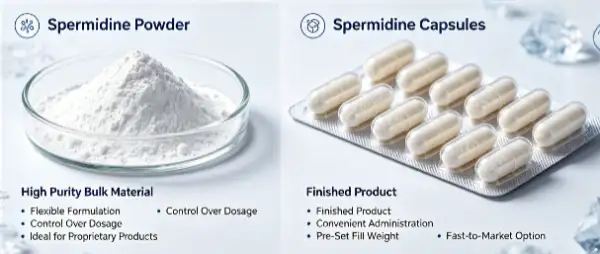
Spermidine powder is a raw ingredient form commonly used by supplement manufacturers for customized formulations. Spermidine capsules are finished dosage forms that offer convenient consumption. Powder provides more flexibility for dosage adjustment, blending, and product development, while capsules simplify packaging and reduce formulation complexity.
Q2. Which is better for supplement manufacturers, spermidine powder or capsules?
The choice depends on product requirements. Spermidine powder is suitable for manufacturers developing customized supplements, including capsules, tablets, sachets, and blends. Spermidine capsules are preferred for ready-to-market products requiring simple production and faster commercialization. Bulk spermidine powder offers greater formulation control and cost flexibility.
Q3. What formulation factors should be considered when using spermidine powder?
Key considerations include active ingredient concentration, dosage accuracy, powder flowability, moisture control, particle size, and compatibility with other ingredients. Manufacturers should evaluate stability, packaging requirements, and quality specifications when developing spermidine supplements with bulk spermidine powder.
Q4. Can spermidine powder be used to make capsules and tablets?
Yes. High-quality spermidine powder can be used as a raw material for capsule and tablet manufacturing. During formulation, manufacturers need to consider excipients, mixing uniformity, compression properties, and the stability of spermidine during processing and storage.
Q5. Does spermidine powder have better formulation flexibility than spermidine capsules?
Yes. Spermidine powder provides greater flexibility because manufacturers can adjust dosage, combine it with vitamins, minerals, plant extracts, or other nutraceutical ingredients. It is commonly selected for OEM and ODM supplement development where customized formulas are required.
Q6. Are spermidine capsules easier to produce than powder-based supplements?
Spermidine capsules can reduce some production steps because the active ingredient is already enclosed in a dosage form. However, manufacturers still need to evaluate capsule size, filling accuracy, ingredient compatibility, and regulatory requirements before commercialization.
Q7. How should spermidine powder be stored during supplement production?
Spermidine powder should generally be stored in a cool, dry environment away from moisture, heat, and direct light. Proper packaging, sealed containers, and quality testing help maintain ingredient stability during storage and transportation.
Q8. What quality tests are important for spermidine powder suppliers?
Reliable spermidine powder suppliers typically provide quality documentation, including specification sheets, COA, purity testing, and contaminant analysis. HPLC testing is commonly used for active ingredient identification and content determination to ensure batch consistency.
Q9. Can spermidine powder and spermidine capsules have the same dosage?
They can contain the same active amount, but dosage depends on the product formulation. Powder allows manufacturers to customize serving sizes, while capsules have limitations based on capsule capacity and excipient requirements.
Q10. Where can manufacturers buy high-quality bulk spermidine powder?
Supplement manufacturers can source bulk spermidine powder from experienced nutraceutical ingredient suppliers that provide consistent quality, technical documentation, and customization support. Suppliers with advanced testing systems and OEM/ODM capabilities can help develop spermidine capsules, tablets, and other supplement formats.
Summary:
Selecting between spermidine powder and spermidine capsules depends on product positioning, target consumers, formulation requirements, and application scenarios rather than simply determining which form is better. For supplement manufacturers, understanding the advantages of each dosage form helps optimize spermidine supplement formulation and product development strategies.
• Spermidine powder
Natural Spermidine powder is suitable for applications requiring flexible dosage adjustment, weight-based dosing, or incorporation into functional foods and beverages. It allows manufacturers to create customized formulations, control production costs, and conduct small-batch trials during the product development stage. Pure spermidine powder is also preferred for companies developing drink mixes, nutrition powders, and customized supplement blends.
• Spermidine capsules
Spermidine capsules are preferred when precise dosing, convenience, and standardized delivery are priorities. Capsules provide a fixed serving size, improve consumer acceptance, and help mask the taste or odor of spermidine ingredients. They are commonly used in dietary supplements, combination formulas, and research-based products requiring consistent dosage control.
A growing trend among supplement brands is offering both spermidine supplement ingredient powder and capsule formats. This dual-format strategy allows companies to meet different consumer preferences while expanding market opportunities. Powder products provide flexibility for food and beverage applications, while capsules offer convenience and accurate dosing.
Guanjie Biotech is a professional spermidine powder supplier providing high-quality spermidine raw materials for global dietary supplement manufacturers. The company offers OEM and ODM services, including custom formulations, ingredient specifications, capsule filling solutions, and packaging options. As a reliable spermidine manufacturer, Guanjie Biotech supports capsule product development with customized blends, capsule materials, and dosage requirements. Supported by strict quality control systems, advanced testing equipment, and consistent production management, we ensure high purity, stability, and batch-to-batch reliability for bulk spermidine powder and finished supplement applications.
References:
[1] Senekowitsch S, Wietkamp E, Grimm M, et al. High-Dose Spermidine Supplementation Does Not Increase Spermidine Levels in Blood Plasma and Saliva of Healthy Adults: A Randomized Placebo-Controlled Pharmacokinetic and Metabolomic Study. Nutrients. 2023;15(8):1852. doi:10.3390/nu15081852
[2] Keohane P, Everett JR, Pereira R, et al. Supplementation of spermidine at 40 mg/day has minimal effects on circulating polyamines: An exploratory double-blind randomized controlled trial in older men. Nutr Res. 2024;132:1-14. doi:10.1016/j.nutres.2024.09.012
[3] Chrysea. Bioavailability of Spermidine in Healthy Males. ClinicalTrials.gov identifier: NCT06017219. Updated August 29, 2024
[4] Rhodes CH, Hong BV, Tang X, et al. Absorption, anti-inflammatory, antioxidant, and cardioprotective impacts of a novel fasting mimetic containing spermidine, nicotinamide, palmitoylethanolamide, and oleoylethanolamide: A pilot dose-escalation study in healthy young adult men. Nutr Res. 2024;132:125-135. doi:10.1016/j.nutres.2024.10.006
[5] Xu YJ, et al. Simultaneous determination of endogenous and orally administered (15)N-labeled polyamines in rat organs. Anal Biochem. 2002;301(2):255-260. doi:10.1006/abio.2001.5510
[6] Enriching polyamine enrichment from wheat germs: A study utilizing response surface methodology and liquid chromatography-mass spectrometry. Food Chem. 2024. doi:10.1016/j.foodchem.2024.030589
[7] Potential use of glycerol- and/or spermidine-plasticized secalin films as leaf surface coatings. J Clean Prod. 2021. doi:10.1016/j.jclepro.2021.036404
[8] U.S. Food and Drug Administration. FDA 101: Dietary Supplements. Updated March 2, 2025
[9] U.S. Food and Drug Administration. Dietary Supplements Guidance Documents & Regulatory Information. Updated December 10, 2025