Identifying authentic bulk ginseng extract is a critical step in ensuring its quality and potency. The identification method can be carried out from the appearance, chemical analysis, physical and chemical properties, biological activity and other aspects.

1. Colour
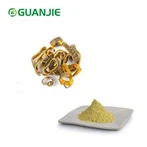
The colour of genuine ginseng extracts usually ranges from light yellow to dark brown, whereas forgeries may be unevenly coloured or too bright, which may be the result of the addition of artificial colouring.
2. Form
Genuine ginseng extract is usually in powder form with uniform texture. Fake ginseng extracts may have granularity or be mixed with impurities.
3. Odor
Genuine bulk ginseng extract has the characteristic smell of ginseng, which is fragrant and herbal. Fake ginseng bulk extracts may not have a distinctive odour or may have a pungent odour, which indicates that artificial flavourings may have been added.
4. Solubility:
Bulk extract ginseng powder dissolves easily in water and forms a clear or slightly turbid solution.
Fake ginseng bulk extracts may not dissolve easily in water. Or it may form precipitate or suspension after dissolution.
5. Moisture determination:
The moisture content of genuine ginseng extract is low, usually below 5%. False ginseng extracts may have higher moisture content and are prone to mould and deterioration.
6. Ash determination:
Genuine ash content is low, usually below 3%. Fake ginseng root extracts may have a higher ash content, indicating that they are less pure and contain more impurities.
7. pH Determination:
Genuine pH is usually between 5.0 and 7.0. Counterfeit pH may deviate from this range and exhibit a distinct acidic or alkaline character.
Authentication of Ginseng Extract
Ginseng belongs to the family of plants. It belongs to the same family and has different species of plants. Such as, American ginseng and Panax ginseng. These ingredients are also more common herbs. Because of the harsh growing conditions and the difficulty of artificial cultivation, the price of ginseng root and Panax ginseng root are the most expensive raw materials.
Ginseng root/stem and leaves, American ginseng root/stem and leaves, and Panax ginseng root/stem and leaves all contain ginsenosides of similar composition. The ginsenoside content of bulk ginseng extract is often calculated as the sum of seven saponin monomers, Rg1+Re+Rf+Rb1+Rc+Rb2+Rd. The content of ginseng is often calculated as the sum of five saponin monomers, Rg1+Re+Rb1+Rc+Rb2+Rd. There are two algorithms for the content of Panax ginseng. One is to R1 + Rg1 + Rb1 the three saponin monomers to calculate. The other is calculated as the sum of the five monomers R1+Rg1+Re+Rb1+Rd. The above assay method to calculate the content of the sum of saponin monomers is High-Performance Liquid Chromatography or HPLC for short.
● HPLC Testing
In addition to HPLC, there is also a UV-visible spectrophotometric method for the determination of ginsenoside content in Wujiake plant products, using Re as the control, which was initially referred to from the Chinese Pharmacopoeia (Ginseng Stem and Leaf Total Saponin). The method uses the absorbance value of ginsenoside Re as the reference for the standard curve. The absorbance value of the sample is then used to calculate the total saponin content. The results of this method are often higher than those of HPLC. Because the HPLC method only calculates the sum of several target ginsenosides. However, the plant is rich in components other than these target saponins, but with a similar structure, and thus can contribute to the UV absorption value. This leads to results where UV assay data are often higher than HPLC data. In the case of ginseng stem and leaf extracts, for example, the content of the bulk ginseng extract standard specification in circulation is 40-45% by HPLC. By UV method, the content is usually in the range of 75-85%.
Compared with the HPLC method, the UV detection method has low equipment cost and relatively simple operation. Therefore, it is also widely used. However, the UV detection method has no specificity and cannot decompose the components in the sample. As a result, it leads to the emergence of some indiscriminate phenomenon in the market, which is false to the truth. For example, bulk ginseng powder with 10 times price difference; ginseng extract with American ginseng extract; and even ginseng extract bulk with American ginseng stem and leaf extract. Guanjie Biotech, with nearly ten years of research and development on bulk supplements ginseng, has fully mastered the way to deal with different scams, and shared the following common methods to identify the authenticity of ginseng as follows:
● TLC identification

- Comparison of the similarity of the chromatogram unfolding.
- The presence or absence of ginsenoside Rf spots:
Ginsenoside Rf is a unique saponin component in bulk ginseng extract, and this method can effectively differentiate ginseng extracts from other extracts of Wujiake family sources.
● High-performance liquid chromatography (HPLC) analysis

- Control herb comparison:
Extracts should have peak shapes that appear in equal proportions at the same relative retention time as the control herb.
- Ginsenoside Rf Comparison:
As mentioned above, ginsenoside Rf is a unique saponin component in ginseng. Normal ginseng root extract should have a small area of peak at the corresponding position, while other Wujiake family plants do not have it at the same position.
- Indicator content comparison:
Ginseng root and stem and leaves originate from different parts of the same plant. The constituent species on ginsenosides are the same. However, the proportion of each component is quite different. This method can identify bulk ginseng extract and ginseng stem and leaf extract. For the difficult scam of adding ginseng stem and leaf extract to ginseng root extract, Guanjie Biotech can also easily calculate the proportion of stem and leaf added with the database accumulated for many years.
Guanjie Biotech has focused on bulk ginseng extract for 20 years. We specialise in ginseng bulk extract. High quality and competitive price. Welcome to enquiry us at info@gybiotech.com.