Removing esculin from horse chestnut extract powder is a critical step in producing safe, standardized, and commercially viable extracts, particularly those intended for dietary supplements, pharmaceuticals, or cosmetic formulations. Esculin, a coumarin glycoside naturally present in horse chestnut (Aesculus hippocastanum), is associated with potential toxicity when consumed in significant amounts. Therefore, its removal or reduction is essential to ensure product safety and regulatory compliance, especially since the desired active compound in horse chestnut extract powder is typically aescin (also spelled escin), which provides vascular and anti-inflammatory benefits. So, how to remove esculin from horse chestnut extract?

How To Remove Esculin From Horse Chestnut Extract?
Removing esculin from horse chestnut extract powder involves a multi-stage purification process rather than a single step. It begins with raw material pretreatment, followed by primary extraction to obtain the crude extract. Esculin is then reduced through liquid-liquid partitioning, where polarity differences separate it from aescin. Further purification can be achieved using adsorption resins or chromatography, with optional recrystallization or membrane filtration for higher purity. The process concludes with drying and standardization to ensure consistent quality. Each stage is carefully designed to minimize esculin content while preserving the beneficial aescin, producing a safe and effective extract.
Raw Material Pretreatment
The production of high-quality horse chestnut extract powder starts with careful selection of premium seeds. Initially, the seeds are thoroughly cleaned to remove dust, debris, and other impurities. They are then dried under controlled temperature and humidity conditions to preserve active compounds and prevent microbial growth. Once dried, the seeds are ground into a fine powder, which increases the surface area and enhances extraction efficiency. In some processes, a defatting step is included, where non-polar solvents such as hexane or petroleum ether are used to remove lipophilic substances like oils and waxes. This pretreatment not only reduces unwanted impurities but also optimizes the extraction of the target active component, aescin, in subsequent steps. High-quality pretreatment ensures that the final horse chestnut extract is safe, potent, and consistent in efficacy.
Solvent Extraction
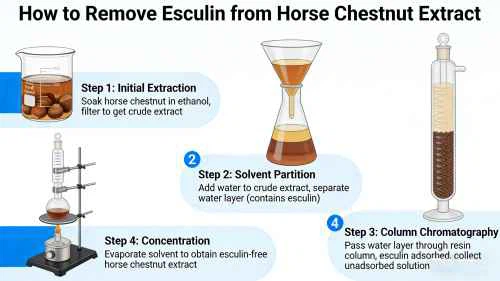
The first step in processing horse chestnut extract powder involves using 50–70% aqueous ethanol as the solvent. This solvent system is preferred because it effectively dissolves aescin, the active compound, while also extracting esculin, which must be removed in later steps. The extraction is conducted under carefully controlled conditions, typically at 50–70°C with continuous agitation to ensure maximum yield. Once the extraction is complete, the mixture is filtered to separate insoluble materials, resulting in a crude extract that contains both aescin and esculin, ready for further purification to reduce unwanted components.
Liquid-Liquid Partitioning
Liquid-liquid extraction is an effective method to remove esculin by exploiting polarity differences. Esculin is highly water-soluble, while aescin is less polar and dissolves in organic solvents. In practice, the crude horse chestnut extract is diluted with water and extracted using solvents like ethyl acetate or n-butanol. During this process, esculin stays mostly in the aqueous phase, and aescin migrates into the organic phase. Separating the organic layer effectively reduces esculin content, enriching the extract with aescin for safer, higher-quality formulations.
Adsorption Resin Purification
Macroporous adsorption resins are commonly employed for industrial-scale purification of horse chestnut extract powder. Typical resins include AB-8, D101, and HPD series, which work by selectively adsorbing compounds according to their polarity and molecular size. In practice, the crude extract is loaded onto the resin column, then washed with water to remove hydrophilic impurities such as esculin. Afterward, ethanol is used to elute and recover the target compound, aescin. This method is highly efficient, cost-effective, and scalable, making it ideal for large-scale production. Guanjie Biotech uses this technique to ensure their horse chestnut extracts are high-purity, standardized, and meet rigorous quality standards.
Column Chromatography
For applications requiring high-purity horse chestnut extract, column chromatography is an effective method. Common types include silica gel chromatography and reverse-phase C18 chromatography. In this process, the extract is applied to the column, and compounds are separated using solvent gradients such as methanol-water mixtures. Esculin and aescin separate based on their differing affinities for the stationary phase, allowing for precise removal of esculin. While highly efficient, column chromatography is more costly and is generally reserved for pharmaceutical-grade extracts rather than large-scale bulk production, making it suitable for specialized, high-quality formulations.
Membrane Filtration Technology
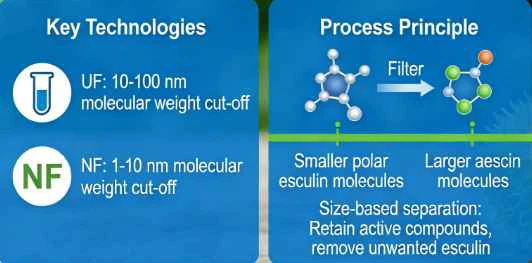
Modern horse chestnut extract powder production increasingly adopts membrane filtration technologies, including ultrafiltration (UF) and nanofiltration (NF), to remove unwanted compounds like esculin. These methods offer significant advantages: they eliminate the need for chemical solvents, are energy-efficient, and allow continuous operation. The process works by separating molecules based on size and molecular weight-esculin, being smaller and more polar, is selectively removed while retaining larger active compounds like aescin. This solvent-free, precise approach aligns with green extraction trends and is especially suitable for producing high-purity extracts, meeting both safety and quality standards efficiently.
Recrystallization
Recrystallization is sometimes employed as a final polishing step to increase the purity of pure horse chestnut extract powder. In this process, the purified extract is dissolved in an appropriate solvent, and controlled cooling allows aescin to crystallize. Esculin, being more soluble, stays in the solution and is removed. This technique effectively enriches aescin content, producing a high-purity extract, though it may slightly reduce overall yield due to some loss of material during crystallization.
Enzymatic Degradation (Emerging Method)
Recent studies have investigated using enzymes to reduce esculin content by converting it into safer compounds. Specifically, β-glucosidase can hydrolyze esculin into esculetin and glucose. This approach offers a targeted and environmentally friendly alternative to chemical methods. However, despite its potential, enzymatic degradation is not yet widely implemented in industrial-scale bulk horse chestnut extract powder production because of high costs, technical complexity, and challenges in scaling the process efficiently.
Quality Control and Testing
After purification, strict quality control is vital to ensure safety and consistency. Common analytical techniques include High-Performance Liquid Chromatography (HPLC), UV-Vis spectrophotometry, and Thin-Layer Chromatography (TLC). Among these, HPLC is the preferred method for accurately measuring aescin content and detecting residual esculin. High-quality horse chestnut extract powder typically meets strict specifications, with aescin levels standardized between 16–20% and esculin minimized to trace amounts or below detectable limits. These rigorous testing protocols guarantee that the final product is both safe and effective for consumer use.
Why removing Esculin Is Necessary?
From both toxicological and regulatory perspectives, the removal of esculin from natural horse chestnut extract powder is essential to ensure product safety and compliance. Raw horse chestnut seeds naturally contain several bioactive compounds, including esculin and fraxin, which can pose health risks if consumed without proper processing. Esculin, in particular, is considered undesirable due to its potential toxicity and its classification within coumarin derivatives, which are subject to strict regulatory control in many global markets.
• Safety And Regulatory Requirements
One of the primary reasons for removing esculin is to meet safety and regulatory requirements. Authorities across Europe, the United States, and Asia enforce limits on coumarin-related compounds in food, dietary supplements, and pharmaceutical products. Failure to adequately reduce esculin content can result in non-compliance, restricting market access, and posing potential health risks to consumers.
• Product Standardization
Another key factor is product standardization. High-quality horse chestnut extract powder is typically standardized to contain 16–20% aescin, the main active compound responsible for vascular and anti-inflammatory benefits. Achieving this specification requires the removal of non-target substances like esculin, ensuring a consistent and reliable product profile.
• Improves The Sensory Characteristics
In addition, eliminating esculin significantly improves the sensory characteristics of the extract. Esculin contributes a pronounced bitter taste, which can negatively affect the palatability of finished products, particularly in functional foods and oral supplements.
• Overall Purity And Functional Performance
Finally, reducing esculin enhances the overall purity and functional performance of the extract. By removing unnecessary or potentially interfering compounds, manufacturers can improve the bioavailability and efficacy of aescin, resulting in a more effective and higher-quality ingredient suitable for a wide range of applications.
Conclusion
Removing esculin from horse chestnut extract powder is a technically demanding but essential process. It involves a combination of solvent extraction, phase separation, adsorption, and advanced purification techniques. The goal is to produce a high-purity extract rich in aescin while minimizing potentially harmful components like esculin.
Among the various methods, liquid-liquid extraction and macroporous resin adsorption are the most widely used due to their balance of efficiency, scalability, and cost-effectiveness. Advanced techniques such as membrane filtration and chromatography further enhance purity for specialized applications.
Guanjie Biotech plays an important role in this industry by employing optimized extraction technologies and strict quality control systems. As a professional horse chestnut extract supplier, we ensure that our horse chestnut extract powder products meet global safety standards while delivering consistent potency and performance. Welcome to enquire with us at info@gybiotech.com.
Ultimately, the removal of esculin is not just a technical requirement but a fundamental step in transforming raw botanical material into a safe, effective, and market-ready ingredient.
References
[1] Hostettmann, K., & Marston, A. (1995). Saponins. Cambridge University Press. pp. 225–230. - Discusses chemical properties and extraction of saponins, including aescin from horse chestnut.
[2] Högger, P., & Suter, A. (2001). Pharmacokinetics and metabolism of aescin. Planta Medica, 67(6), 544–548. - Provides insight into the bioactive compounds and the need for esculin removal in extracts.
[3] European Medicines Agency (EMA). (2017). Assessment report on Aesculus hippocastanum L., seed extract. EMA/HMPC/1234. - Regulatory guidelines on coumarin glycosides, including esculin.
[4] Li, J., Zhang, H., & Chen, Y. (2010). Optimization of macroporous resin purification of aescin from horse chestnut seeds. Journal of Chromatography B, 878(28), 2801–2806. - Details industrial purification using adsorption resins.
[5] Silva, F., & Costa, R. (2015). Removal of coumarin derivatives from botanical extracts: Liquid-liquid partitioning and recrystallization techniques. Industrial Crops and Products, 65, 45–52. - Discusses practical methods for reducing esculin content.
[6] Zhang, W., Li, M., & Wang, X. (2018). Application of membrane filtration in herbal extract purification. Separation and Purification Technology, 194, 173–182. - Reviews ultrafiltration and nanofiltration for selective compound removal.
[7] Chen, L., & Zhao, Y. (2020). Enzymatic hydrolysis of esculin in horse chestnut extracts. Journal of Natural Products, 83(7), 2105–2112. - Explores emerging enzymatic methods to degrade esculin.