In the development and production of β-nicotinamide mononucleotide NMN products, dosage form selection directly affects raw material stability, bioavailability, production process compatibility, and the market performance of the end product. For B2B food and health industry clients, understanding the differences between nicotinamide mononucleotide NMN powder and capsule dosage forms helps in making reasonable raw material procurement and formulation design decisions based on target application scenarios. Is NMN Better In Powder or Capsules?

How Many Forms Does NMN Have?
NMN powder refers to the raw material form without encapsulation, usually existing as crystalline powder or freeze-dried powder cake. Its preparation process ends with a dried powder, without involving additional encapsulation or molding processes. Guanjie Biotech supplies bulk nicotinamide mononucleotide NMN powder using freeze-drying and vacuum drying technologies. These two processes remove moisture under low-temperature conditions, reducing the damage to the NMN molecular structure caused by high temperatures, ultimately obtaining a high-purity powder product with low residual solvents.
Capsule dosage forms require mixing bulk NMN powder with excipients such as lubricants, glidants, and fillers, and then filling them into gelatin or hydroxypropyl methylcellulose (HPMC) shells using capsule filling equipment. This process adds quality control steps such as verifying mixing uniformity, controlling filler volume variation, and testing capsule sealing. From a process complexity perspective, capsule production requires additional equipment investment (such as capsule filling machines, polishing machines, and metal detectors) and excipient costs, and the production cycle is longer than direct powder packaging.
Is NMN Better In Powder or Capsules?
NMN Powder & Capsules:
NMN molecules are prone to degradation under conditions of high temperature, high humidity, strong acids and alkalis, and the presence of certain metal ions. Stability is a core parameter determining the shelf life of the raw material.
• NMN Powder Formulation:
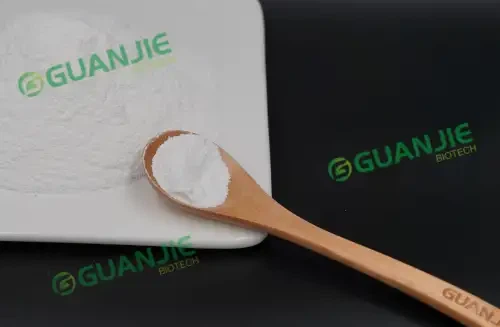
NMN bulk powder has a large exposed surface area. If the packaging is not sealed, it can come into contact with moisture and oxygen in the air. Experimental data show that under open conditions of 25℃ and 60% relative humidity. NMN nicotinamide mononucleotide powder can degrade by 3-5% within 30 days. Therefore, nicotinamide mononucleotide NMN powder formulations require high-barrier packaging (such as aluminum foil bags with desiccants) or vacuum sealing to maintain stability. Guanjie Biotech's vacuum-dried NMN powder uses multi-layer composite packaging and reduces oxygen content through nitrogen replacement, achieving a shelf life of over 24 months under cool, dry conditions.
• NMN Capsule Formulation:
The capsule shell provides a physical barrier for NMN bulk powder, especially HPMC capsules which have a low moisture content (typically below 8%), further reducing the contact between moisture and NMN. Encapsulated NMN powder has a smaller contact area with the external environment, resulting in a degradation rate approximately 40-60% lower than that of bare powder. However, it's important to note that gelatin capsules may undergo cross-linking reactions at high temperatures, leading to delayed disintegration; HPMC capsules do not have this problem but are sensitive to humidity fluctuations. Overall, under the same packaging conditions (e.g., bottled with desiccant), capsule formulations have better long-term stability than nicotinamide mononucleotide NMN powder formulations.

Biological absorption
Bioavailability refers to the rate and extent to which an active ingredient is absorbed into the systemic circulation.
•NMN Powder Formulation:
NMN powder needs to be taken orally and esophageally into the stomach, where it dissolves in the acidic environment of the stomach. Some nicotinamide mononucleotide NMN may be degraded by stomach acid; studies have shown that the stability of nicotinamide mononucleotide NMN powder in simulated gastric juice is approximately 80% (pH 1.2, 37°C, 1 hour). However, the rapid dispersion of powder allows for partial absorption via the sublingual or buccal mucosa (if designed as a sublingual powder). The mainstream method of administration is via aqueous solution-the powder is pre-dissolved in water before drinking. In its liquid state, NMN bulk powder enters the duodenum and is rapidly absorbed via oligopeptide transporter 1 (PEPT1).
•NMN Capsule Formulation:
The capsule shell delays the release time of NMN, typically requiring a 15-30 minute disintegration and release process. This delay may result in longer exposure of NMN in the acidic environment of the stomach, unless enteric-coated capsules are used. The release site of ordinary capsules remains in the stomach, consistent with the absorption origin of powder formulations, but the release rate is slower than that of nicotinamide mononucleotide NMN powder solutions. Comparative studies show that the time to peak concentration (Tmax) of powder-water solutions is 15-30 minutes, while that of ordinary capsules is 45-60 minutes. Powder formulations have an advantage in rapid absorption.
•Special Processing Considerations:
Enteric-coated capsules allow NMN bulk powder to be released in the intestinal environment with a pH > 5.5, avoiding degradation by stomach acid. However, this design increases process complexity and cost, and requires verification of NMN's transport efficiency in specific regions of the intestine. Currently, there is a lack of publicly available data directly comparing the bioavailability of bulk NMN powder and enteric-coated capsules.
How To Choose NMN Powder Or Capsules?
One of the core concerns for B2B clients is whether raw materials can be adapted to different end-product formats.
• Powder Formulation:
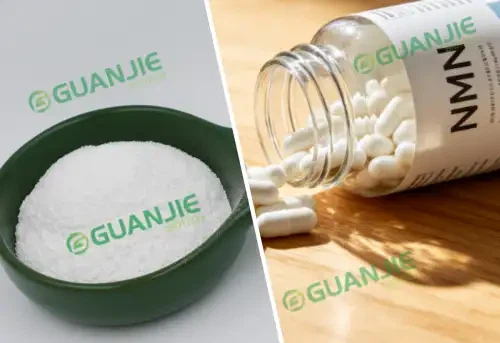
Pure NMN powder can be directly used in a variety of applications, including bulk powder products (bagged or canned), which are suitable for scenarios requiring high doses or flexible dosage adjustments. It is also widely applied in solid beverages when blended with vitamins, minerals, or fruit juice powders. For tableting, additional excipients such as flow agents, binders, and disintegrants are required to ensure proper compressibility and stability. Furthermore, NMN bulk powder can serve as an intermediate for capsule filling, allowing B2B clients to purchase the raw powder and encapsulate it independently. It can also be incorporated into functional foods, such as energy bars or gummies, provided that the formulation can withstand processing temperatures. Overall, nicotinamide mononucleotide NMN powder formulations offer the highest degree of flexibility, enabling clients to adjust excipient ratios, flavors, and dosages according to market positioning. Guanjie Biotech's freeze-dried NMN powder features a loose microstructure and rapid dissolution, making it particularly suitable for instant beverages and sublingual applications.
• Capsule Formulation:
In contrast, capsule products are pre-filled, meaning the formulation is fixed. This limits the ability to modify the dosage per capsule or incorporate additional active ingredients without compromising the capsule shell. If a compound formulation (e.g., NMN combined with resveratrol and quercetin) is required, the capsule product must be redeveloped to ensure uniform blending and ingredient compatibility. Capsule dosage forms are therefore better suited for brands aiming to launch standardized products quickly, rather than those requiring high levels of customization.
Conclusion:
Pure NMN powder and capsule formulations each have their applicable scenarios, and there is no absolutely "better" formulation. Powder formulations have advantages in formulation flexibility, absorption rate, unit cost, and adaptability to large-scale processing, making them suitable for B2B clients with formulation capabilities. Capsule formulations perform better in terms of stability protection, ease of use, and rapid market launch for small-scale applications, making them suitable for brands lacking filling equipment or seeking to simplify their supply chain.
Guanjie Biotech is a professional bulk NMN powder supplier. We recommend that clients make comprehensive decisions based on their own production capabilities, target product form, and market demand. Clients requiring further technical support can contact us to obtain samples, stability data, and formulation processing suggestions.
References
[1] GE J, et al. Preparation of lycopene/NMN-loaded microgels and their protective mechanism against acute liver injury[J]. Food & Function, 2024, 15(2): 809-822.
[2] NADEESHANI H, LI J, YING T, et al. Application prospects and safety considerations of β-nicotinamide mononucleotide (NMN) as a potential anti-aging health product[J]. Advanced Research Journal, 2022, 37: 267-278.
[3] Tokyo Ginza Health and Anti-Aging Clinic. How the way NMN is used changes its meaning - oral, intravenous and nasal administration routes based on purpose[EB/OL]. (2026-02-02).https://tgwaclinic.com/en/report/en/.
[4] GE J, et al. Preparation of microgels loaded with lycopene/NMN and their protective mechanism against acute liver injury[J]. Food & Function, 2024, 15(2): 809-822. DOI: 10.1039/d3fo03293k.
[5] NADEESHANI H, LI J, YING T, et al. Nicotinamide mononucleotide (NMN) as a potential anti-aging health product: Promises and safety concerns[J]. Journal of Advanced Research, 2022, 37: 267-278.
[6] YOSHINO J, BAUR J A, IMAI S I. NAD+ intermediates: The biology and therapeutic potential of NMN and NR[J]. Cell Metabolism, 2018, 27(3): 513-528.
[7] AMIRYAGHOUBI N, KIM B S. Recent advances in nicotinamide mononucleotide delivery systems[J]. Journal of Drug Delivery Science and Technology, 2026. DOI: 10.1016/j.jddst.2026.2935.