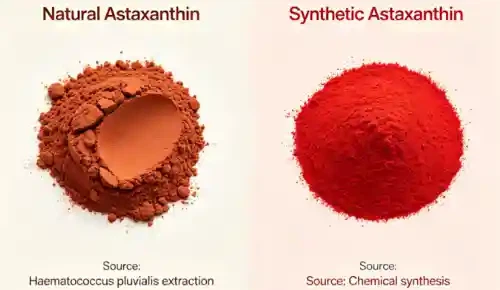
Astaxanthin is a valuable ketocarotenoid in business-to-business (B2B) industries-like algae farming, fish feed, human nutrition supplements, and cosmetics. The way it is used directly affects how well the final product performs and how it is positioned in the market. Currently, there are two main sources of astaxanthin on the market: natural astaxanthin (mostly from a type of algae called Haematococcus pluvialis) and synthetic astaxanthin (made in a lab). Natural Astaxanthin vs. Synthetic Astaxanthin are very different in their molecular structure, how they are made, their biological activity, and how well they work in products.
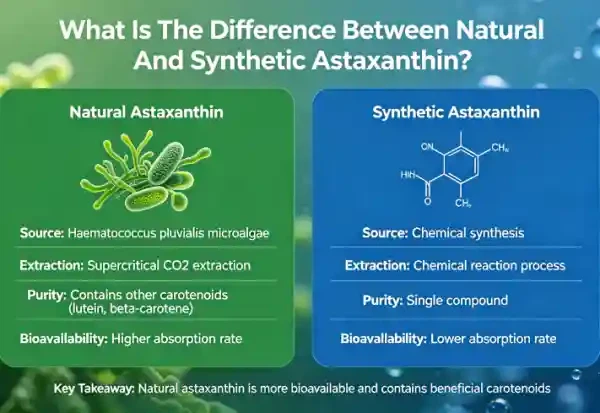
What Is The Difference Between Natural And Synthetic Astaxanthin?
Difference in Molecular Structure
Astaxanthin molecules have two chiral centers. This creates three possible shapes, called stereoisomers: (3S, 3'S), (3R, 3'R), and (3R, 3'S) (the meso-form).
• Natural astaxanthin (from Haematococcus pluvialis) is almost entirely in the (3S, 3'S) form-over 95% pure astaxanthin powder. This is the same form that naturally builds up in marine animals like salmon and krill.
• Synthetic astaxanthin is made from petrochemicals (like toluene and isophorone) through a series of chemical reactions. This process creates a mix of all three forms in equal amounts: (3S, 3'S), (3R, 3'R), and (3R, 3'S) in a 1:1:1 ratio. Only the (3S, 3'S) form works the same way in living things as natural astaxanthin does.
This structural difference is what causes later differences in how they work in the body.
Differences in Production and Quality Control
• Natural astaxanthin production:
The algae are grown in closed tanks or open ponds. Under stress (like too much light or not enough nutrients), the algae produce astaxanthin. The steps after that include spinning to remove liquid, breaking open the cells, extracting with CO₂ or solvents, saponification, and purification. The process of pure natural astaxanthin must be kept clean and safe to avoid contamination.
• Synthetic astaxanthin production:
It is made through chemical reactions, such as the Wittig reaction. The starting materials come from petrochemicals. This method allows for large-scale, non-stop production. It is not affected by weather or biological contamination. However, leftover chemicals and solvents must be carefully removed.
• Quality control differences:
For natural astaxanthin, quality checks focus on algae purity, heavy metals (like arsenic, lead, cadmium), polycyclic aromatic hydrocarbons, pesticide residues, and microbes.
For synthetic astaxanthin, quality checks focus on the ratio of the three forms, unreacted raw materials, byproducts, leftover organic solvents (like dichloromethane), and overall purity.
Differences in Bioactivity and Safety
• Antioxidant activity:
Natural (3S, 3'S) astaxanthin fits well into cell membranes. It arranges itself across the membrane, which makes it a strong antioxidant. It is about 1.5 to 2 times better at neutralizing singlet oxygen than synthetic astaxanthin. This is because the natural shape works better with the fats in the cell membrane.
Synthetic astaxanthin, because it contains the other two forms, does not arrange itself as well in the membrane. As a result, its antioxidant power is lower.
• Absorption and bioavailability:
Natural astaxanthin is mostly found as esters (monoesters and diesters), with a small amount in free form. The ester forms need to be broken down by enzymes in the gut before they can be absorbed. This actually leads to more stable levels in the blood and a longer time that it stays in the body. Many studies in animals and humans show that natural astaxanthin is better absorbed and used by the body than the synthetic version.
Synthetic astaxanthin is mostly in free form. It is absorbed quickly but also leaves the body quickly. Also, the unnatural forms in the synthetic mix may block the natural (3S, 3'S) form from being absorbed, lowering its overall effectiveness.
• Toxicological safety:
Natural astaxanthin (from Haematococcus pluvialis) has the FDA's GRAS (Generally Recognized as Safe) status in the United States. It is also approved as a novel food in the European Union. Its safe intake level is relatively high, with no observed side effects even at high doses.
Synthetic astaxanthin is allowed for use in fish feed (for example, in China's national standard GB/T 18963.2 and the EU additives list). However, it has much less approval for use in human supplements. The main reasons are potential chemical impurities from the manufacturing process and a lack of long-term safety data in humans.
Differences Between Regulations And Application Scenarios
|
Dimensions |
Natural astaxanthin |
Synthetic astaxanthin |
|
Human Nutritional Supplements |
Permitted, widely used for anti-oxidation, eye health, skin protection, etc. |
Disallowed in most countries, or only permitted for use in specific pharmaceuticals |
|
Aquatic Feed (Salmon, Shrimp) |
Permitted, can be used in products labeled "naturally colored". |
Permitted, but must be labeled as synthetic (if required by regulations) |
|
Cosmetics |
Permitted, commonly used in high-end skincare products. |
Rarely used due to low antioxidant efficacy and potential skin irritation risk |
|
Organic Certification |
Some products can obtain it through organic algae cultivation. |
Unable to obtain organic certification |
|
Cost and Price |
Higher concentration (limited by algae cultivation cycle and yield). |
Lower price (approximately 30–50% of the price of natural astaxanthin, depending on purity) |
How To Choose Astaxanthin?
For B2B buyers, here are the key things to think about when choosing bulk astaxanthin.
What is your product for?
If you're making high-end human supplements, functional foods, natural skincare, or baby formula, choose natural astaxanthin (from Haematococcus pluvialis algae). It fits the "clean label" trend, and customers like natural sources.
If you're making low-cost fish feed (like for tilapia or ornamental fish) and don't need "organic" or "natural" claims, synthetic astaxanthin works well as a cheap red colorant.
Check the laws in your target market
In the US, human astaxanthin is almost always required to be natural.
The EU's Novel Food rules clearly separate natural and synthetic uses.
Japan and Australia also have strict rules for natural astaxanthin powder in human products.
In China, natural astaxanthin is a "new resource food ingredient" (Health Ministry Announcement No. 17, 2010). Synthetic astaxanthin is only allowed as a feed additive.
Do you need health benefits or just color?
For high antioxidant, anti-inflammatory, or immune support (e.g., sports nutrition, eye health), only natural astaxanthin has proven clinical effects. If you only need red color that is stable and even, synthetic bulk astaxanthin saves money.
Supply and stability
Natural astaxanthin depends on algae growing conditions. Choose bulk astaxanthin powder suppliers with large-scale photobioreactors and ask for batch consistency data (HPLC charts, isomer ratios, ester profiles).
Synthetic supply is not seasonal, but watch out for raw material price changes and low purity (under 95% total astaxanthin).
Quality control that you should always ask for
● Total astaxanthin content (no fillers)
● Steroid ratio (to tell natural from synthetic)
● Heavy metals (lead, arsenic, mercury, cadmium)
● Leftover solvents (ethanol/acetone for natural; dichloromethane/benzene for synthetic)
● Microbes (especially for natural astaxanthin)
Conclusion:
Natural and synthetic astaxanthin differ in four ways: molecular structure, how the body uses them, legal approval, allowed uses, and product performance. For B2B buyers, here's how to choose.
If you're making human health products (like supplements or medical foods), high-end cosmetics, organic seafood, or pet nutrition, pick natural astaxanthin from Haematococcus pluvialis. Always check its (3S, 3'S) isomer content and esterification level.
If you just need a low-cost color for non-food industrial uses or regular animal feed (and rules allow synthetic dyes), then synthetic astaxanthin is an option.
Your purchase contract must state the source type, isomer range, and batch test reports.
Buyers should also check local laws, product goals, and costs-so you don't face product recalls, false claims, or market bans.
Guanjie Biotech is a professional astaxanthin supplier. We provide testing reports for isomers, esterification levels, and heavy metals. It serves clients in over 100 countries, offering compliance documents and custom solutions.
References
[1] Guerin M, Huntley M E, Olaizola M. Haematococcus astaxanthin: applications for human health and nutrition[J]. Trends in Biotechnology, 2003, 21(5): 210-216.
[2] Miki W. Biochemical functions and activities of animal carotenoids[J]. Pure and Applied Chemistry, 1991, 63(1): 141-146.
[3] Chew B P, Park J, Wong M W, et al. A comparison of the anticancer activities of dietary β-carotene, canthaxanthin, and astaxanthin in mice in vivo[J]. Anticancer Research, 1999, 19(3A): 1849-1853.
[4] Liu X H, Wang B J, Liu Y F, et al. Effects of dietary botanical and synthetic astaxanthin on E/Z and R/S isomer composition, growth performance, and antioxidant capacity of white shrimp, Litopenaeus vannamei, in the nursery phase[J]. Invertebrate Survival Journal, 2018, 15(1): 1-12.
[5] Xue Y C, Wang Z C, Liu M T, et al. From indicator evaluation to optimization decision: Effects of synthetic vs. natural astaxanthin on pigmentation, growth, and health in Penaeus vannamei[J]. Aquaculture, 2025, 609: 742782.
[6] Ambati R R, Phang S M, Ravi S, et al. Astaxanthin: sources, extraction, stability, biological activities and its commercial applications-a review[J]. Marine Drugs, 2014, 12(1): 128-152.
[7] Lorenz R T, Cysewski G R. Commercial potential for Haematococcus microalgae as a natural source of astaxanthin[J]. Trends in Biotechnology, 2000, 18(4): 160-167.
[8] Liu Ziyi, Shen Qigui. Bioactivity and development and application prospects of astaxanthin [J]. Chinese Marine Drugs, 1997, 16(3): 46-49.
[9] Ministry of Health of the People's Republic of China. Announcement of the Ministry of Health on the Approval of New Resource Foods such as Haematococcus pluvialis: Announcement No. 17 of 2010 of the Ministry of Health [EB/OL]. (2010-04-08). http://chc.org.cn/news/detail.php?id=58969. [citation:10]
[10] Zhou Qiang, Zhou Dawei, Sun Jingxiang, et al. Research progress in the biosynthesis of astaxanthin [J]. Synthetic Biology, 2024, 5(1): 126-143.
[11] Liu X, Osawa T. cis-Astaxanthin and especially 9-cis astaxanthin exhibits a higher antioxidant activity in vitro compared to the all-trans isomer[J]. Biochemical and Biophysical Research Communications, 2007, 357(2): 396-401.