


Yes. From the perspective of industrial raw material standards, the standard appearance of compliant GHK-Cu Copper Tripeptide-1 powder is a light blue to dark blue crystalline powder. High-purity industrial-grade batches may show a uniform indigo color. This color is an inherent physical property of the product. It is not caused by artificial dyes or post-treatment color adjustment. It is an important appearance indicator used by the industry to evaluate product compliance.
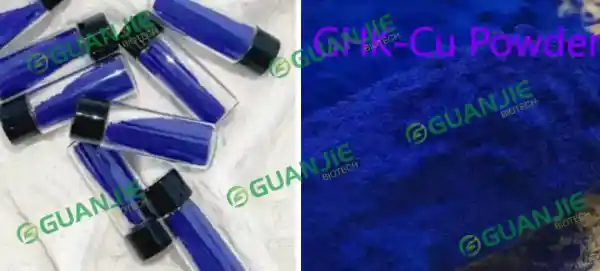
For buyers, such as cosmetic manufacturers and biopharmaceutical companies, the blue color is a direct identifier. It helps distinguish genuine GHK-Cu powder from ordinary peptide powders and low-quality modified powders. Compliant mass-produced GHK-Cu powder should have a uniform color. It should not show abnormal color changes, such as whitening, yellowing, graying, or dullness. The GHK-Cu Copper Tripeptide-1 powder should have a dry and loose texture. It should not contain lumps, visible impurities, or unpleasant odors. These characteristics meet the appearance quality requirements for bulk raw materials before warehouse storage.
White, colorless, or almost transparent light-colored GHK-Cu powder found in the market does not meet industry standards. Such products are considered non-compliant raw materials.
Why Is GHK-Cu Powder Blue?
The blue color of pure GHK-Cu powder is mainly caused by the optical properties of its stable molecular chelate structure. The key factor is the coordination between divalent copper ions and the GHK tripeptide chain.
GHK tripeptide consists of three amino acids: glycine, histidine, and lysine. Its molecular structure contains active groups, including the histidine imidazole ring and the lysine amino group. These groups can specifically bind with divalent copper ions through chelation. This process forms a stable five-membered ring coordination structure and creates a complete GHK-Cu complex.
This stable complex changes the way the molecule absorbs visible light. It absorbs certain wavelengths of light and reflects blue light. As a result, Copper Peptide GHK-Cu Powder shows its characteristic blue color in both GHK-Cu Copper Tripeptide powder and solution forms.
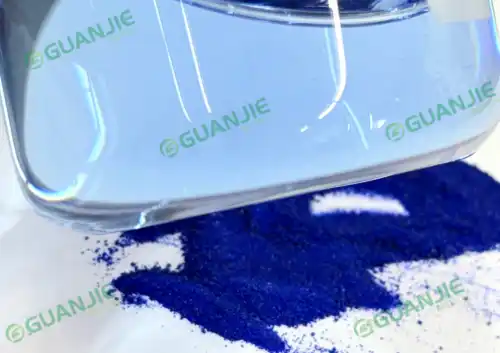
From the perspective of raw material production, only products with accurate peptide-to-copper ratios, controlled reaction conditions, and complete purification processes can form a stable GHK-Cu complex structure. These products can show the standard blue appearance.
If the reaction conditions are not properly controlled, the ratio is incorrect, or purification is insufficient, the GHK-Cu Copper Tripeptide-1 powder may contain free copper ions or incomplete complex structures. These problems can cause abnormal color changes.
Ordinary white peptide powders do not contain a copper ion chelate structure. Therefore, they do not have the blue color characteristic of raw GHK-Cu powder. This molecular feature is a key difference between natural GHK-Cu powder and common peptide raw materials.
This mechanism also provides an important technical basis for rapid quality evaluation of GHK-Cu powder batches before use in applications.
Relationship Between Blue Color and Product Purity
For large-scale manufacturers, the blue color of pure GHK-Cu bulk powder is more than an appearance feature. It is an important indicator of raw material purity, bioactivity, and physicochemical stability. It is also a key reference during the first quality inspection after bulk materials arrive at the factory. This helps reduce quality control risks and lowers production costs. Industry testing shows that GHK-Cu Copper Tripeptide powder with a purity of ≥98% has a copper ion content of 15%–16%. It also has a high complexation rate and a uniform, pure blue color. Its bioactivity meets the requirements of skincare, repair, anti-aging, and antioxidant formulations.
Abnormal powder color usually indicates quality problems. This follows standard quality control procedures. GHK-Cu Copper Tripeptide-1 powder that is too light or appears white often has a low peptide-copper complexation rate. It may also contain fewer active ingredients and more free tripeptides and impurities. This can reduce the performance of the final product and affect its stability. Powder that appears dark, gray, or yellow may have been damaged by oxidation, moisture, or excess impurities. These problems reduce molecular stability and product purity. They can also shorten the storage life of the raw material. In finished products, they may cause turbidity, sedimentation, microbial contamination, and a shorter shelf life.
The color of the solution after dissolving the Copper Peptide GHK-Cu Powder is another important quality indicator. High-quality GHK-Cu bulk powder dissolves easily in water. It forms a clear and transparent blue solution. The solution should have no sediment, layering, or turbidity. GHK-Cu Copper Tripeptide powder should also remain blue without fading or changing color after standing at room temperature. This shows that the product has good physicochemical stability. It is suitable for automated mixing, filling, and storage. GHK-Cu Copper Tripeptide-1 powder also reduces the risk of quality problems during production. These characteristics make it suitable for large-scale B2B manufacturing.
How To Choose High-quality GHK-Cu?
By understanding the blue color of raw powder GHK-Cu and its link to quality, companies can build a standard incoming inspection process. They can quickly check raw material quality by appearance. This helps reduce bulk purchasing risks. First, inspect the color of each batch. A pure and uniform blue is the basic acceptance standard. Reject batches with uneven or mottled color. Second, perform a water solubility test. High-quality GHK-Cu powder dissolves into a clear, uniform, and stable blue solution. This test quickly identifies raw materials with low purity or poor complex formation. Finally, compare the color of different batches over time. Consistent color shows that the supplier has a stable production process, reliable quality control, and consistent GHK-Cu Copper Tripeptide-1 powder quality.
Large and well-managed suppliers can produce GHK-Cu Copper Tripeptide powder with consistent color, purity, and activity in every batch. They use precise peptide-to-copper ratio control, constant temperature and pressure during production, and multi-step purification. These processes keep the GHK-Cu Copper Tripeptide complex stable and ensure a standard blue color. They also provide complete HPLC test reports and quality documents. This supports raw material registration, quality inspection, and regulatory compliance. It also meets the needs of companies that require long-term supply and large-scale production.
FAQs:
1. Is GHK-Cu powder naturally blue?
Yes. Genuine GHK-Cu (Copper Tripeptide-1) powder is naturally light blue to dark blue. The color comes from the stable chelation between the GHK peptide and copper ions. No artificial color is added. A uniform blue color is one of the basic appearance standards for qualified GHK-Cu raw materials.
2. Why is GHK-Cu powder blue instead of white?
The blue color is produced when glycine, histidine, and lysine bind with divalent copper ions to form a stable GHK-Cu Copper Tripeptide-1 powder complex. This molecular structure absorbs certain wavelengths of visible light and reflects blue light. Ordinary peptide powders do not contain copper ions, so they are usually white.
3. Does GHK-Cu's darker blue color mean higher purity?
Not always. High-purity GHK-Cu powder generally has a uniform blue appearance, but color alone cannot determine purity. The GHK-Cu Copper Tripeptide-1 powder should also be supported by HPLC testing, purity analysis, and quality certificates. Extremely dark, gray, or yellow powder may indicate oxidation or impurities rather than better quality.
4. Can white GHK-Cu powder be genuine?
No. Genuine GHK-Cu Copper Tripeptide-1 powder should not be white or colorless. White powder usually indicates that the copper-peptide complex has not formed correctly, the product contains mostly free peptides, or it is not authentic GHK-Cu. Such materials do not meet normal industry appearance standards.
5. What color should GHK-Cu solution be after dissolving?
High-quality GHK-Cu powder dissolves easily in water and forms a clear, transparent blue solution. The solution should remain stable without sediment, turbidity, or color fading under normal storage conditions. Poor-quality materials may produce cloudy solutions or visible precipitation.
6. Can the GHK-Cu blue color change during storage?
Yes. Improper storage may cause oxidation or moisture absorption, leading to gray, yellow, or dull-colored powder. To maintain stability, GHK-Cu bulk powder should be stored in a cool, dry place away from heat, light, and humidity. Proper packaging also helps preserve product quality.
7. How do manufacturers use color during quality inspection?
Many cosmetic and biotechnology manufacturers first inspect the appearance of incoming GHK-Cu batches. A uniform blue color, dry texture, and absence of impurities provide a quick visual assessment before laboratory testing. Final acceptance is typically confirmed with HPLC reports, purity data, and other quality control documents.
Summary:
Qualified GHK-Cu powder is a standard blue crystalline powder. The blue color is a natural property of its complete molecular complex. It is not created by artificial coloring. The purity, uniformity, and stability of the blue color reflect the purity, biological activity, and physicochemical stability of the raw material. The blue color is an important and simple quality indicator. It helps companies inspect incoming materials, choose reliable suppliers, maintain consistent finished product quality, and reduce production risks.
Guanjie Biotech specializes in the R&D, production, and supply of bulk GHK-Cu powder. The company focuses on technological innovation and standardized production of bioactive peptide ingredients. It mainly serves B2B customers, including cosmetic manufacturers, biotechnology companies, and skincare OEM factories. It supplies high-purity, high-stability, and batch-consistent natural GHK-Cu powder. The company has replaced traditional production methods with advanced technology and continuous innovation. It has built a standardized production system to ensure consistent quality and reliable supply for bulk GHK-Cu Copper Tripeptide orders. Welcome to enquire with us at info@gybiotech.com.
References:
[1] Vanguard Laboratory. (2026, March 8). *GHK-Cu: The Science Behind the Blue Molecule*.
[2] Certificate of Analysis for GHK-Cu (TFA removed), Cat.#: 319855, Lot No. MTFA33433-251009*. NovoPro Labs.
[3] Bossak-Ahmad, K., Wiśniewska, M. D., Bal, W., Drew, S. C., & Fraczyk, T. (2021). Ternary Cu(II) complex with GHK peptide and cis-urocanic acid as a potential physiologically functional copper chelate. *International Journal of Molecular Sciences*, *21*(17), 6190. Supplementary Materials.
[4] Biosynth. (2024, November 19). *Certificate of Analysis for Copper peptide (GHK-Cu) TFA salt, Cat No. FC138108, Lot No. 0000038378*.
[5] Lin Yujia, Yu Haiying, Diao Feiyan, et al. Determination of copper tripeptide-1 in cosmetic raw materials by high-performance liquid chromatography [J]. Chemical Analysis and Metrology, 2025, 34(1). DOI: 10.3969/j.issn.1008-6145.2025.01.012.
[6] Zhang Liangyu, Li Qiyan, Li Jingjing, et al. Determination of the content of blue copper peptide in cosmetic raw materials by high performance liquid chromatography-hydrogel particle laser counting [J]. Chemical Research and Application, 2026, 38(2).


