The influence of environmental factors on astaxanthin
1. The effect of temperature
(1) high temperature environment
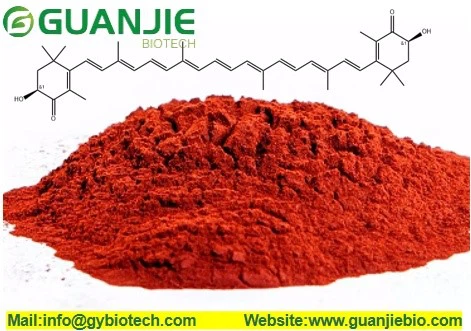
When astaxanthin is in a high-temperature environment, the thermal movement of molecules intensified. This violent molecular movement makes it easier for astaxanthin molecules to come into contact with surrounding oxygen, moisture, and other possible reactants. For example, during cooking, astaxanthin can degrade rapidly if the food containing it is left at high temperatures for an extended period of time. In the case of shrimp, for example, the amount of astaxanthin decreases dramatically under high-temperature cooking methods such as deep-frying. This is because the high temperature prompted astaxanthin conjugated double bond oxidation reaction, the generation of oxidation products, resulting in the loss of its antioxidant properties. Moreover, high temperatures may also cause isomerisation of astaxanthin molecules, altering their chemical structure and thus affecting their physiological activity.
From the point of view of chemical reaction kinetics, an increase in temperature will increase the reaction rate constant. For the oxidation reaction of astaxanthin powder wholesale, according to the Arrhenius equation (where is the reaction rate constant, is the prefactor, is the activation energy, is the ideal gas constant, and is the temperature), the reaction rate constant increases exponentially with increasing temperature. This means that at high temperatures, the oxidation reaction of astaxanthin is accelerated.
(2) Low Temperature Environment
Lowering the temperature slows down the thermal movement of the molecules. When astaxanthin is in a low-temperature environment, its contact with reactants such as oxygen and moisture is reduced, and the rate of reaction decreases. For example, in laboratory research, astaxanthin samples were placed at room temperature and low temperature (e.g., 4 ℃), and after a period of time, it was found that the degree of degradation of astaxanthin at room temperature was significantly higher than that of the samples in the low-temperature environment. This is due to the fact that low temperatures slow down the rate of reactions such as oxidation and hydrolysis of astaxanthin molecules.
Low temperatures may also have an effect on the physical state of astaxanthin. At lower temperatures, the solubility of astaxanthin in certain solvents may be reduced, potentially leading to its precipitation from solution. However, this can usually be controlled within the range of suitable solvent systems and appropriate low temperatures.
2. Effect of light
Astaxanthin is sensitive to light, especially ultraviolet light. Ultraviolet light has high energy and can excite the electrons in the astaxanthin molecule, causing them to jump from the ground state to the excited state. Molecules in the excited state have increased chemical activity and are more likely to undergo chemical reactions. For example, in direct sunlight, bulk astaxanthin products packaged without good light shielding, astaxanthin will decompose rapidly. The light-induced degradation reaction of astaxanthin occurs mainly through a free radical mechanism. The energy of photons causes chemical bonds in astaxanthin molecules to break, generating free radicals, and these free radicals subsequently undergo a chain reaction with surrounding molecules, leading to a significant loss of astaxanthin.
3. Influence of oxygen and humidity
Oxygen is the key reactant in the oxidation reaction of astaxanthin. In an aerobic environment, the conjugated double bonds of astaxanthin readily react with oxygen to form oxidation products such as peroxides. Humidity also has an important effect on the stability of astaxanthin bulk powder. In high humidity environments, moisture may trigger hydrolysis reactions of astaxanthin, especially for free state astaxanthin. Moreover, the presence of moisture promotes the dissolution and diffusion of oxygen around astaxanthin, further exacerbating the oxidation reaction. For example, the shelf life of astaxanthin products is significantly reduced in humid air.
Benefits of Refrigeration for Astaxanthin
• Retardation of oxidative reactions
As mentioned earlier, low temperatures reduce the rate of astaxanthin oxidation. Under refrigerated conditions (typically 2 - 8°C), the thermal movement of astaxanthin molecules is slowed and the frequency of collisions with oxygen is reduced. According to the principle of chemical kinetics, the reaction rate is closely related to the collision frequency of reactant molecules. When the temperature decreases, the effective number of collisions between astaxanthin molecules and oxygen molecules decreases, and the rate constant of the oxidation reaction decreases. In the case of astaxanthin oil, for example, the rate of oxidation can be reduced by several times in a refrigerated environment than at room temperature. Refrigeration can effectively extend the shelf life of astaxanthin products and maintain their antioxidant properties.
• Reducing the occurrence of other chemical reactions
In addition to oxidation reactions, refrigeration can also inhibit hydrolysis reactions of astaxanthin. At low temperatures, the activity of water is reduced, and the interaction between astaxanthin molecules and water molecules is weakened. This is particularly important for free-form astaxanthin. This is because free astaxanthin is more susceptible to hydrolysis. Refrigeration reduces the rate of hydrolysis. For example, in high humidity environments, free astaxanthin may undergo significant hydrolysis within a few days if the bulk astaxanthin product is not refrigerated. Refrigeration can delay the onset of this hydrolysis reaction by weeks or even months.
• Maintaining product quality and efficacy
For the various product forms of astaxanthin wholesale, refrigeration helps to maintain their quality and efficacy. In astaxanthin oils, refrigeration maintains the stability of the oil and prevents it from oxidising and rancidising. This ensures good solubility and stability of astaxanthin in the oil. For astaxanthin powders, refrigeration keeps the powder dry and reduces moisture-induced agglomeration and chemical reactions.
Problems when astaxanthin is not refrigerated
• Accelerated product deterioration
If astaxanthin bulk supplements products are not refrigerated, the rate of deterioration is significantly accelerated in high temperature environments. In the case of astaxanthin oil, for example, if refrigeration is not taken, the oil may show obvious signs of oxidation within a few weeks. For example, darkening of colour and the appearance of off-flavours. In the case of astaxanthin powder, under high humidity and high temperature environment, caking and discolouration may occur. This is due to accelerated oxidation and hydrolysis reactions.

• Reduced product efficacy
The main value of astaxanthin lies in its powerful antioxidant effects. When the product deteriorates due to lack of refrigeration, the chemical structure of astaxanthin is destroyed. Its antioxidant capacity is greatly reduced. For example, oxidised astaxanthin may lose the integrity of its conjugated double bond system and is unable to scavenge free radicals effectively. Moreover, deteriorated astaxanthin powder bulk products may produce some harmful oxidation products. These products not only have no antioxidant effect, but also may have adverse effects on the human body.
• Shorten the shelf life of the product
Not refrigeration will shorten the shelf life of astaxanthin products. Generally speaking, the shelf life of bulk astaxanthin products under refrigeration can reach 1 - 2 years or even longer. At room temperature, especially under poor storage conditions, the shelf life may be reduced to a few months or even less. Consumers need to use the product within a shorter period of time, otherwise the quality and efficacy of the product will not be guaranteed.
Astaxanthin should Be Refrigerated. Guanjie Biotech is a bulk astaxanthin supplier. Our astaxanthin is stable. The quality can be guaranteed. If you are an astaxanthin food manufacturer, you can choose our astaxanthin powder or astaxanthin liquid in your products. Welcome to enquire info@gybiotech.com.