What Are The Differences NMN And liposomal NAD+ powder?
NMN And liposomal NAD+ powder Core Mechanisms of Action
NAD+ is an important coenzyme involved in cellular metabolism, DNA repair, and mitochondrial regulation. It participates in thousands of physiological reactions. A major factor in aging and metabolic decline is the continuous reduction of NAD+ levels in the body over time. Current supplementation strategies are divided into two types: indirect and direct. These correspond to NMN and liposomal NAD+ powder, respectively.
• NMN
NMN is an NAD+ precursor. After ingestion, it must undergo a multi-step metabolic conversion process to become NAD+ in the body. This pathway depends on endogenous enzyme systems. Conversion efficiency varies due to individual factors such as age, metabolic rate, gastrointestinal function, and enzyme activity.
In middle-aged and elderly populations, or individuals with reduced metabolic function, lower enzyme activity can significantly reduce NMN conversion efficiency. This leads to inconsistent NAD+ output and variable product performance. This variability is a common limitation in conventional NMN products.
• Liposomal NAD+ powder
liposomal NAD+ powder uses a direct supplementation approach. It does not require enzymatic conversion steps. The active ingredient is the intact NAD+ molecule, protected by liposomal encapsulation technology. After ingestion, it can participate directly in cellular physiological processes.
From a functional food development perspective, this mechanism offers several advantages. It reduces performance variability caused by individual differences. It improves product consistency and stability. It also lowers reputational risk for end brands. Overall, it better fits standardized manufacturing and commercial distribution models for functional food products.
NMN And liposomal NAD+ powder Absorption and Bioavailability
Bioavailability is the effective proportion of an active ingredient absorbed and utilized by the human body. It is the core metric for functional food ingredients. It directly determines cost-performance ratio and market competitiveness. It is also a key difference between ingredient types.
• Regular NMN
Conventional NMN is a water-soluble small-molecule ingredient. It has a "naked" molecular structure without protection. This makes it highly vulnerable to degradation by gastric acid and intestinal enzymes in the digestive tract. Only a small portion survives digestion. Absorption depends on limited intestinal transport proteins. These transport channels are restricted and have low capacity. As a result, much of the NMN cannot enter the bloodstream. It is eventually excreted as metabolic waste.
Industry data shows that the bioavailability of standard oral NMN is low. Most of the active ingredient is not effectively utilized. This leads to ingredient loss and limits product efficacy.
• Liposomal NAD+ powder
Liposomal NAD+ powder uses phospholipid bilayer nano-delivery technology. It addresses issues of ingredient loss and poor absorption. The liposomal membrane is similar to human cell membranes. It has strong biocompatibility. It encapsulates NAD+ molecules and protects them from gastric acid and digestive enzymes.
The nanoscale particles bypass intestinal transport limitations. They enter the bloodstream and cells through membrane fusion and endocytosis. This significantly improves absorption and effectiveness. Cell studies and industry data show that liposomal delivery systems can increase the bioavailability of NAD+ compounds by more than 1.5 times. They also provide a faster onset of action compared to conventional NMN.
For food manufacturers, higher bioavailability means better efficacy at the same dosage. Alternatively, manufacturers can reduce dosage, optimize formulations, and control costs while maintaining performance.
NMN And liposomal NAD+ Product Stability and Production Compatibility
Industrial food production requires high stability, processing resistance, and storage compatibility. Ingredient stability directly affects yield, shelf life, and product quality control. It is a key factor in raw material selection.
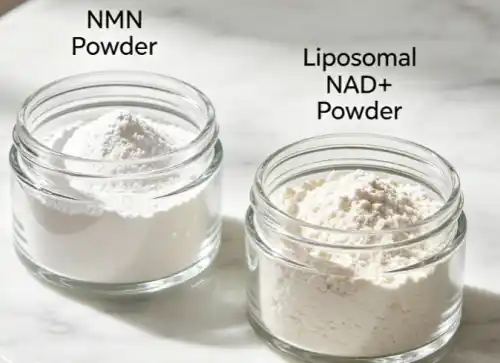
• Regular NMN
Conventional NMN powder has moderate stability. It is sensitive to temperature, humidity, and light. It is prone to oxidation and moisture absorption. It may lose activity under high-temperature or high-humidity conditions. Loss of activity can occur during processing, storage, and transport. NMN is also incompatible with some food excipients. This makes formulation more difficult. It requires strict production conditions and specialized packaging. These factors increase production and quality control costs.
• Liposomal NAD+ powder
Liposomal NAD+ powder powder is stabilized through phospholipid encapsulation. This improves structural stability significantly. It has better resistance to heat, moisture, and oxidation than standard NMN. The liposomal structure remains stable under typical food processing temperatures. There is minimal loss of active ingredients. It is suitable for tablets, powders, solid beverages, and liquid formulations. Its stability reduces degradation during storage and transport. This helps extend product shelf life.
Through standardized production processes, Guanjie Biotech produces liposomal NAD+ powder powder with uniform particle size and consistent encapsulation efficiency. This supports bulk supply for global food manufacturers. It also helps solve stability challenges in large-scale production of functional ingredients.
NMN And liposomal NAD+ Absorption and Bioavailability
Bioavailability is the proportion of an active ingredient that the body can absorb and use. It is a key measure for functional food ingredients. It affects cost-performance, market competitiveness, and the difference between ingredient types.
• Traditional NMN powder
Traditional NMN powder is a water-soluble, small molecule. Its unprotected structure is easily broken down by stomach acid and digestive enzymes. Only a small fraction survives and is absorbed through specific intestinal transport proteins. Because these transport channels are limited, most NMN fails to reach the bloodstream and is excreted. Industry data shows standard oral NMN has low bioavailability. Most of the ingredient is wasted, reducing the product's effectiveness.
• Liposomal NAD+ powder
Liposomal NAD+ powder uses a phospholipid bilayer nano-delivery system. This protects NAD+ molecules from stomach acid and enzymes. The liposomal membrane is similar to human cell membranes, so it is highly biocompatible. Nanoscale liposomes can bypass intestinal transport limits. They enter cells directly via membrane fusion and endocytosis. This increases absorption and efficiency. Experiments and industry data show liposomal NAD+ powder can improve bioavailability by more than 1.5 times. Results appear faster than with traditional NMN powder. For manufacturers, higher bioavailability means better efficacy per dose. It also allows cost optimization and the potential for premium products.
Is NMN And liposomal NAD+ Product Stability?
Industrial food production has strict requirements for raw material stability, processing tolerance, and storage compatibility. The physicochemical stability of raw materials directly affects production yield, shelf life, and final quality control. It is a key factor in bulk material selection.
• Traditional NMN powder
Traditional NMN powder powder has moderate physicochemical stability. It is highly sensitive to temperature, humidity, and light. It can easily oxidize, absorb moisture, and lose activity in high-temperature or high-humidity conditions. Therefore, some activity loss is unavoidable during high-temperature processing, long-term storage, and transportation.
In addition, NMN bulk powder is not compatible with some food excipients. This limits formulation development. It also requires strict production conditions and special packaging. As a result, production and quality control costs increase for manufacturers.

• Liposomal NAD+ powder
Liposomal NAD+ powder powder is modified through phospholipid encapsulation. This structure significantly improves molecular stability. It also provides stronger resistance to heat, moisture, and oxidation compared with traditional NMN powder.
The liposomal structure remains stable within standard food processing temperatures. It helps maintain active ingredient integrity with no significant loss. This makes it suitable for industrial production of tablets, powders, solid beverages, and liquid formulations.
Its stable physicochemical properties also reduce degradation during storage and transport. This effectively extends product shelf life.
Through standardized production processes, Guanjie Biotech achieves large-scale production of liposomal NAD+ powder powder with uniform particle size and consistent encapsulation efficiency. This supports bulk procurement and standardized manufacturing for global food companies and addresses stability challenges in large-scale production of high-end functional ingredients.
What is NMN And liposomal NAD+ Used For?
In the functional food market, consumers now seek high efficacy, stability, and safety. Simple "conceptual benefits" are no longer enough. Traditional ingredients with low efficiency and high loss rates are gradually being phased out.
• Traditional NMN powder
Pure NMN powder has low conversion efficiency, poor absorption, limited stability, and regulatory challenges. This causes product homogenization. The market is dominated by price wars. Profit margins for brands are being squeezed.
• Liposomal NAD+ powder
Liposomal NAD+ powder has clear advantages: direct action, high bioavailability, strong stability, and broad regulatory compliance. It is ideal for anti-aging foods, sports nutrition, and daily supplements. Brands can differentiate their products, avoid low-end price competition, and increase both product value and brand reputation. From an industry view, advanced delivery technologies are the main trend. Moving from traditional NMN bulk powder to liposomal NAD+ powder is inevitable in NAD+ supplement upgrades.
FAQs:
1. What is the key difference in the mechanism of action between NMN and liposomal NAD+?
NMN works as an NAD+ precursor, requiring multi-step enzymatic conversion inside the body before becoming active NAD+.
Liposomal NAD+ powder delivers intact NAD+ directly, protected by phospholipid encapsulation, reducing reliance on metabolic conversion pathways.
2. How does absorption differ between NMN and liposomal NAD+ powder?
NMN has limited absorption due to enzyme degradation and restricted transport pathways in the intestine.
Liposomal NAD+ powder uses phospholipid bilayer nano-carriers, which protect NAD+ during digestion and enhance cellular uptake via membrane fusion and endocytosis, improving absorption efficiency.
3. How stable are NMN and liposomal NAD+ powders during production and storage?
NMN is sensitive to heat, moisture, and light, which can reduce its stability during processing and storage.
Liposomal NAD+ powder is more stable due to phospholipid encapsulation, offering better resistance to oxidation and environmental stress, making it more suitable for industrial manufacturing.
4. What are the application differences between NMN and liposomal NAD+?
NMN is commonly used in standard dietary supplements focused on NAD+ precursors.
Liposomal NAD+ powder is increasingly used in high-end functional foods, sports nutrition, and premium anti-aging formulations, where performance consistency and absorption efficiency are prioritized.
5. Does NMN still have value in the NAD+ market?
Yes. NMN remains widely used due to its established research base, cost efficiency, and precursor-based metabolic pathway. It is still relevant in mainstream supplement markets, especially where cost sensitivity is important.
6. What are the regulatory and industrial considerations?
NMN may face regulatory variability across regions, depending on classification. Liposomal NAD+ powder, as a delivery-technology-based ingredient, is often positioned within functional food ingredient frameworks, but compliance still depends on jurisdiction and product claims.
Conclusion
liposomal NAD+ powder outperforms traditional NMN powder when looking at action mechanism, absorption, production, compliance, and product value. traditional NMN powder only provides basic NAD+ supplementation. It has drawbacks such as inconsistent efficacy, high loss, regulatory risks, and poor industrial suitability. liposomal NAD+ powder solves these problems through technology. It offers high efficiency, stability, compliance, and industrial compatibility. This makes it ideal for modern food production and global markets. Guanjie Biotech focuses on R&D and production of liposomal NAD+ powder and bulk NMN. We ensure quality through strict controls and provide cost-effective, stable raw materials with custom formulation support.Welcome to enquire with us at info@gybiotech.com.
References:
[1] Bogan, K. L., & Brenner, C. (2008). Nicotinic acid, nicotinamide, and nicotinamide riboside: a molecular evaluation of NAD+ precursor vitamins in human nutrition. Annual Review of Nutrition, 28, 115-130.
[2] Bumrungpert, A., et al. (2024). Bioavailability and pharmacokinetics of liposomal NAD+ supplementation in healthy adults: A randomized double-blind crossover study. Journal of Dietary Supplements.
[3] Cantó, C., Menzies, K. J., & Auwerx, J. (2015). NAD+ metabolism and the control of energy homeostasis: a balancing act between mitochondria and the nucleus. Cell Metabolism, 22(1), 31-53.
[4] Chaleckis, R., Murakami, I., Takada, J., Kondoh, H., & Yanagida, M. (2016). Individual variability in human blood metabolites identifies age-related differences. Proceedings of the National Academy of Sciences, 113(10), 4252-4259.
[5] Imai, S. I., & Guarente, L. (2014). NAD+ and sirtuins in aging and disease. Trends in Cell Biology, 24(8), 464-471.
[6] Liu, L., Su, X., Quinn, W. J., Hui, S., Krukenberg, K., Frederick, D. W., ... & Rabinowitz, J. D. (2018). Quantitative analysis of NAD synthesis-breakdown fluxes. Cell Metabolism, 27(5), 1067-1080.
[7] Yoshino, J., Baur, J. A., & Imai, S. I. (2018). NAD+ intermediates: the biology and therapeutic potential of NMN and NR. Cell Metabolism, 27(3), 513-528.
[8] Imai, S.-i., & Guarente, L. (2014). NAD+ and sirtuins in aging and disease. Trends in Cell Biology, 24(8), 464-471.