For the health supplement, functional food, and nutritional supplement industries, raw material compliance is a crucial foundation for product development and international sales. Indole-3-Carbinol powder has gained wide attention due to its natural origin and abundant research. Many brand owners, formulators, and buyers often ask: Is Indole-3-Carbinol a prohibited substance? From the perspective of global regulations, Indole-3-Carbinol is not prohibited. It is also not classified as a drug, stimulant, or strictly controlled chemical. However, different countries may have different rules regarding its use, dosage, and product registration. Companies must understand the regulatory requirements of their target markets when developing products.
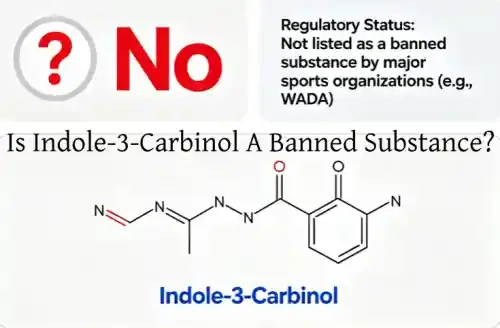
Is Indole-3-Carbinol a Banned Substance?
No. Indole-3-Carbinol powder is explicitly classified as a non-prohibited and unrestricted raw material.
•Domestic Compliance Status
Indole-3-Carbinol I3C is not on any domestic list of prohibited or controlled chemicals or food ingredients. It is not listed in the List of Hazardous Chemicals (2015 Edition), List of Easily Explosive Hazardous Chemicals (2017 Edition), or Classification of Occupational Hazard Factors (2015). There are no restrictions on its production, storage, transport, or distribution. It is not included in sports doping lists, prohibited food additives, or restricted raw materials for health supplements. There are no compliance barriers to domestic production, use, or sale. Physicochemically, it causes only mild irritation. It is not toxic, addictive, or harmful. Its safety and controllability are suitable for routine production and use.
•International Compliance
Indole-3-Carbinol powder is recognized as a legal raw material in major global markets. The US FDA lists it as a compliant dietary supplement ingredient. It can be used routinely in health supplement production and sale. The EU, Australia, and New Zealand do not restrict it. Companies only need to follow general standards for purity, dosage, and production. It is not restricted for international transport and can be traded across borders. Bulk Indole-3-Carbinol powder is a globally accepted functional raw material.
Compliance Boundaries for Indole-3-Carbinol
•Core Application Value
Indole-3-Carbinol powder is a natural extract from cruciferous vegetables such as broccoli, cabbage, and cauliflower. It is a natural breakdown product of glucosinolates. Its safety fits health supplement production requirements. Functionally, it can support liver metabolism, assist toxin breakdown, balance metabolism, and regulate hormone levels. It is stable and highly compatible. It is widely used in metabolic, body maintenance, and functional health supplements. Its compliance is stable, the safety threshold is high, and operational risk is low. It is a key ingredient for functional health products.
•Domestic Application Boundaries
In domestic use, Indole-3-Carbinol is not listed as a new food ingredient. There are no standards for its added amount. It can only be used as a dietary supplement ingredient. Claims of disease treatment or medicinal effects are prohibited. Marketing must follow food and supplement advertising regulations strictly.
•Overseas Market Boundaries
For export to Europe, America, and Southeast Asia, companies must follow local dietary supplement regulations. Purity and dosage must be controlled. Labeling and formulation must meet standards. Overdosing or exceeding Indole-3-Carbinol powder permitted claims is prohibited. Compliance with local rules is essential for legal cross-border sales.
Indole-3-Carbinol Application Management Rules in Different Scenarios:
•Regular Dietary Supplement Application Management Rules:
This is the most common use of Indole-3-Carbinol powder. Management requirements are relatively relaxed but standardized. In production, strict adherence to general food and health product standards is required. Raw material addition must be precise. Batch content must be consistent. In advertising, only claims related to dietary supplementation and nutritional support are allowed. Exaggerated efficacy or medical treatment claims are prohibited. In quality control, routine batch testing is conducted. Focus is on three core indicators: raw material purity, microorganisms, and heavy metals. This ensures products are safe and compliant for market release.
•Functional Health Product Application Management Rules:
Higher standards apply to functional products, such as those for metabolic regulation or endocrine support. Dosages must strictly follow industry-standard safe ranges. Exceeding limits is prohibited. Production must use refined, high-purity raw materials to avoid impurities that affect safety or efficacy. Traceability must be maintained for raw materials, formulation ratios, and quality inspection data. This ensures consistent product performance and regulatory compliance. After-sales labeling must clearly define applicable populations. Instructions for unsuitable populations must be provided to prevent misuse and ensure safety.
•Cross-Border Export Management Rules for Health Supplements:
Exported Indole-3-Carbinol powder products must follow local regulations in each target market. For North America, products must meet US FDA dietary supplement standards. This includes raw material purity, labeling, and ingredient disclosure. For the EU and Southeast Asia, local food raw material regulations apply. Compliance registration and batch Indole-3-Carbinol powder testing are required. Exported Indole-3-Carbinol powder products must retain full raw material qualifications, test reports, and traceability records. These documents are necessary for cross-border inspections and compliance verification. Missing documentation or non-compliance can create trade obstacles.
•R&D and Customized Product Application Management Rules:
For new products, formula development, and high-end customized health products, detailed management is essential. Raw materials must have high stability, high purity, and consistent batch quality. Accurate R&D data depends on precise raw material records, production parameters, and formula ratios. A complete R&D ledger should be maintained. Compliance screening should be done in advance based on regional regulations. This ensures that new products are legally compliant when launched.
FAQs:
1. Is Indole-3-Carbinol a banned substance?
No. Indole-3-Carbinol I3C is not a banned substance in most global markets. It is widely used as a lawful raw material in dietary supplements and functional food formulations. It is derived from cruciferous vegetables such as broccoli and cabbage, and it is generally accepted in nutrition-related applications.
2. Is Indole-3-Carbinol classified as a drug or controlled chemical?
No. I3C is not classified as a pharmaceutical drug or a controlled chemical. It is not listed under controlled substance regulations in major jurisdictions. In regulatory practice, it is typically treated as a functional nutritional ingredient or dietary supplement component rather than a medicinal active pharmaceutical ingredient.
3. Is Indole-3-Carbinol allowed in the United States and Europe?
Yes. In both the United States and the European Union, Indole-3-Carbinol powder is generally permitted for use in dietary supplements. However, approval is conditional on compliance with local regulatory requirements. These include product safety standards, correct labeling practices, and adherence to ingredient usage guidelines. Manufacturers are responsible for ensuring their finished products meet all applicable national regulations.
4. Are there restrictions on dosage?
Yes. Although I3C is not banned, its use is subject to formulation limits depending on the country or region. There is no universal global dosage standard. Instead, regulatory authorities and industry guidelines define acceptable intake levels based on safety data and intended use. Supplement manufacturers must ensure that final product dosages remain within permitted ranges for their target markets.
5. Can Indole-3-Carbinol be used in dietary supplements?
Yes. Indole-3-Carbinol powder is widely used in dietary supplement formulations. Common applications include products positioned for metabolic support, hormonal balance, detoxification pathways, and general wellness support. Its inclusion must follow good manufacturing practices (GMP) and regulatory compliance requirements, especially in relation to claims and labeling.
6. Does Indole-3-Carbinol require special registration as a novel food or ingredient?
In certain jurisdictions, I3C may fall under "novel food" or "new dietary ingredient" review categories depending on its intended use, dosage level, and Indole-3-Carbinol powder product claims. This means that regulatory pre-market notification or safety evaluation may be required before commercialization. Requirements vary significantly between regions, so companies must evaluate compliance on a case-by-case basis.
7. What are the key compliance risks when using Indole-3-Carbinol?
The main risks include incorrect labeling, exceeding permitted dosage levels, and making unsupported health claims. Another key risk is sourcing low-quality or non-traceable raw materials, which may affect Indole-3-Carbinol powder product safety documentation and regulatory acceptance. Proper supplier qualification, documentation, and adherence to local supplement regulations are essential to reduce compliance risk and ensure market approval.
How to Choose Indole-3-Carbinol?
• Purity Selection Criteria:
In the health supplement industry, raw material purity must match the product type. Ordinary dietary supplements use Indole-3-Carbinol with 98% or higher purity. This meets daily metabolic and basic nutritional needs. High-end functional supplements require 99% high-purity raw materials. These have lower impurities, higher bioavailability, and better stability. Raw materials with low purity or large batch variations must be avoided. They can cause inconsistent efficacy and fail quality tests.
• Properties and Stability Selection:
High-quality Indole-3-Carbinol powder is a white to grayish-white crystalline powder. It is odorless, non-caking, and free of discolored impurities. Stable raw materials resist oxidation or deterioration under normal light-proof, dry storage conditions. They are suitable for long-term production and inventory. Materials must also meet moisture, ash, and heavy metal standards. Substandard raw materials with excessive heavy metals or microbial levels must be rejected. This ensures the safety of the final product.
• Qualification and Traceability Selection:
Raw materials must be fully qualified and traceable. Suppliers should have production qualifications, batch testing reports, compliance documents, and a traceability system. They must provide COA reports, production descriptions, and compliance declarations. Non-standard materials without qualifications, repackaged bulk materials, or those lacking traceability must be rejected. This reduces risks in product registration, sampling, and trade compliance.
• Compatibility Selection:
Raw materials should match the final Indole-3-Carbinol powder product formulation. High-activity, high-purity materials suit tablets, capsules, powders, and oral liquids. They must be compatible with other ingredients and support R&D and production needs.
Choosing a professional indole-3-carbinol powder supplier ensures raw material purity, stability, and compliance. Guanjie Biotech is an indole-3-carbinol supplier; we ensure the above. This reduces operational risks such as batch fluctuations, lack of qualifications, and failed testing. Using experienced suppliers helps meet regulatory requirements in different markets. It supports standardized formulation design, production control, and marketing. This strengthens the market competitiveness of end-product health supplements.
Conclusion:
Two key points stand out:
• Indole-3-Carbinol is not a prohibited substance.
It has no domestic or international restrictions. It is a safe, mature, and compliant raw material for dietary supplements and functional health products.
• A legitimate supply chain is essential.
Guanjie Biotechnology provides high-quality, traceable, and compliant Indole-3-Carbinol raw materials. With strong R&D, strict quality control, global supply, and compliance services, it supports product upgrades, compliant operations, and global market expansion. This ensures stable raw material supply for the health supplement industry. Welcome to enquire with us at info@gybiotech.com.

References:
[1] Bell, M. C., Crowley-Nowick, P. A., Bradlow, H. L., Sepkovic, D. W., & Schmidt-Grimminger, D. (2000). Placebo-controlled trial of indole-3-carbinol in the treatment of CIN. Gynecologic Oncology, 78(2), 123-129.
[2] Bradfield, C. A., & Bjeldanes, L. F. (1991). Modification of carcinogen metabolism by indolylic autolysis products of Brassica oleraceae. Advances in Experimental Medicine and Biology, 289, 153-163.
[3] Bradlow, H. L., Michnovicz, J. J., Halper, M., Miller, D. G., Wong, G. Y., & Osborne, M. P. (1994). Long-term responses of women to indole-3-carbinol or a high fiber diet. Cancer Epidemiology, Biomarkers & Prevention, 3(7), 591-595.
[4] Jongen, W. M. (1996). Glucosinolates in Brassica: occurrence and biological activity. Food Chemistry, 58(3), 229-236.
Ministry of Health of Canada. (2023). Special Report on Indole-3-Methanol Natural Health Products. Database of Natural Health Product Ingredients.
[5] Michnovicz, J. J., Adlercreutz, H., & Bradlow, H. L. (1997). Changes in levels of urinary estrogen metabolites after oral indole-3-carbinol treatment in humans. Journal of the National Cancer Institute, 89(10), 718-723.
[6] National Institutes of Health (NIH). (2019). Indole-3-carbinol: Fact Sheet for Health Professionals. NIH Office of Dietary Supplements.
[7] Paliwal, P., Chauhan, G., Gautam, D., Dash, D., Patne, S. C., & Krishnamurthy, S. (2018). Indole-3-carbinol improves neurobehavioral symptoms in a cerebral ischemic stroke model. Naunyn-Schmiedeberg's Archives of Pharmacology, 391(6),
[8] Wong, G. Y., Bradlow, L., Sepkovic, D., Meil, S., & Osborne, M. P. (1997). Dose-ranging study of indole-3-carbinol for breast cancer prevention. Journal of Cellular Biochemistry, 67(S28-29), 111-116.