Yes, Liposomal coenzyme Q10 has good solubility. Coenzyme Q10 is an important substance in human mitochondrial energy metabolism. It is widely used in dietary supplements, functional foods, cosmetics, and biomedical products. Natural Coenzyme Q10 is highly hydrophobic. It has very poor water solubility. It dissolves only in small amounts in certain organic solvents. This limits its use in many industrial applications.
Liposome encapsulation technology can improve the dispersion and solubility of Coenzyme Q10 at the molecular level. It helps Coenzyme Q10 disperse more evenly in different systems. Bulk liposomal coenzyme Q10 powder and oil also provide good compatibility in both water- and oil-based formulations. In addition, it improves stability and makes the ingredient easier to use in various product applications.
Why Does Regular Coenzyme Q10 Have Poor Solubility?
From the perspective of molecular properties and industrial applications, standard Coenzyme Q10 has poor solubility. This limits its use in large-scale production. The problem is mainly reflected in two aspects:
• Its molecular structure is highly hydrophobic.
Coenzyme Q10 is a ubiquinone compound. It contains a long isoprene chain that is highly hydrophobic. It has very few hydrophilic groups and low molecular polarity. Based on the principle of "like dissolves like," it dissolves well in oils but poorly in water. Therefore, it has very low water solubility.
• Its industrial processing performance is limited.
In water-based production systems, ordinary Coenzyme Q10 powder can easily form lumps. It may disperse unevenly and settle during storage. This can lead to inconsistent active ingredient content, product separation, and a shorter shelf life.
In oil-based systems, Coenzyme Q10 has low solubility at low temperatures and can easily crystallize. Manufacturers must carefully control temperature and mixing conditions. This increases energy use and production costs.
In addition, poor solubility limits the dispersion of Coenzyme Q10 in body fluids. This can reduce its bioavailability and make it harder to achieve the desired product benefits. As a result, solubility remains a common technical challenge in the Coenzyme Q10 industry.
Why Does Liposomal Coenzyme Q10 Have Good Solubility?
Amphiphilic Liposome Vesicle Structure
The excellent solubility of bulk liposomal coenzyme Q10 comes from the unique amphiphilic structure of phospholipid bilayer nanovesicles. This structure helps overcome the hydrophobic nature of coenzyme Q10 without changing its chemical activity.
1. Basic Structural Characteristics
Liposomes use high-purity phospholipids as the main material. They form a stable bilayer nanovesicle structure. Phospholipid molecules have amphiphilic properties. Each molecule contains a hydrophilic head and a hydrophobic tail. During encapsulation, coenzyme Q10 is trapped inside the hydrophobic core of the vesicle. The hydrophilic heads face outward. This structure allows the active ingredient to work well with the surrounding solvent system.

2. Water and Oil Solubility
Liposomal Coenzyme Q10 powder and oil have a unique structure with a hydrophilic outer layer and a lipophilic inner core.
In water-based systems, the outer hydrophilic groups interact with water molecules. This allows the nanovesicles to disperse evenly in water without aggregation or sedimentation. As a result, the product shows good water dispersibility.
In oil-based systems, the hydrophobic tails interact with lipophilic substances. This helps maintain the integrity of the vesicle structure and prevents coenzyme Q10 from crystallizing.
Compared with traditional physical mixing or conventional emulsification methods, liposome technology improves both solubility and stability. It is well suited for industrial-scale production.
Nanoscale Preparation Process
Particle size, specific surface area, and interfacial activity are important factors that affect dissolution and dispersion. Guanjie Biotechnology further improves the solubility of liposomal coenzyme Q10 powder and oil through standardized large-scale manufacturing processes.
1. Nanoscale Particle Size Control
The company uses its self-developed liposome microencapsulation technology. Processes such as homogenization, emulsification, gradient coating, and low-temperature curing are used to control particle size at the nanoscale. Compared with conventional micron-sized coenzyme Q10 particles, nanovesicles have a much larger specific surface area. This increases contact with water and oil systems and improves dispersion efficiency. As a result, the product can disperse quickly and evenly without large amounts of emulsifiers or co-solvents. This helps reduce excipient costs and lowers compliance risks for customers.
2. Uniform and Stable System Characteristics
Standardized manufacturing processes help maintain vesicle integrity and uniform particle size. This effectively prevents particle aggregation. The nanoparticles form a stable colloidal dispersion system. They show good stability under different temperatures and pH conditions. They also provide excellent storage stability.
These properties make the product suitable for beverages, oral liquids, skincare products, and health supplements. The technology of liposomal Coenzyme Q10 powder helps solve common issues associated with traditional coenzyme Q10, such as phase separation, precipitation, and reduced effectiveness.
This allows manufacturers to achieve stable, automated, large-scale production and improve product yield.
How To Choose Liposomal Coenzyme Q10?
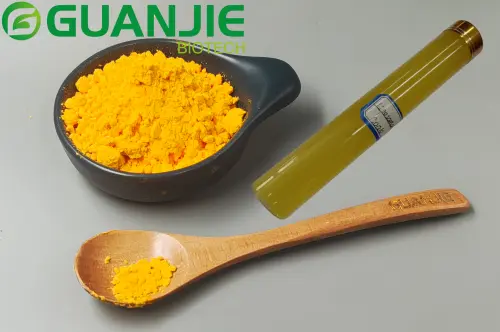
Liposome Coenzyme Q10 is available in two forms: powder and oil. Each form is developed and produced for different industrial applications. Strict quality control is applied throughout the production process.
1. Liposome Coenzyme Q10 Powder
Liposome Coenzyme Q10 Powder is produced using a low-temperature freeze-drying process. This process helps preserve the phospholipid bilayer vesicle structure. The powder has good flowability, low moisture content, and high stability. It disperses quickly in water without residue or precipitation. It is suitable for solid formulations such as solid beverages, tablets, compressed candies, and powdered dietary supplements. It can also dissolve rapidly in water-based liquid systems and is compatible with various liquid products.
2. Liposome Coenzyme Q10 Oil
Liposome Coenzyme Q10 Oil is produced using high-purity lipid carriers. The formulation is optimized to improve lipid-phase solubility. Coenzyme Q10 remains fully dissolved even at low temperatures without crystallization. It is suitable for soft capsules, oil-based skincare products, and functional oils. All products undergo multiple quality tests. These tests ensure high vesicle encapsulation efficiency, stable retention of active ingredients, and consistent dissolution performance between batches. This helps meet the requirements of standardized and large-scale production for global customers.
What Is Highly-Soluble Liposomal Coenzyme Q10 Used For?
From the perspective of industrial applications and product development, the excellent solubility of liposomal coenzyme Q10 offers several advantages. It helps companies develop more products and improve market competitiveness.
1. Expanding Product Development Opportunities
Liposomal coenzyme Q10 has both water-soluble and oil-soluble properties. This allows it to be used in a wider range of products. Traditional coenzyme Q10 is mainly used in fat-based formulations. In contrast, liposomal coenzyme Q10 can be added to water-based beverages, skincare products, powders, and other formulations. This gives companies more flexibility in product development and helps expand their product lines.
2. Reducing Costs and Improving Production Efficiency
Its good dispersion and dissolution properties help reduce the need for emulsifiers, stabilizers, and solubilizers. This can simplify the formulation process and make production more efficient. Fewer additives may also lower production costs. In addition, simpler formulations support the growing demand for clean-label products. This can improve product appeal and support regulatory compliance.
3. Supporting Stable Product Quality
Good solubility helps ensure that coenzyme Q10 is evenly distributed throughout the finished product. This reduces the risk of ingredient content variation between batches. It also improves product stability during storage and may help extend shelf life. Stable product quality can reduce customer complaints and after-sales issues. As a result, liposomal coenzyme Q10 provides reliable raw material support for large-scale production and long-term brand development.
FAQs:
1.How does liposome technology improve Coenzyme Q10 solubility?
Liposome technology encapsulates Coenzyme Q10 inside phospholipid bilayer vesicles. The structure contains a hydrophilic outer surface and a hydrophobic inner core. This design improves dispersion in aqueous systems. It also protects Coenzyme Q10 from degradation and crystallization, resulting in better stability and usability in formulations.
2.Is Liposomal Coenzyme Q10 soluble in both water and oil systems?
Yes. It shows dual compatibility:
In water systems, it disperses evenly without sedimentation.
In oil systems, it remains stable without crystallization.
3.What industries use highly soluble Liposomal Coenzyme Q10?
It is widely used in dietary supplements, functional foods, beverages, cosmetics, and pharmaceutical formulations due to its high stability and improved bioavailability potential.
4.What are the advantages of Liposomal Coenzyme Q10 in product formulation?
It improves dispersion, reduces the need for emulsifiers, enhances stability, lowers formulation complexity, and supports clean-label product development.
Conclusion:
The excellent solubility of liposomal coenzyme Q10 comes from several factors. These include its amphiphilic phospholipid vesicle structure, nanoscale production technology, and standardized product form. This technology improves solubility through physical structure modification. It does not damage the active structure of coenzyme Q10. It offers good safety, stability, and compatibility in different applications. Liposomal technology is one of the most effective solutions for improving the limitations of natural coenzyme Q10. It helps increase its usability in food, health products, cosmetics, and other industries.
Guanjie Biotech focuses on the bulk liposomal coenzyme Q10 market. We are committed to technological innovation and strict quality control. It continuously improve product solubility and formulation compatibility. Guanjie provides global customers with stable, cost-effective, and highly compatible raw materials. These products support the development of functional foods, cosmetics, and biopharmaceutical products. Welcome to enquire with us at info@gybiotech.com.

References:
[1] Akram, M. W., et al. (2022). Liposomal coenzyme Q10: A promising strategy for enhanced bioavailability and therapeutic efficacy. Journal of Drug Delivery Science and Technology, 68, 103089.
[2] Barenholz, Y. (2012). Doxil® - The first FDA-approved nano-drug: Lessons learned. Journal of Controlled Release, 160(2), 117-134.
[3] Bhagavan, H. N., & Chopra, R. K. (2006). Coenzyme Q10: Absorption, tissue uptake, metabolism and pharmacokinetics. Free Radical Research, 40(5), 445-453.
[4] Bhardwaj, P., et al. (2020). Liposomal formulation of coenzyme Q10: A novel approach for improving its oral bioavailability. Current Drug Delivery, 17(8), 680-690.
[5] Kalen, A., Appelkvist, E. L., & Dallner, G. (1989). Biosynthesis of ubiquinone in human tissues. Lipids, 24(7), 579-584.
[6] Liu, X., et al. (2021). Nanostructured liposomal coenzyme Q10 with improved solubility and stability for functional food applications. Food Chemistry, 345,
[7] Palamakula, A., & Khan, M. A. (2004). Evaluation of the solubility of coenzyme Q10 in various solvents and its solubilization in lipid-based formulations. AAPS PharmSciTech, 5(3), e46.
[8] Zmitek, J., et al. (2020). The influence of liposomal encapsulation on the bioavailability of coenzyme Q10: A randomized crossover study. Journal of Medicinal Food, 23(5), 498-504.
[9] Li Chunyan, et al. (2020). Research progress on improving the bioavailability of poorly soluble nutrients using liposome technology. China Food Additives, 31(5), 156-163.
[10] Zhang Yumei, et al. (2022). Current status and development trend of liposome delivery systems in functional food ingredients. Food Industry Technology, 43(12), 401-409.