In the natural plant active ingredient industry, indole-3-carbinol I3C powder and sulforaphane (SFN) powder are both key active compounds derived from cruciferous vegetables. They are widely used in dietary supplements, functional foods, biopharmaceuticals, and cosmetics. Because they share similar sources and application fields, they are often confused by procurement, R&D, and production teams. However, from an industrial perspective, they are two completely different, non-interchangeable natural active ingredients. So, what are the differences between Indole 3-carbinol and Sulforaphane?
Is Indole 3 Carbinol The Same As Sulforaphane?
Basic physicochemical and chemical property differences
Indole-3-carbinol and sulforaphane belong to different chemical classes. Their molecular structures determine key differences in stability, production difficulty, and storage and transport requirements. This is the basis for distinguishing their industrial applications.
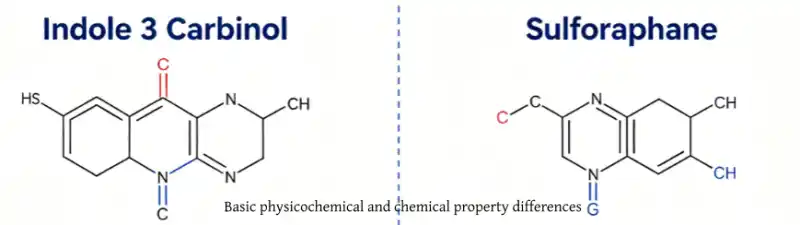
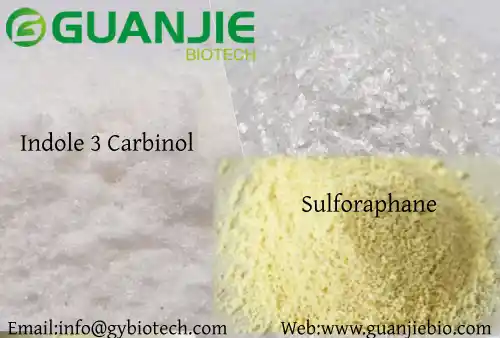
Indole-3-carbinol is an indole derivative. It is a hydrolysis product of glucobrassicin from cruciferous vegetables. It contains an indole ring as its core structure. It is relatively stable chemically and appears as a white crystalline powder under normal conditions. It is easily soluble in organic solvents. It has flexible storage requirements and is not easily decomposed or inactivated at room temperature. It is suitable for large-scale production, long-term storage, and long-distance transportation.
Sulforaphane is an isothiocyanate compound. It is formed from glucoraphanin through enzymatic or hydrolysis reactions. Its molecule contains an isothiocyanate functional group. Although it has stronger biological activity, it has poor physicochemical stability and is highly sensitive to environmental conditions. High temperature, strong acid, and strong alkali can easily damage its structure and cause degradation. Therefore, strict requirements are needed for production purification, aseptic packaging, temperature-controlled storage, and sealed logistics.
Biological mechanism and core efficacy
The two compounds act on different biological targets and pathways. This leads to clear differences in their functional focus. This is a key basis for product formulation and positioning in applications.
Indole-3-carbinol is mainly involved in hormone metabolism regulation and immune modulation. After entering the human body, it is converted into diindolylmethane (DIM) under gastric acid and enzymatic action. It helps regulate the liver cytochrome P450 enzyme system. It supports balanced estrogen metabolism by increasing beneficial estrogen metabolites and reducing harmful ones. It may also regulate immune cell activity and reduce chronic inflammation. It is commonly used in endocrine support, hormone balance, and basic immune health formulations.
Sulforaphane mainly supports antioxidant activity, detoxification pathway activation, and cellular protection. It is a strong activator of the Nrf2 signaling pathway. It modifies the Keap1 protein structure and activates the body's endogenous antioxidant and detoxification systems. It promotes the expression of phase II detoxification enzymes and helps eliminate free radicals and other harmful substances. It also helps reduce inflammation and oxidative stress damage. It is widely used in cellular protection, systemic antioxidant products, liver support, anti-aging applications, and high-end functional formulations.
Industrialization Characteristics
Due to differences in chemical properties, production processes, and cost structures, indole-3-carbinol and sulforaphane, two plant-based bioactive raw materials, show clear differences in industrial production models, application fields, quality control requirements, and cost systems. They are suited to different product positioning and price segments and present distinct industrial application scenarios.
• Indole-3-carbinol
Indole-3-carbinol has a high level of industrial maturity and is suitable for large-scale production. Its production process has been optimized over time and now has a stable and well-established technical system. The purification process is relatively simple, and the final product shows good stability. In industrial production, raw material loss is controllable. Production efficiency is stable. Mass production costs can be effectively reduced. This ensures a consistent and sufficient supply for bulk demand.
With its advantages of high cost-effectiveness, strong compatibility, and easy scalability, indole-3-carbinol is mainly used in mass-market applications. It is widely applied in dietary supplements, general functional foods, and basic health ingredient formulations. It meets the industry need for large-scale and standardized production. It is a versatile and widely used basic plant active ingredient.
• Sulforaphane
Sulforaphane is a high-end and refined raw material with significantly higher industrial production barriers and a more premium positioning. Its purification process is complex and technically demanding. The retention of active compounds requires advanced equipment and strict process control. Production losses are relatively high, which leads to higher manufacturing and production costs. In addition, quality control standards are more strict. There are tight requirements for purity, activity retention, and impurity limits.
With its high bioactivity and premium quality, sulforaphane is not positioned for mass production. It is mainly used in high-end and specialized applications. These include premium customized dietary supplements, precision nutrition products, biomedical research and development, and high-end functional skincare. It focuses on supplying high-purity and high-activity customized raw materials. It is designed to meet the precise and advanced R&D and formulation needs of premium end products.
Industrial Coordination and Application Value:
Indole-3-carbinol and sulforaphane are not different in quality. Their difference lies only in application scenarios. They have strong synergistic value and represent a mainstream research direction for compound functional raw materials.
Companies can use the hormone-balancing and immune-regulating benefits of indole-3-carbinol together with the antioxidant, detoxification, and cell-repair functions of sulforaphane. This enables multi-pathway and comprehensive body regulation effects.
This approach helps overcome the limitations of single-ingredient formulations. It also significantly improves the functionality, professionalism, and market competitiveness of final compound products.
FAQs:
Is Indole-3-Carbinol the same as Sulforaphane?
No. They are two completely different plant-derived active compounds. They differ in chemical structure, biological pathways, stability, and industrial applications.
Do Indole-3-Carbinol and Sulforaphane come from the same source?
Both originate from cruciferous vegetables, but they come from different precursors. I3C is derived from glucobrassicin, while sulforaphane is derived from glucoraphanin.
Which one is more stable during storage and transport?
Indole-3-carbinol is relatively stable under normal conditions and suitable for long-term storage. Sulforaphane is highly unstable and requires strict temperature and protection conditions.
Do Indole-3-Carbinol and Sulforaphane have the same biological effects?
No. I3C mainly supports hormone metabolism and immune regulation. Sulforaphane mainly supports antioxidant defense, detoxification pathways, and cellular protection.
Can Indole-3-Carbinol and Sulforaphane be used interchangeably in formulations?
No. They are not interchangeable. Each has distinct mechanisms and should be selected based on specific functional goals.
Can Indole-3-Carbinol and Sulforaphane be used together?
Yes. They are often considered complementary. I3C supports hormone balance, while sulforaphane supports antioxidant and detoxification pathways.
High-quality indole-3-carbinol and sulforaphane Supplier:
Guanjie Biotech is a core bulk supplier of indole-3-carbinol and sulforaphane. It focuses on innovative R&D, large-scale production, and standardized quality control of these two plant-based active ingredients. It meets the mass production, R&D, and customization needs of global B2B clients.

Full-Chain Standardized Production System:
The company has moved away from extensive production methods. It has built a complete quality control system covering raw material extraction, purification, activity testing, aseptic packaging, temperature-controlled storage, and logistics. All production parameters are traceable and controllable. This ensures stable product quality and minimal batch-to-batch variation.
Differentiated Raw Material Supply Solutions:
For indole-3-carbinol, the company focuses on large-scale production supply. It ensures high purity, high stability, and cost-effectiveness to meet large-volume customer needs.
For sulforaphane, the company strictly controls key parameters such as production temperature, pH, and purification accuracy. This helps preserve bioactivity and reduce impurities. It meets the strict standards of high-end biopharmaceuticals, precision nutrition, and functional skincare.

Global Customer Service Capabilities:
The company provides customized raw materials with different purities and specifications based on customer needs. It supports formulation development and mass production across multiple industries. Its service network covers more than 100 countries and regions. It provides stable and efficient supply chain services to B2B clients in food, health products, biopharmaceuticals, and cosmetics. It is widely recognized for consistent quality and professional service.
Summary
In summary, indole-3-carbinoland sulforaphane are two independent natural active ingredients. They differ in structure, efficacy, industrial characteristics, and application scenarios. They should not be confused or used as substitutes.
For B2B industry clients, selection should be based on product positioning, core efficacy needs, and production standards. Indole-3-carbinolis suitable for basic mass-market products. High-activity sulforaphane is suitable for high-end functional products. The two ingredients can also be combined to achieve synergistic effects in advanced compound formulations.
In the future, Guanjie Biotech will continue to improve its production processes. It will also upgrade its quality control system and expand its product portfolio. The company aims to provide global customers with cost-effective, stable, and highly adaptable solutions for natural plant active ingredients. This supports continuous improvement and upgrading of end products. Welcome to enquire with us at info@gybiotech.com.
References:
[1]Clarke JD, Hsu A, Riedl K, et al. Bioavailability and tissue distribution of sulforaphane in the mouse after oral administration. The FASEB Journal. 2010;24(1):148.
[2]Frydoonfar HR, McGrath DR, Spigelman AD. The effect of indole-3-carbinol and sulforaphane on a prostate cancer cell line. ANZ Journal of Surgery. 2003;73(3):154-156.
[3]Hauder J, Winkler S, Bub A, et al. LC–MS/MS quantification of sulforaphane and indole-3-carbinol metabolites in human plasma and urine after dietary intake of selenium-fortified broccoli. Journal of Agricultural and Food Chemistry. 2011;59(15):8047-8057.
[4]Ho E, Wong CP, Bouranis JA, Shannon J, Zhang Z. Cruciferous Vegetables, Bioactive Metabolites, and Microbiome for Breast Cancer Prevention. Annual Review of Nutrition. 2025;45(1):171-195.
[5]Kokotou MG, Revelou PK, Pappas C, Constantinou-Kokotou V. High-resolution mass spectrometry studies of sulforaphane and indole-3-carbinol in broccoli. Food Chemistry. 2017;240:566-573.
[6]Li Y, Zhang T, Korkaya H, et al. Sulforaphane, a dietary component of broccoli/broccoli sprouts, inhibits breast cancer stem cells. Clinical Cancer Research. 2010;16(9):2580-2590.
[7]Beaver LM, Kuintzle R, Buchanan A, et al. Long-term exposure to sulforaphane and indole-3-carbinol induces DNA damage and inhibits growth in prostate cancer cells. Molecular Nutrition & Food Research. 2017;61(10):1600980.
[8]Wakefield R. What is the clinical evidence that cruciferous vegetables and the supplemental compounds 3,3' diindolylmethane, sulforaphane and indole-3-carbinol, modulate the potentially harmful effects of oestrogen metabolites? A narrative review. NCA. 2023.