Spermidine and Urolithin A are two important ingredients used in research on cellular health and healthy aging. Although both are associated with cellular quality control, they have different primary mechanisms. Urolithin A mainly supports mitophagy, the process through which damaged or dysfunctional mitochondria are selectively removed. In contrast, spermidine promotes autophagy, a broader cellular recycling process that helps remove unwanted cellular components. Research suggests that these two anti-aging ingredients have overlapping but distinct biological pathways. Urolithin A is primarily associated with mitochondrial health, while spermidine is studied for its broader role in autophagy and metabolic regulation. For B2B purchasers, understanding the differences between spermidine and Urolithin A is important when selecting raw materials, developing cellular health supplements, designing formulations, and evaluating regulatory requirements and target markets.
Chemical Nature and Sources
Urolithin A
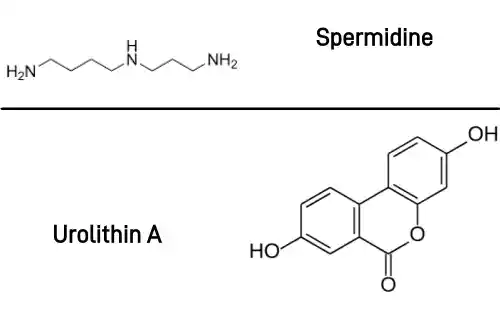
Urolithin A (molecular formula: C₁₃H₈O₄) is a dibenzo-γ-pyrone compound produced by gut microbiota through the metabolism of ellagitannins and ellagic acid. Natural precursors are found in foods such as pomegranates, strawberries, walnuts, and raspberries. However, not everyone can efficiently convert these compounds into Urolithin A. This variation depends largely on individual gut microbiota composition, resulting in differences in natural Urolithin A production.
For supplement manufacturers, high-purity Urolithin A powder (99%) provides a standardized raw material option. Commercial Urolithin A is mainly produced through chemical synthesis, with fermentation also being a possible production route. It is widely considered for use in premium dietary supplement formulations.
Spermidine
Spermidine (molecular formula: C₇H₁₉N₃) is a naturally occurring aliphatic polyamine found in plants, animals, and microorganisms. It participates in important cellular processes, including DNA stabilization, mRNA translation, and ion channel regulation. Common natural spermidine sources include wheat germ, soybeans, mushrooms, fermented soy products, and aged cheese.
For commercial applications, spermidine powder is available in different forms, including wheat germ extract and high-purity synthetic spermidine. Both spermidine raw materials and Urolithin A are used in the development of dietary supplement products. Manufacturers should evaluate purity, source, production method, specifications, and quality documentation when selecting bulk ingredients.
|
Dimension |
Urolithin A |
Spermidine |
|
Chemical Category |
Benzocoumarin-type metabolite |
Aliphatic polyamine |
|
Molecular Formula |
C₁₃H₈O₄ |
C₇H₁₉N₃ |
|
Natural Source |
Final metabolic product of ellagitannins (found in pomegranates, strawberries, and walnuts) by gut microbiota |
Wheat germ, soybeans, mushrooms, fermented foods |
|
In Vivo Transformation |
Dependent on gut microbiota; conversion rates vary among individuals |
Directly absorbable; no microbial conversion required |
|
Industrial Production Route |
Produced via total synthesis (primary method) or fermentation |
Derived from wheat germ or produced via chemical synthesis |
|
Typical Purity Specification |
≥99% |
Available as extracts (1%–5% spermidine content) or in high-purity form (≥98%) |
Mechanisms of Action: Similarities and Differences Between Spermidine and Urolithin A
Spermidine and Urolithin A are two increasingly researched ingredients associated with cellular health, autophagy, and aging-related biological processes. Although both compounds influence cellular quality control, their primary mechanisms of action are different. Understanding the differences between Urolithin A and spermidine can help supplement manufacturers and ingredient buyers evaluate their potential applications.
Urolithin A: A Targeted Mechanism Focused on Mitophagy
The primary mechanism of Urolithin A is its ability to promote mitophagy, a selective autophagy process that removes damaged or dysfunctional mitochondria. This process helps maintain mitochondrial quality and supports normal cellular energy metabolism.
Research suggests that Urolithin A can influence mitochondrial quality-control pathways, including PINK1/Parkin signaling and receptor-mediated pathways involving proteins such as BNIP3 and NIX. It may also interact with signaling networks associated with AMPK, ULK1, and mitochondrial biogenesis. These processes help coordinate the removal of damaged mitochondria and the maintenance of healthy mitochondrial populations.
Animal studies have reported improvements in physical activity and endurance following Urolithin A supplementation. However, these findings should not be directly interpreted as proven human outcomes. Its potential effects on mitochondrial function and muscle performance have also been investigated in human clinical trials.
Compared with general autophagy, Urolithin A mitophagy is more specifically associated with mitochondrial quality control. This makes it an important research ingredient for applications involving mitochondrial function, muscle health, and healthy aging.
Spermidine: A Broader Mechanism Focused on Cellular Autophagy
Spermidine is a naturally occurring polyamine involved in several important cellular processes. Its primary mechanism of action is associated with the regulation of general autophagy, which helps cells remove damaged proteins, dysfunctional organelles, and other unwanted cellular components.
One proposed mechanism involves the inhibition of EP300 (p300), an acetyltransferase that regulates autophagy-related proteins. By influencing protein acetylation, spermidine may support the activation of autophagy-related processes involving proteins such as LC3, ATG5, and ATG7.
Spermidine also interacts with several cellular signaling pathways, including AMPK, SIRT1, and mTOR. In addition, it supports hypusination of eIF5A, a process involved in protein translation and cellular function.
Although spermidine may also influence mitophagy, its biological effects are broader than mitochondrial quality control alone. Research has investigated its potential relationship with cardiovascular function, cognitive health, and cellular aging. However, many findings remain based on preclinical studies and observational research.
Implications for Ingredient Selection and Product Development
The different mechanisms of spermidine and Urolithin A influence their potential positioning in dietary supplement formulations.
• Urolithin A
Urolithin A is commonly researched for mitochondrial health, muscle function, and physical endurance. Its human clinical research provides a foundation for evaluating these specific application areas.
• Spermidine
Spermidine has a broader research profile related to autophagy, cellular maintenance, and healthy aging. However, evidence supporting specific health benefits varies, and additional human clinical trials are needed.
For B2B supplement manufacturers, Urolithin A may be considered for mitochondrial health and muscle-focused formulations, while spermidine may be evaluated for products targeting cellular health and healthy aging. Final product positioning should always reflect the available clinical evidence and applicable regulatory requirements.
Comparison of Clinical Evidence
• Urolithin A
Urolithin A has been investigated in randomized controlled trials involving human participants. A 2019 study by Andreux et al. examined oral supplementation and mitochondrial-related biomarkers in healthy older adults. A 2022 randomized clinical trial published in JAMA Network Open further evaluated its effects on muscle endurance and mitochondrial health in older adults.
• Spermidine
Spermidine research in humans is less extensive. The smartAge trial investigated its potential effects on cognitive performance in older adults, but larger and longer-term clinical studies are still needed.
Both ingredients have demonstrated promising research profiles, but their clinical evidence should be evaluated separately. Supplement manufacturers should also review ingredient specifications, purity, safety documentation, and recommended application levels when sourcing bulk spermidine or Urolithin A powder.
Compliance and Regulatory Landscape (Key Considerations for B2B)
|
Region |
Urolithin A |
Spermidine |
|
United States |
FDA GRAS (Generally Recognized As Safe) status (approved in 2020 for use as a food ingredient) |
Used as an ingredient in dietary supplements; no "novel food" regulatory hurdles. |
|
European Union |
EFSA "Novel Food" authorization (granted in 2021) |
Spermidine derived from wheat germ has a history of consumption in Europe. |
|
United Kingdom |
Novel food application currently under risk assessment (by the FSA; ongoing) |
Depends on the specific source and specifications. |
|
Switzerland |
Classified as a "novel food" by the FSVO (as of 2025), requiring a formal authorization process |
Depends on the specific source. |
|
China |
Not yet approved as a "novel food ingredient" (or "new resource food") domestically; currently focused on cross-border and export markets |
Not yet included in the catalog of "novel foods" (new resource foods); primarily distributed via cross-border channels. |
It is important to note that while the regulatory status of Urolithin A is relatively clear in Europe and the United States, it has not yet been approved as a "new food ingredient" in the Chinese mainland market. Furthermore, as of 2025, the Swiss Federal Food Safety and Veterinary Office (FSVO) still classifies it as a "novel food" and requires a formal authorization process-an indication that the regulatory pathway for this substance is still evolving in certain markets.
For purchasers supplying goods to different markets, this necessitates two entirely distinct sets of regulatory filing strategies and labeling systems.
Application Scenarios and Formulation Strategies
Targeted Applications of Urolithin A
• Muscle Health and Sports Nutrition:
Urolithin A is used in healthy aging and sports nutrition formulations focused on muscle function, endurance, and mitochondrial health. It is particularly relevant to products targeting middle-aged and older adults concerned about age-related muscle changes.
• Energy and Metabolic Health:
Urolithin A supports mitochondrial function and is a potential ingredient for energy metabolism formulations. It can be combined with NAD+ precursors such as NMN, PQQ, and L-ergothioneine to develop multi-ingredient supplements.
• Product Formats and Dosage:
Urolithin A supplements are available in capsules, tablets, softgels, and powders. Daily amounts of 100–500 mg may be considered during formulation, depending on the intended product and supporting clinical evidence. Its limited water solubility should also be considered when selecting delivery systems.
Targeted Applications of Spermidine
Healthy Aging Supplements: Spermidine is widely studied for its relationship with autophagy, cellular renewal, and healthy aging. It is suitable for supplement formulations targeting cellular health and general wellness.
Oral Beauty and Women's Health: Spermidine can be incorporated into beauty-from-within and healthy aging products. Formulators may combine spermidine with NMN, Urolithin A, PQQ, or ergothioneine to develop multi-ingredient supplement concepts.
Product Formats and Dosage: Spermidine is commonly formulated into capsules, tablets, and powder blends. Daily amounts of 1–6 mg are used in some research and product formulations. The appropriate dosage depends on the ingredient source, regulatory requirements, and applicable safety evidence.
Spermidine and Urolithin A: Combination vs. Monotherapy
Spermidine and Urolithin A have different but potentially complementary biological mechanisms. Urolithin A is associated with mitophagy, the process of removing damaged mitochondria, while spermidine is studied for its role in autophagy and cellular maintenance.
Combining Spermidine and Urolithin A may offer opportunities for developing differentiated healthy aging supplements. However, direct human clinical evidence supporting their combined use remains limited. Brands should carefully evaluate ingredient compatibility, dosage, product stability, and regulatory requirements before developing combination products. Monotherapy formulations may offer a simpler approach to ingredient standardization, clinical evidence evaluation, and product positioning.
Conclusion: How To Choose Spermidine or Urolithin A?
Selecting between Spermidine and Urolithin A requires careful consideration of target markets, product positioning, ingredient quality, dosage, and supply chain reliability. Both are widely discussed in the healthy aging and dietary supplement sectors, but they have different mechanisms of action, research backgrounds, and regulatory considerations.
Regulatory Requirements in Target Markets
For US and European markets, buyers should verify the regulatory status of each ingredient separately. Urolithin A has an established US GRAS notification history and an EU novel food authorization. However, the permitted conditions of use, specifications, and labeling requirements must be checked before commercialization. Spermidine also requires market-specific regulatory assessment, particularly regarding its source and intended application. For cross-border e-commerce and multi-market distribution, compliance should be evaluated country by country.
Ingredient Selection and Product Positioning
Urolithin A is commonly positioned in supplements targeting mitochondrial function, muscle health, and healthy aging. Spermidine is associated with autophagy research and broader healthy-aging product concepts. Manufacturers should select ingredients according to their target consumers, scientific evidence, and permitted marketing claims rather than relying solely on popular anti-aging trends.
Raw Material Quality and Supply Chain Verification
When purchasing bulk Urolithin A powder, buyers should verify the manufacturing route, purity (such as ≥99% when specified), impurity profile, residual solvents, and stability data. For Spermidine powder, important factors include raw material source, extraction or synthesis methods, assay methodology, free-base or salt-form calculation, and residual solvent levels. A reliable supplier should provide a COA and relevant quality documentation.
Dosage and Formulation Costs
Urolithin A is generally formulated at hundreds of milligrams per serving, while Spermidine is typically used at milligram-level quantities. Therefore, their cost contributions differ significantly. Buyers should calculate formulation costs using evidence-based serving levels and verified ingredient content. Low-dose products should also be checked to ensure meaningful ingredient quantities.
Combination Strategies
Combining Spermidine and Urolithin A may offer complementary research-based positioning because they are associated with different cellular pathways. Urolithin A is studied for mitophagy, while Spermidine is investigated for autophagy regulation. However, ingredient compatibility, formulation stability, dosage, and regulatory compliance should be assessed before combining them.
Ultimately, choosing a suitable Spermidine or Urolithin A supplier requires more than comparing prices. Buyers should prioritize documented purity, consistent quality, transparent manufacturing information, and regulatory suitability for their target markets.
Spermidine and Urolithin A Powder Supplier
Guanjie Biotech is a professional spermidine powder supplier and urolithin A powder supplier, providing raw material ingredients for dietary supplement manufacturers and other B2B customers. We specialize in supplying bulk spermidine powder and bulk urolithin A powder for different product development needs. As an experienced supplier of spermidine and urolithin A raw materials, we focus on product quality, consistent specifications, and reliable bulk supply. We also offer flexible OEM and ODM services to support customized supplement development and manufacturing requirements. Whether you are sourcing spermidine or urolithin A for capsules, tablets, or other supplement formulations, Guanjie Biotech can provide ingredient sourcing solutions for your business.
References:
[1] Borsky P, Valachovic T, Fedorova T. Distinct roles of urolithin A and spermidine in mitophagy and autophagy: implications for dietary supplementation. Nutrition Research Reviews, 2025. Cambridge University Press.
[2] Borsky P, et al. Distinct roles of urolithin A and spermidine in mitophagy and autophagy: implications for dietary supplementation - Abstract. PubMed PMID: 41404767. https://pubmed.ncbi.nlm.nih.gov/41404767/
[3] Ryu D, Mouchiroud L, Andreux P A, et al. Urolithin A induces mitophagy and prolongs lifespan in C. elegans and increases muscle function in rodents. Nature Medicine, 2016, 22(8): 879-888. PMID: 27400265.
[4] Liu S, D'Amico D, Shankland E, et al. Effect of Urolithin A Supplementation on Muscle Endurance and Mitochondrial Health in Older Adults: A Randomized Clinical Trial. JAMA Network Open, 2022, 5(1): e2144279. doi:10.1001/jamanetworkopen.2021.44279. https://jamanetwork.com/journals/jamanetworkopen/fullarticle/2788244
[5] Liu S, et al. Effect of Urolithin A Supplementation on Muscle Endurance and Mitochondrial Health in Older Adults: A Randomized Clinical Trial. PMC: PMC8777576. https://pmc.ncbi.nlm.nih.gov/articles/PMC8777576/
[6] Andreux P A, Blanco-Bose W, Ryu D, et al. The mitophagy activator urolithin A is safe and induces a molecular signature of improved mitochondrial and cellular health in humans. Nature Metabolism, 2019, 1(6): 595-603.
[7] Singh A, D'Amico D, Andreux P A, et al. Urolithin A improves muscle strength, exercise performance, and biomarkers of mitochondrial health in a randomized trial in middle-aged adults (ATLAS). Cell Reports Medicine, 2022, 3(5): 100633. PMID: 35584623.
[8] U.S. Food and Drug Administration. Agency Response Letter GRAS Notice No. GRN 000791 - Urolithin A (Amazentis SA). 2018-12-20. https://www.fda.gov/media/120300/download
[9] U.S. Food and Drug Administration. GRAS Notice No. 791 - Urolithin A (GRAS Notice Inventory). https://www.hfpappexternal.fda.gov/scripts/fdcc/index.cfm?set=grasnotices&id=791
[10] Keohane P, et al. Supplementation of spermidine at 40 mg/day has minimal effects on circulating polyamines: An exploratory double-blind randomized controlled trial in older men. Nutrition Research, 2024, 132: 1-14. doi:10.1016/j.nutres.2024.09.012. PMID: 39405978.
[11] Mackert A, et al. High-Dose Spermidine Supplementation Does Not Increase Spermidine Levels in Blood Plasma and Saliva of Healthy Adults: A Randomized Placebo-Controlled Pharmacokinetic and Metabolomic Study. Nutrients, 2020. https://pmc.ncbi.nlm.nih.gov/articles/PMC10143675/
[12] Schwarz J, et al. Safety and tolerability of spermidine supplementation in mice and older adults with subjective cognitive decline. Aging (Albany NY), 2018, 10(1): 19-33. PMID: 29315079.
[13] Natural Bioactive Compounds Targeting Key Hallmarks of Aging: Functional Food Potential of Spermidine, Fisetin, Berberine, and Urolithin A. Nutrients (MDPI), 2026, 18(15): 2511.
[15] Urolithin A: Benefits and Evidence - Regulatory status (as of May 2026). Superpower Health Guide, 2026-10-15.
[16] Urolithin A - New Food Application(New food application, status: in progress). FSA / FSVO