Latest Products

Contact Us
-
6th Floor, 2nd Building, Xijing NO.3, XiJing Industrial Park, DianZi Western Street, Xi'an, Shaanxi, China
-
+86-2988253271
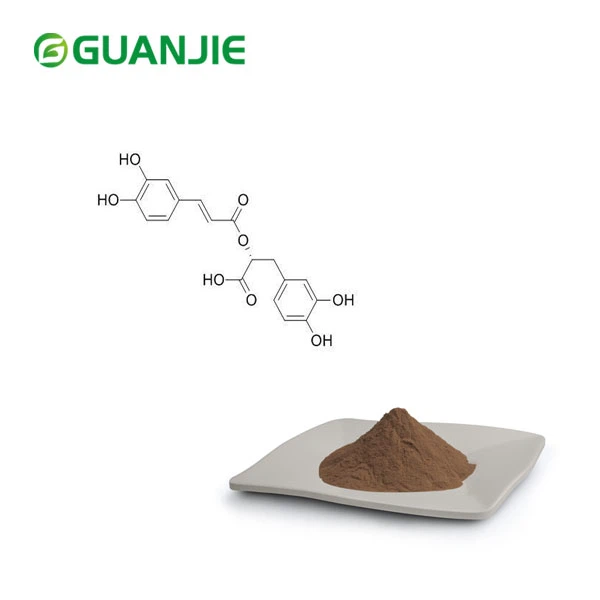


Rosemary Extract Powder
Specifications:5%, 10% ,15%,25%
Test method: HPLC
Appearance:Brown fine powder
Uses:Pharmaceutical, Food, Cosmetics
Shelf time:Two years
Storage conditions: Nomal temperature
Two Factories & Three production lines
CGMP standard workshop & two independent laboratories
Certifications: Halal,ISO9001,PAHS Free,NON-GMO,KOSHER,SC
Overseas warehouse(NJ,USA)
Delivery term: DHL, FEDEX, Air freight,Sea freight
Provide Free Sample
MOQ: 1KG
Not for Private Person Sale
Description
Rosemary Extract Powder Supplier:
Guanjie focuses on Rosemary Extract Powder researching, producing and trading for 20 years. It is derived from the Rosemary plant of the Lamiaceae family. It is available in 5%, 10%, 15%, and 25% specifications and is tested using the advanced HPLC method. The powder has a brown fine appearance and is soluble in water. With a shelf life of two years, it is recommended to store it at normal temperature.

Why Choose Guanjie?
● Customize products as your requirement
● Available Certificates of ISO9001, ISO22000, Kosher, Halal
● Practical Base for Master's Students in the School of Chemistry and Materials Science, Northwest University
● Our factory makes sure the product quality steps
Product Introduction:
Casesavi powder is a natural supplement made from the leaves of the rosemary plant. Rosemary Extract Powder is often used as an antioxidant and as a natural preservative in food and cosmetic products. It is also believed to have anti-inflammatory, as well as improving memory and concentration.
Certificate of analysis
|
Item |
Specification |
Result |
Method |
|
Basic Product Information |
|||
|
Genus and Species |
Rosmarinus officinalis |
Conform |
/ |
|
Part of the Plant |
Leaf |
Conform |
/ |
|
Country of Origin |
China |
Conform |
/ |
|
Marker Compounds |
|||
|
Assay(ROSMARINIC ACID) |
>25% |
25.21% |
HPLC |
|
Organoleptic Data |
|||
|
Appearance |
Fine powder |
Conform |
GJ-QCS-1008 |
|
Color |
Light Brown powder |
Conform |
GB/T 5492-2008 |
|
Odor |
Characteristic |
Conform |
GB/T 5492-2008 |
|
Taste |
Characteristic |
Conform |
GB/T 5492-2008 |
|
Process Data |
|||
|
Method of Processing |
Extraction |
Conform |
/ |
|
Solvent(s) Used |
Grain alcohol/water |
Conform |
/ |
|
Drying Method |
Vaccum drying |
Conform |
/ |
|
Excipient |
None |
Conform |
/ |
|
Physical Characteristics |
|||
|
Particle Size (80 mesh) |
100.0%pass 80mesh |
Conform |
GB/T 5507-2008 |
|
Loss on Drying |
<5.0% |
3.12% |
GB/T 14769-1993 |
|
Ash Content |
<4.0% |
2.16% |
AOAC 942.05, 18th |
|
Solvent Residue |
Eur. Pharm |
Conform |
GJ-QCS-1007 |
|
Heavy Metals |
|||
|
Total Heavy Metals |
<10ppm |
Conform |
USP <231>, method II |
|
As |
<1.0ppm |
Conform |
AOAC 986.15, 18th |
|
Pb |
<3.0ppm |
Conform |
AOAC 986.15, 18th |
|
Cd |
<1.0ppm |
Conform |
AOAC 986.15, 18th |
|
Hg |
<0.1ppm |
Conform |
AOAC 971.21, 18th |
|
Pesticide Residue |
|||
|
666 |
<0.2ppm |
Conform |
GB/T5009.19-1996 |
|
DDT |
<0.2ppm |
Conform |
GB/T5009.19-1996 |
|
Microbiology |
|||
|
Total Plate Count |
<1,000cfu/g |
Conform |
AOAC 990.12, 18th |
|
Yeast & Mold |
< 100cfu/g |
Conforms |
FDA (BAM) Chapter 18, 8th Ed. |
|
E. Coli |
Negative |
Negative |
AOAC 997.11, 18th |
|
Salmonella |
Negative |
Negative |
FDA (BAM) Chapter 5, 8th Ed. |
Extraction Methods:
● Water Extraction:
Water extraction is the most straightforward method of Rosemary Extract Powder extraction, which involves soaking rosemary leaves in hot water to extract the desired chemical constituents. The water is heated to 80°C and then mixed with rosemary leaves. The mixture is kept for some time to allow the extraction of the desired chemicals from the leaves into the water. The solution is then filtered, and the filtrate can be concentrated and dried to obtain rosemary extract powder.
● Ethanol Extraction:
Ethanol extraction is a popular method for obtaining rosemary extract powder. This method involves immersing the rosemary leaves in ethanol, which can extract both water-soluble and fat-soluble compounds. The mixture is then heated, and the ethanol evaporates, leaving behind a concentrated extract.
● Supercritical Fluid Extraction:
Supercritical fluid extraction (SFE) is a modern method of extracting rhodanolic acid powder, which uses supercritical carbon dioxide (CO2) as a solvent. In this method, CO2 is heated and pressurized until it becomes a supercritical fluid that can dissolve non-polar compounds from the rosemary leaves.
● Microwave-assisted Extraction:
Microwave-assisted extraction (MAE) is a relatively new method of extracting rosemary extract powder. In this method, the rosemary leaves are immersed in a suitable solvent, such as ethanol or water, and then subjected to microwaves. The microwaves generate heat that helps to extract the active compounds from the leaves more quickly and efficiently.
Dosage:
In general, the recommended daily dosage for cinnamyl glycoside ranges from 500 milligrams to 1,500 milligrams per day. This dosage can be taken in divided doses throughout the day to maximize the benefits. For specific health conditions, such as cognitive function or digestion issues, a healthcare practitioner may recommend a higher dose.
When using rosemary extract powder for culinary purposes, the dosage will depend on the recipe and personal preference. Typically, a small amount is added to dishes such as roasted vegetables, meats, or baked goods for flavor and antioxidant benefits. It is important to note that rosemary extract powder is a concentrated form of the plant and should not be taken in excessive amounts.
Factory&Team:

Certification

Package & Shipment

Hot Tags: rosemary extract powder, China rosemary extract powder manufacturers, suppliers, factory, Sodium Copper Chlorophyllin Powder, Gynostemma Extract Powder, bulk stevia powder, Daidzein Powder, pure bulk fisetin, gaba bulk powders
You Might Also Like