Latest Products

Contact Us
-
Building 2, QinChuang Chang'an Industrial Park,Chang'an District, Xi'an City, Shaanxi Province
-
+86-2988253271
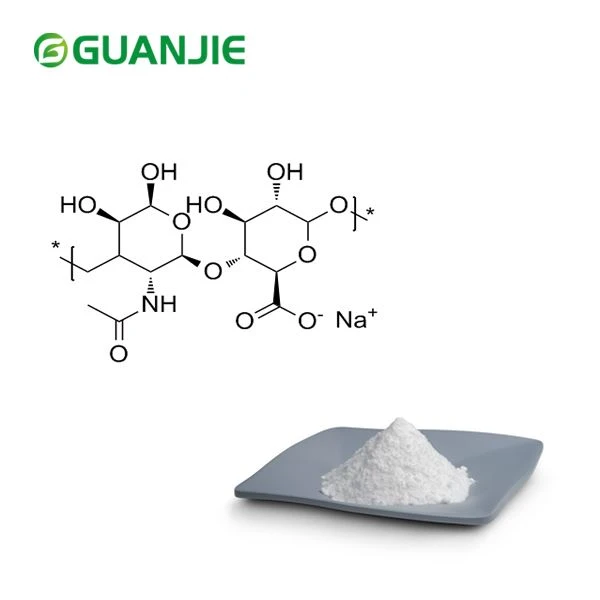
Sodium Hyaluronate Powder Bulk
Appearance White crystals or crystalline powder
Assay (%) ≥99.0
CAS No.:9004-61-9
Two Factories & Three production lines
GMP standard workshop & two independent laboratories
FDA Cert.
Certifications: Halal,ISO9001,PAHS Free,NON-GMO,KOSHER,SC
Overseas warehouse(NJ,USA)
Delivery term: DHL, FEDEX, Air freight,Sea freight
Provide Free Sample
MOQ: 1KG
Not for Private Person Sale
Description
Sodium Hyaluronate Powder Supplier for Customized Ingredient Solutions
Guanjie Biotech is a bulk Sodium Hyaluronate Powder supplier, providing water-soluble sodium hyaluronate for various industrial applications. This white granule or powder dissolves in water to form a clear, viscous, non-Newtonian solution. It is insoluble in ethanol, acetone, and ether. Sodium hyaluronate, also known as hyaluronic acid sodium salt, is a linear polysaccharide composed of repeating disaccharide units of glucuronic acid and N-acetylglucosamine. Its molecular weight influences its physicochemical properties and solution viscosity. Guanjie Biotech offers bulk sodium hyaluronate powder with OEM and ODM services, supporting customized specifications and formulation requirements for B2B manufacturers and ingredient buyers.

COA:
|
Test Items |
Standard |
Result |
|
Appearance |
White powder |
White powder |
|
Sodium Hyaluronate |
≥90% |
99.10 |
|
Glucuronic acid |
≥43% |
48% |
|
Molecular weight |
0.8-1.6X 10⁶ |
1.1X 10⁶ |
|
PH |
6.0-8.0 |
7.2 |
|
Loss on drying |
<10% |
4.1% |
|
Particle Sizk |
0.15-0.25 |
Complies |
|
Heavy metal |
<20ppm |
Complies |
|
Arsenic |
<2ppm |
Complies |
|
Heat remaining strong |
≤13.0% |
12.0% |
|
Bacterial counts |
<1000cfu/g |
Complies |
|
Mold and Yeast |
<100cfu/g |
Complies |
|
Staphylococcus aureus |
Can not be checked |
Complies |
|
Chlorop seu domonas |
Can not be checked |
Complies |
How Is Sodium Hyaluronate Powder Produced?

Sodium Hyaluronate & Hyaluronic Acid Differences
Sodium hyaluronate ≠ Hyaluronic acid
Sodium Hyaluronate Powder Bulk is the sodium salt of hyaluronic acid.
Although it is common to refer to sodium hyaluronate as hyaluronic acid, the two are not the same substance. Hyaluronic acid (HA), also known as vitric acid, is widely found in living organisms. Its commonly used form is sodium hyaluronate (SH), which is often referred to as hyaluronic acid as well.
Hydrolyzed sodium hyaluronate has a much lower molecular weight, allowing it to be absorbed into deeper layers of the body. Meanwhile, sodium hyaluronate possesses immune-regulating and anti-inflammatory properties, lubricates joints, and helps to beautify and nourish the skin.
Molecular weight size
The skin care function of Sodium Hyaluronate Powder Bulk mainly depends on the molecular weight and dosage. Commonly used sodium hyaluronate are:
◆ Ultra-micro sodium hyaluronate (molecular weight less than 10,000 Da)
◆ Small molecule sodium hyaluronate (molecular weight 10,000Da-1,000,000Da)
◆ Medium molecule sodium hyaluronate (molecular weight 1,000,000Da-1,800,000Da)
◆ Sodium hyaluronate macromolecule (molecular weight >1.8 million Da)
Sodium hyaluronate with molecular weight above 2,000,000 Da is mainly used for water storage and moisturising, UV protection, etc. 1,200,000-1,600,000 Da is the most commonly used sodium hyaluronate with the highest cost-effectiveness. 200,000-400,000 Da is based on the conventional molecular weight and its molecular weight is lowered by enzyme dissolution, which increases its fluidity. It plays a better moisturising effect in serums. Molecular weight of 10,000 Da or less can penetrate into the stratum corneum of the skin to achieve the function of deep hydration.
What Does Sodium Hyaluronate Powder Do?
Sodium Hyaluronate Powder is a water-binding ingredient widely used in skin care, cosmetics, pharmaceutical formulations, and other personal care products. As the sodium salt of hyaluronic acid, it helps maintain moisture, supports skin hydration, and contributes to the development of moisturizing formulations. Its functional properties depend on factors such as molecular weight, concentration, purity, and formulation design.
● Supports Skin Hydration and Cosmetic Performance
One of the primary benefits of Sodium Hyaluronate Powder is its ability to attract and retain water. In skin care formulations, it helps maintain skin moisture, improve surface smoothness, and reduce the appearance of dryness. Sodium hyaluronate for skin care is commonly incorporated into facial serums, moisturizing creams, lotions, masks, and other cosmetic products.
Different molecular weights offer different formulation benefits. High molecular weight sodium hyaluronate primarily forms a moisturizing film on the skin's surface, helping reduce moisture loss. Low molecular weight sodium hyaluronate has different penetration and hydration characteristics, depending on the formulation. Selecting the appropriate molecular weight can help manufacturers develop products with specific sensory and moisturizing properties.
● Provides Antioxidant-Related Benefits
Hyaluronic acid has been investigated for its potential role in protecting skin cells against oxidative stress. Research suggests that hyaluronic acid and related formulations may influence cellular responses to reactive oxygen species and environmental stressors. However, these effects depend on the experimental conditions, molecular characteristics, and finished formulation.
For cosmetic manufacturers, Sodium Hyaluronate Powder is primarily valued as a moisturizing ingredient. It can be combined with other formulation components, such as antioxidants, to develop skin care products designed to support skin hydration and overall appearance. It should not be considered a substitute for sunscreen or a proven treatment for UV-induced skin damage.
● Supports Wound Care Formulations
Sodium hyaluronate participates in processes associated with tissue hydration, cell migration, and tissue repair. Research has examined its potential role in wound healing and the development of wound care products. Its ability to maintain a moist environment may support suitable conditions for tissue repair.
The effectiveness of sodium hyaluronate for wound care depends on its grade, concentration, delivery system, and intended application. Pharmaceutical and medical applications require appropriate quality controls and regulatory assessment. Cosmetic-grade sodium hyaluronate should not automatically be considered suitable for medical use.
● Helps Manage Inflammatory Responses
Hyaluronic acid is a natural component of connective tissues and synovial fluid, where it contributes to lubrication and tissue function. Sodium hyaluronate is also used in certain medical formulations, including intra-articular products for specific joint conditions. Its biological effects vary according to molecular weight, dosage, administration route, and product design.
For ingredient buyers, it is important to distinguish cosmetic applications from pharmaceutical or medical applications. Evidence from injectable sodium hyaluronate products should not be directly applied to topical cosmetic ingredients.
● Helps Maintain Moisture Balance
The chemical structure of sodium hyaluronate contains hydrophilic groups that interact with water molecules. This water-binding capacity makes it a useful humectant in cosmetic formulations. By helping retain moisture, Sodium Hyaluronate Powder can improve skin hydration and contribute to a smoother, more supple appearance.
Hyaluronic acid levels in the skin can change with age and other biological factors. However, the effects of orally consumed sodium hyaluronate on skin hydration depend on the specific ingredient, dosage, absorption, and available clinical evidence. Topical and oral applications should therefore be evaluated separately.
What Is Sodium Hyaluronate Powder Used For?
◆ Medical Beauty
Sodium Hyaluronate Powder Bulk has a high level of safety as the main component of the extracellular matrix of animal connective tissue. Sodium hyaluronate has a certain viscosity after absorbing water. 1% sodium hyaluronate aqueous solution presents gel-like. It can be used as a filler in cosmetic surgery.
◆ Clinical treatment
Sodium Hyaluronate Powder Bulk has the characteristics of natural, degradable and good absorption. It has a wide range of clinical uses. Sodium hyaluronate has good viscoelasticity. It can effectively prevent the occurrence of postoperative shallow anterior chamber complications, delayed blister leakage after trabeculectomy and other ocular diseases. It is more widely used in eye surgeries such as cataract surgery, IOL transplantation and corneal transplantation.
◆ Food
Hyaluronic acid is used in cosmetology to moisturise the skin, enhance skin elasticity and prevent skin aging. However, as a biological macromolecule, it is not easily absorbed externally. The degradation of hyaluronic acid into small fragments (1~5)x105 orally. It is absorbed through the intestine in vivo, degraded into monosaccharides, and can increase the body's synthesis of hyaluronic acid required precursor.
At present, many developed countries have approved Sodium Hyaluronate Powder Bulk can be consumed as a common food additive. In 2021, China will include sodium hyaluronate in the list of new resources of food ingredients; it will be developed in the general food industry.
FAQs:
Q1. What is the difference between sodium hyaluronate powder and hyaluronic acid powder?
Sodium hyaluronate is the sodium salt of hyaluronic acid. Both ingredients are valued for their water-binding properties, but they differ in chemical form and certain physicochemical characteristics. Sodium hyaluronate is widely used in skincare formulations because of its compatibility with aqueous systems. Formulators should compare molecular weight, solubility, viscosity, purity, and product specifications when selecting between these ingredients.
Q2.Is sodium hyaluronate powder water-soluble?
Yes. Sodium hyaluronate powder is water-soluble, although its dissolution rate and solution viscosity depend on molecular weight, concentration, temperature, and mixing conditions. It may form lumps if added too quickly to water. For better processing, formulators should disperse the powder gradually under controlled agitation and allow sufficient hydration time. The final solution should be evaluated for uniformity, viscosity, and stability.
Q3. What purity should bulk sodium hyaluronate powder have?
The required purity depends on the intended application and the product's quality specification. Cosmetic manufacturers should review the assay or purity method, molecular weight, moisture content, microbial limits, and relevant contaminant data. Pharmaceutical or other regulated applications may require additional controls. A Certificate of Analysis (COA) should document the agreed parameters for each batch, and the analytical method should be appropriate for the material.
Q4. How should sodium hyaluronate powder be stored?
Sodium hyaluronate powder should generally be stored in a tightly sealed container in a cool, dry environment, protected from moisture and direct sunlight. Because the powder can absorb moisture, exposure during handling should be minimized. Manufacturers should follow the supplier's recommended storage temperature, packaging instructions, and shelf life. Once opened, the material should be resealed promptly to help maintain its specified quality.
Q5. What factors affect the viscosity of sodium hyaluronate powder solutions?
The viscosity of sodium hyaluronate solutions is affected by molecular weight, concentration, temperature, pH, ionic strength, and the presence of other ingredients. Higher molecular weight or concentration often increases viscosity under comparable conditions. Electrolytes and certain formulation components can change polymer behavior. Manufacturers should establish standardized preparation and measurement procedures to compare viscosity consistently between batches and during product development.
Certification

Company Advantages:

Package

Shipment

Hot Tags: sodium hyaluronate powder bulk, China sodium hyaluronate powder bulk manufacturers, suppliers, factory, L-carnitine Fumarate Powder, D-Chiro Inositol Powder, Alpha-GPC Powder
You Might Also Like