Latest Products


Contact Us
-
6th Floor, 2nd Building, Xijing NO.3, XiJing Industrial Park, DianZi Western Street, Xi'an, Shaanxi, China
-
+86-2988253271
Berberine HCL Bulk
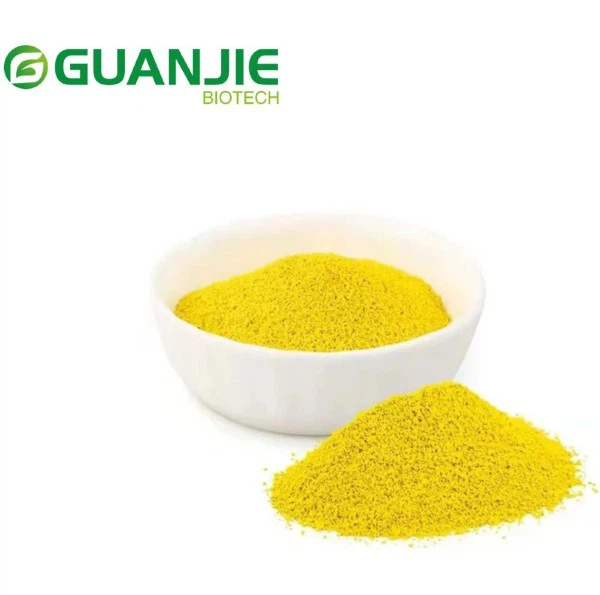
Other Name: Berberine Hydrochloride Powder
Raw Material: Golden cypress
Secification:97% 98% Berberine HCL
Appearance: Yellow crystalline powder
CAS No.:633-65-8
Test Method: HPLC,Titration
Two Factories & Three production lines
GMP standard workshop & two independent laboratories
FDA Cert.
Certifications: Halal,ISO9001,PAHS Free,NON-GMO,KOSHER,SC
Overseas warehouse(NJ,USA)
Delivery term: DHL, FEDEX, Air freight, Sea freight
Provide Free Sample
MOQ: 1KG
Not for Private Person Sale
Description
Berberine HCL Bulk Supplier:
Guanjie Biotech has professional experience in the berberine HCL bulk powder production and marketing. The company adopts advanced extraction and purification technologies to ensure high purity and stability of the products. If you are interested in our products, welcome to inquiry us: info@gybiotech.com.

- We adopt advanced testing methods. Such as, HPLC. This can ensure the quality of each batch of products.
- Our factory is set up in compliance with GMP standards. Ensure the hygiene and safety of berberine HCL bulk powder production process.
- We provide customized service. Adjust the product specification according to the customer's demand.
Certificate of Analysis
|
Item |
Specification |
Result |
Method |
|
Basic Product Information |
|||
|
Genus and Species |
Phellodendron amurense Rupr |
Conform |
/ |
|
Part of the Plant |
Root |
Conform |
/ |
|
Country of Origin |
China |
Conform |
/ |
|
Marker Compounds |
|||
|
Berberine hydrochloride |
>97.0% |
98.12% |
Titration |
|
Organoleptic Data |
|||
|
Appearance |
Powder |
Conform |
/ |
|
Color |
Yellow fine powder |
Conform |
/ |
|
Odor |
Characteristic |
Conform |
/ |
|
Taste |
Characteristic |
Conform |
/ |
|
Process Data |
|||
|
Method of Processing |
Extraction |
Conform |
/ |
|
Physical Characteristics |
|||
|
Particle Size (80 mesh) |
98.0%pass 80mesh |
Conform |
GB/T 5507-2008 |
|
Loss on Drying |
<5.0% |
3.04% |
5g/105℃/2hrs |
|
Ash Content |
<10.0% |
5.12% |
2g/525℃/3hrs |
|
Heavy Metals |
|||
|
Total Heavy Metals |
<10 ppm |
Conform |
USP<231>, method II |
|
As |
<1.0 ppm |
Conform |
AOAC 986.15, 18th |
|
Pb |
<2.0 ppm |
Conform |
AOAC 986.15, 18th |
|
Hg |
<0.5 ppm |
Conform |
AOAC 971.21, 18th |
|
Cd |
<0.5 ppm |
Conform |
AOAC 971.21, 18th |
|
Pesticide Residue |
|||
|
666 |
<0.2ppm |
Conform |
GB/T5009.19-1996 |
|
DDT |
<0.2ppm |
Conform |
GB/T5009.19-1996 |
|
Microbiology |
|||
|
Total Plate Count |
<1,000cfu/g |
Conform |
AOAC 990.12, 18th |
|
Total Yeast & Mold |
<100cfu/g |
Conform |
FDA (BAM) Chapter 18, 8th Ed. |
|
E. Coli |
Negative |
Negative |
AOAC 997.11, 18th |
|
Salmonella |
Negative |
Negative |
FDA (BAM) Chapter 5, 8th Ed. |
What is Berberine hydrochloride?
Berberine hydrochloride is a natural isoquinoline alkaloid produced by Berberis vulgaris. It has strong pharmacological effects. Berberine has been around since antiquity. Guanjie Biotech's berberine HCL bulk powder products are extracted from Coptis chinensis. Coptis chinensis has been widely used in traditional Chinese and Asian medicine for centuries.
Testing Methods:
Berberine Hydrochloride is an important alkaloid. Its detection methods are various, with liquid chromatography (HPLC) and titration being the two common quantitative analysis methods. Guanjie Biotech has rich experience in producing and detecting Berberine Hydrochloride powder. The company uses HPLC as the primary quality control method to ensure high purity and consistency of berberine HCL bulk. See the difference between the two below.
1. Liquid Chromatography (HPLC)
(1) Principle:
HPLC passes the mobile phase (solvent) containing the sample through a column containing the stationary phase under high pressure. Different components of the berberine HCL bulk powder sample are separated in the column due to different interactions with the stationary phase and the mobile phase. They are then detected by a detector and characterised based on retention time and quantified on the basis of peak area or peak height.
(2). Focus:
- High resolution: HPLC is capable of separating multiple components in complex sample matrices.
- High sensitivity: The UV-Vis detector is extremely sensitive for the detection of berberine HCL powder.
- Accuracy: Berberine HCL bulk can be accurately quantified by comparison with standards of known concentration.
(3). Advantage:
- Suitable for analysis of complex berberine extract powder samples.
- Multiple components can be identified and quantified simultaneously.
(4). Limitations:
- Higher cost of equipment and maintenance.
- Higher technical requirements for operators.
2. Titration
(1). Principle:
Titration is performed by adding a reagent of known concentration (titrant) drop by drop to a solution containing the substance to be measured. This is done until the chemical reaction is complete. The amount of the substance to be measured is calculated by measuring the volume of titrant consumed.
(2). Focus:
- Directness: titrations are usually based on direct chemical reactions. Such as acid-base titration, redox titration.
- Simplicity: simple operation, no need for complex instruments.
(3). strengths:
- Simple equipment and operation. Lower cost.
- For some types of chemical reactions, titration can be very accurate.
(4). Limitations:
- Usually, only a single or few components can be analyzed.
- It is strongly influenced by the sample matrix of berberine HCL bulk. May require complex sample pretreatment.

3. Differences in detection methods
(1). Analytical principle:
HPLC is based on the principle of chromatographic separation, which achieves separation and detection by the difference in migration speed of different components in the chromatographic system. While titration is based on the stoichiometric relationship of a chemical reaction, the volume of titrant consumed determines the amount of the substance to be measured.
(2). Sample suitability:
HPLC is suitable for analyzing a wide range of components in complex berberine hydrochloride samples. In contrast, titrimetric methods are usually only suitable for the analysis of a single or a few components.
(3). Sensitivity and accuracy:
HPLC usually has higher sensitivity and accuracy. Especially when modern detectors are used. The sensitivity and accuracy of titrimetric methods can be affected by the berberine HCL bulk sample matrix and chemical reaction conditions.
(4). Operational complexity:
HPLC operation is relatively complex. It requires specialized chromatographic equipment and some technical knowledge. Titration is relatively simple. It is easy to implement in a variety of laboratory settings.
(5). Cost:
The cost of HPLC equipment and maintenance is high, whereas the cost of the titrimetric method is low.
(6). Data processing:
HPLC usually requires the use of a chromatography workstation for data processing and analysis. Titration usually requires only basic calculations.
Liquid chromatography and titrimetric methods have their own focus and advantages in the determination of berberine HCL bulk. HPLC has the advantage of high resolution, high sensitivity and accuracy in the analysis of complex samples. Guanjie Biotech will use both methods to test berberine hydrochloride to ensure the quality of our customers' products, whereas titration is valuable for its simplicity and cost-effectiveness in specific cases.
Functions:
1. Lose Weight
Berberine has been shown to have a positive effect on reducing body fat and altering body composition. Its main benefits revolve around the activation of the AMPK enzyme. This enzyme plays a crucial role in the management of our metabolism. Berberine HCL bulk on fat loss is thought to be related to its improved insulin sensitivity as well as its activation of the AMPK enzyme.
Supplementing with berberine has potential benefits for inhibiting the body's ability to grow fat cells. But more research is needed before anything can be definitive.
There have been 2 key studies looking at the physical effects of berberine supplementation on overweight individuals. One 12-week study had obese individuals take 500 mg of berberine 3 times a day. On average, participants lost more than 2kg. The percentage of body fat decreased by about 3.6%. In a second study, obese individuals were given 300 mg of berberine 3 times a day and their BMI levels dropped from 31.5 to 27.4. Most importantly, overall health indicators improved significantly.
2. Improved Overall Health
Berberine HCL bulk has been shown to lower cholesterol levels, thereby reducing the risk of heart disease. This is thought to be caused by berberine's inhibitory effect on an enzyme called PCSK9, which when inhibited causes more LDL (bad cholesterol) to be removed from the bloodstream.
Dosage:
Dose per serving:
The ideal dose per serving of berberine appears to be between 500 - 1,000 mg. This relates to daily dosing. However, a single dose of 500 mg did appear in some studies. Then take a look at some of the top GDA and digestive supplements on the market The upper limit of 1,000 mg seems to be as high as some.
We will pay particular attention to the fact that many supplements will use a dose of 200 - 300 mg of berberine. However, based on our research, we would recommend at least 500 mg per serving.
Daily Dose:
From a daily perspective, a daily intake of 1,000 to 1,500 mg of berberine HCL bulk is recommended. Whether it is three 500 mg doses per day or two 1,000 mg doses or even one 1,000 dose of berberine per day, it all depends on the desired effect of this ingredient.
Factory&Team:

Certification

Package & Shipment

Hot Tags: berberine hcl bulk, China berberine hcl bulk manufacturers, suppliers, factory, Pure Resveratrol Powder, 5-htp powder bulk, Pure L-Theanine Powder, 5-HTP Powder, raw powders 5-htp, Cycloastragenol Powder
You Might Also Like