In large-scale production of functional skincare ingredients, liposomal vitamin C has become an important raw material. Its phospholipid encapsulation and sustained-release technology help solve the common problems of traditional vitamin C, such as poor stability, easy oxidation, and low skin absorption. It is widely used in beauty, skincare, and functional formulations. Compared with regular vitamin C, liposomal vitamin C has a protective liposome structure. This structure greatly improves its physical and chemical stability. However, proper storage is still important. Storage conditions affect the product's activity, purity, particle size, and compatibility with finished formulations.
What Is the Storage Stability of Liposomal Vitamin C?
Liposomal vitamin C is a modified vitamin C powder made with phospholipid bilayer encapsulation technology. The phospholipid vesicles surround and protect L-ascorbic acid, the active ingredient. This structure makes liposomal vitamin C much more stable than ordinary vitamin C. Traditional vitamin C has no protective coating. It is easily damaged by oxygen, light, heat, and moisture. This can cause oxidation, yellowing, reduced purity, and loss of activity. Because of this, traditional vitamin C requires strict storage conditions.
Liposomal vitamin C is different. Its phospholipid coating helps protect the active ingredient from air, moisture, and light. This greatly improves product stability. It is also the main reason why the powder does not always require refrigerated storage.
From a physical and chemical standpoint, industrial-grade liposomal vitamin C powder has very low water activity. It also meets the storage requirements for bulk raw materials. When stored in a sealed container at room temperature, it can maintain the integrity of the phospholipid structure and the stability of the active ingredient.
However, the phospholipid bilayer is still sensitive to heat. High temperatures or repeated temperature changes can damage the liposome structure. This may cause the active ingredient to leak and oxidize more quickly. It can also lead to uneven particle size and powder clumping. These problems may reduce the stability and quality of the final product.
For this reason, liposomal vitamin C powder should be stored according to different conditions. Standard room-temperature storage is suitable for normal use. Long-term storage and high-temperature environments require additional protection. A tiered storage strategy is more effective than using only refrigeration or only room-temperature storage.
Is Necessary to Refrigerate Liposomal Vitamin C?
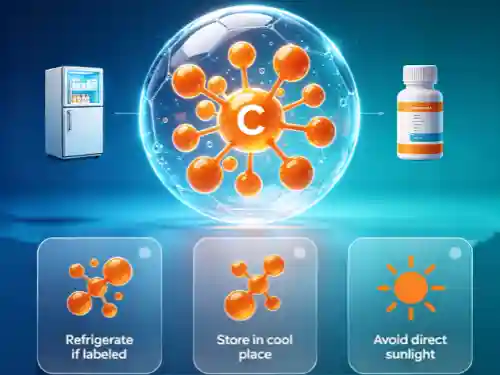
For industrial production, unopened liposome vitamin C powder does not require refrigeration. Standard room-temperature storage is enough to meet its shelf-life requirements. Refrigeration is an optional storage method, not a mandatory condition. This applies to bulk raw material storage, warehouse stockpiling, and long-distance transportation.
Based on industry testing standards and the physical and chemical properties of the material, storage conditions can be divided into two categories: room-temperature storage and refrigerated storage.
• The recommended room-temperature storage conditions are 15–25°C.
Store the powder in a sealed container. Keep it in a dry, well-ventilated place and protect it from light. Under these conditions, unopened industrial-grade liposome vitamin C powder has a stable shelf life of 24–36 months. The phospholipid coating remains intact. More than 98% of the vitamin C activity is retained. There is no obvious oxidation, caking, or degradation. The product fully meets the quality requirements for industrial skincare manufacturing. This storage method is suitable for most warehouse environments. It also helps B2B customers reduce cold-chain storage costs while supporting large-scale inventory management.
• Refrigerated storage is recommended for special situations.
The storage temperature should be kept between 2–8°C. Refrigeration can further slow the loss of active ingredients. It also helps reduce oxidation and extends the optimal use period of the raw material. This method is recommended for high-temperature or high-humidity regions, long-term storage of more than 18 months, opened containers, and high-purity customized materials.
• Refrigeration is the only way to improve storage quality.
It does not change the basic physical or chemical properties of the raw material. Do not freeze the product. Temperatures below 0°C can damage the phospholipid vesicle structure. This may reduce the activity of vitamin C and lower the overall product quality.
How To Store Liposomal Vitamin C?
Addressing the core needs of clients in bulk purchasing, industrialized production, and raw material turnover, standardized tiered storage specifications have been developed, taking into account storage cycles, environmental climate, and raw material conditions. These specifications adapt to the storage conditions and production rhythms of different enterprises, ensuring stable and controllable raw material quality.

• Standard Bulk Storage (Mainstream Scenario).
Suitable for bulk liposome vitamin C powder in regions with normal climates, storage cycles of 6-18 months, and unopened standard packaging. A room-temperature sealed storage model is adopted. The warehouse must avoid direct sunlight, high-temperature heat sources, and humid environments, maintaining a dry and well-ventilated environment with humidity controlled below 60%. This model requires no investment in cold chain equipment, has low storage costs, and strong adaptability, making it the mainstream storage method for skincare factories and OEM manufacturers. The raw material quality can fully meet the requirements of mass production formulations.
• High-Temperature and High-Humidity Environment Optimized Storage (Special Climate Scenario).
Suitable for enterprises in areas with high temperatures and humidity in summer and without constant-temperature storage conditions. When the ambient temperature consistently exceeds 28℃ and humidity exceeds 70%, it is recommended to use refrigerated storage at 2-8℃. This effectively avoids softening of the phospholipid structure and vesicle rupture caused by high temperatures, as well as powder agglomeration and component oxidation caused by high humidity. This ensures batch stability of raw materials and avoids the risk of batch raw material loss and formula failure.
• Dedicated storage of raw materials after opening (production turnover scenario).
Once opened, liposome vitamin C powder experiences a significant decrease in stability due to contact with air and moisture. It must be stored in a refrigerated, sealed container. After opening, it must be immediately sealed to isolate it from air and stored in a refrigerated environment at 2-8℃. It must be used within 3 months to prevent continued oxidation of active ingredients and powder deterioration, avoiding impact on product quality for subsequent small-batch production and formula adjustments.
• Storage of high-purity customized raw materials (high-end formulation scenario).
Customized liposomal vitamin C raw materials with high purity and high encapsulation rate are suitable for the production of high-end anti-aging and brightening skin care product formulas. It is recommended to store them under refrigeration throughout the process to maximize the preservation of the raw material's bioactivity and transdermal performance, ensuring the efficacy of high-end end products and meeting the refined production needs of mid-to-high-end brands.
Misconceptions Of Storing Liposomal Vitamin C
In bulk raw material storage and production, improper storage can reduce the quality of liposomal vitamin C powder. It may cause formulation compatibility issues, lower product performance, and color differences between batches. Based on our industrial experience, we have identified several common storage mistakes. We also provide practical solutions to help B2B customers reduce production losses.

• First, the misconception that all products must be refrigerated.
Some companies confuse the storage requirements for liquid liposomal vitamin C with those for powder raw materials. Liquid products contain more water and are more likely to support microbial growth. They should be refrigerated after opening. Powder raw materials have low water activity and good stability. Mandatory refrigeration is unnecessary. It also increases cold chain costs. Temperature changes may cause condensation inside the package, which can lead to moisture absorption and clumping. The correct approach is to store powder raw materials in sealed containers at room temperature. Refrigeration is only needed in special situations.
• Second, the misconception of improper refrigeration or freezing.
Some warehouse staff fail to control refrigeration temperatures correctly. In some cases, the temperature falls below 0°C. Freezing can damage the phospholipid bilayer structure. It also exposes the vitamin C to oxidation, reducing product quality and making the raw material unusable. The correct solution is to keep refrigerated storage between 2°C and 8°C. Freezing and ultra-low temperatures should always be avoided.
• Third, the misconception of leaving opened packages unsealed.
If opened powder is not sealed properly, it will absorb moisture and react with oxygen. This can quickly cause clumping, yellowing, and reduced activity. It also creates quality differences between production batches and affects the consistency of the final product. After opening, reseal the package immediately. Store the remaining material under refrigerated conditions if recommended, and use it within the specified period.
• Fourth, the misconception of ignoring light and ventilation requirements.
Direct sunlight and hot, poorly ventilated storage areas can speed up the degradation of phospholipids. Even at room temperature, these conditions can shorten shelf life and reduce ingredient stability. Raw materials should be stored in a cool, dry, and dark place. Keep them away from heat sources and corrosive materials such as acids and alkalis. A stable storage environment helps maintain product quality.
FAQs:
1. Does liposomal vitamin C powder need refrigeration?
No. Unopened liposomal vitamin C powder does not normally require refrigeration. It can be stored at 15–25°C in a sealed container, away from light, heat, and moisture. Refrigeration is recommended only for special situations, such as long-term storage, hot climates, or after the package has been opened.
2. What is the ideal storage temperature for liposomal vitamin C powder?
The recommended storage temperature is 15–25°C for standard warehouse storage. If the product will be stored for an extended period or in high-temperature and high-humidity environments, 2–8°C refrigeration can help preserve the phospholipid structure and maintain vitamin C activity.
3. Can liposomal vitamin C powder be frozen?
No. Freezing is not recommended. Temperatures below 0°C may damage the phospholipid bilayer that protects the vitamin C. This can reduce encapsulation efficiency, increase oxidation, and lower the quality of the raw material.
4. How should opened liposomal vitamin C powder be stored?
After opening, reseal the package immediately to prevent exposure to air and moisture. If possible, store it at 2–8°C in a tightly sealed container and use it within three months. Proper handling helps maintain product stability and reduces the risk of clumping and oxidation.
5. How long can unopened liposomal vitamin C powder be stored?
When stored correctly in a cool, dry, and sealed environment, unopened industrial-grade liposomal vitamin C powder typically has a shelf life of 24–36 months. Actual shelf life depends on the product specification, packaging, and manufacturer.
6. Why is liposomal vitamin C more stable than regular vitamin C?
Natural liposomal vitamin C is protected by a phospholipid bilayer that surrounds the active ingredient. This protective structure reduces exposure to oxygen, moisture, and light. As a result, it offers better stability, lower oxidation, and improved compatibility with skincare formulations compared with conventional vitamin C powder.
7. What storage mistakes should manufacturers avoid?
Common mistakes include freezing the powder, leaving open packages unsealed, storing it in humid or hot warehouses, and exposing it to direct sunlight. These conditions may damage the liposome structure, reduce vitamin C activity, increase clumping, and affect batch consistency during production.
Conclusion:
Liposomal vitamin C powder does not require routine refrigeration. For most industrial applications, it can be safely stored at room temperature in a sealed, dry, and light-protected environment. Refrigeration is only recommended for specific storage conditions. B2B manufacturers should choose the most suitable storage method based on their warehouse conditions, production schedule, and product requirements.
Guanjie Biotech continues to provide highly stable and cost-effective bulk liposomal vitamin C powder for global cosmetic, skincare, and research industries. With strong quality control, advanced production technology, and reliable supply chain management, we also provide professional storage guidance and application support to help customers improve product quality and production efficiency.
References:
[1] Favarin, F. R., Forrati, É. M., Bassoto, V. A., Gündel, S. S., Velho, M. C., Ledur, C. M., Verdi, C. M., Lemos, J. G., & Ourique, A. F. (2024). Ascorbic acid and ascorbyl palmitate-loaded liposomes: Development, characterization, stability evaluation, in vitro security profile, antimicrobial and antioxidant activities. Food Chemistry, *463*(Pt 3), 141388.
[2] Amalraj, A., Abraham, E. K., Nair, A. S., Sivarajakumar, P., & Gopi, S. (2026). Development of Highly Stable Vitamin C Gummies Using Innovative In Situ Soft Sphere Integrated (ISSI) Liposomal Technology: Characterization and In Vitro Release Studies. ACS Omega, *11*(4), 5798–5812.
[3] Hamadou, A. H., Huang, W.-C., Xue, C., & Mao, X. (2020). Formulation of vitamin C encapsulation in marine phospholipids nanoliposomes: Characterization and stability evaluation during long term storage. LWT - Food Science and Technology, *127*, 109428.
[4] Favarin, F. R., Gündel, S. S., Ledur, C. M., Roggia, I., Fagan, S. B., Gündel, A., Fogaça, A. O., & Ourique, A. F. (2022). Vitamin C as a shelf-life extender in liposomes. Brazilian Journal of Pharmaceutical Sciences, *58*, e20492.
·