Liposomal vitamin C, using vitamin C liposome technology, is a delivery system designed to improve vitamin C stability and bioavailability. Widely used in food supplements and nutraceutical products, its production quality depends on phospholipid selection, formulation design, pH control, homogenization parameters, and storage conditions. Reliable liposomal vitamin C suppliers optimize these factors to ensure consistent bulk liposomal vitamin C quality.

What Factors Affect Liposomal Vitamin C Stability During Production?
Factors Affecting the Stability of Raw Materials and Excipients
The stability of liposomal vitamin C depends heavily on the quality of raw materials, excipients, and formulation design. Selecting premium ingredients and optimizing formulation parameters are essential for producing a stable liposomal vitamin C product with high encapsulation efficiency and long shelf life.

• Phospholipid Type and Quality
Phospholipids form the structural bilayer of liposomal vitamin C, making them one of the most critical raw materials. Food-grade soybean lecithin and egg yolk lecithin are the most commonly used phospholipid sources. A higher phosphatidylcholine (PC) content generally improves membrane integrity, increases liposome encapsulation efficiency, and enhances vesicle stability.
However, the unsaturated fatty acids in phospholipids are susceptible to oxidation, which can damage the lipid bilayer, increase membrane permeability, and accelerate vitamin C degradation. Therefore, manufacturers should select phospholipids with low peroxide values and high purity. Proper storage under low temperatures, light-protected conditions, and nitrogen-flushed packaging further helps maintain phospholipid quality and supports the production of high-quality liposomal vitamin C.
• Vitamin C Form and Purity
The form and purity of vitamin C significantly influence liposomal vitamin C manufacturing. Both ascorbic acid and sodium ascorbate are commonly used. Sodium ascorbate offers better water solubility, which can improve loading capacity, while ascorbic acid is often preferred for formulations requiring a lower pH.
Heavy metal contaminants such as iron (Fe³⁺) and copper (Cu²⁺) can catalyze oxidation reactions that rapidly degrade vitamin C and promote phospholipid peroxidation. Consequently, sourcing pharmaceutical- or food-grade vitamin C raw materials with strict heavy metal specifications is essential for ensuring product stability and quality.
• Excipients and Stabilizers
Excipients play a vital role in maintaining the physical stability of liposomal vitamin C formulations. Cholesterol is commonly incorporated into the phospholipid bilayer to reduce membrane permeability, strengthen membrane rigidity, and minimize vitamin C leakage during storage. The phospholipid-to-cholesterol ratio should be carefully optimized to achieve maximum stability.
Nonionic surfactants such as Tween 80 can improve dispersion and reduce liposome aggregation. However, excessive surfactant levels may disrupt the lipid bilayer, lower encapsulation efficiency, and negatively affect long-term stability. Therefore, precise formulation optimization is essential for developing bulk liposomal vitamin C products that meet the quality requirements of dietary supplement and functional food manufacturers.
Formulation Parameters Affecting Liposomal Vitamin C Stability
The stability and encapsulation efficiency of liposomal vitamin C depend heavily on formulation design. Key factors include the phospholipid-to-vitamin C ratio, aqueous phase pH, and buffer composition. Optimizing these parameters helps manufacturers produce high-quality liposomal vitamin C with improved stability, longer shelf life, and consistent performance in food and dietary supplement applications.
|
Parameter |
Key Impact |
Recommended Control |
|
Phospholipid-to-Vitamin C Ratio |
Determines encapsulation efficiency and vitamin C loading. Excess vitamin C remains free, increasing oxidation risk and reducing liposome stability. |
Optimize phospholipid ratio during formulation development. |
|
Aqueous Phase pH |
Affects vitamin C stability, phospholipid integrity, and liposome formation. |
Maintain mildly acidic conditions; pH around 6.8 provides a balance between stability and structure. |
|
Buffer System Composition |
Controls pH stability, oxidation resistance, dispersion, and particle aggregation. |
Use suitable buffers such as PBS or citrate buffer; control ionic strength. |
Stability Factors Affecting Liposomal Vitamin C Stability
The manufacturing process plays a critical role in determining the stability, encapsulation efficiency, and shelf life of liposomal vitamin C. Parameters such as temperature, homogenization pressure, mixing efficiency, and solvent removal directly influence the integrity of the phospholipid membrane and the retention of vitamin C. For manufacturers of bulk liposomal vitamin C and dietary supplement ingredients, optimizing these processing conditions is essential to achieve consistent product quality.
• Temperature Control
Temperature must be carefully managed throughout liposomal vitamin C production. Below the phospholipid phase transition temperature, membrane fluidity decreases, limiting liposome formation. Conversely, excessive temperatures accelerate vitamin C oxidation while increasing phospholipid membrane permeability, resulting in reduced encapsulation efficiency and active ingredient leakage.
Studies indicate that preparing nano-liposomal vitamin C at approximately 30°C provides higher encapsulation efficiency than production at 40°C or 50°C. During high-pressure homogenization or microfluidic processing, mechanical energy generates heat, making an efficient cooling system essential for maintaining product stability.
• Homogenization Pressure and Mixing Parameters
High-pressure homogenization and microfluidization are widely used in industrial liposomal vitamin C encapsulation. Proper homogenization pressure reduces particle size and creates a more uniform liposomal delivery system. However, excessive pressure can damage phospholipid vesicles, release encapsulated vitamin C, and generate localized heat that accelerates oxidation.
Research has shown that a single homogenization cycle at approximately 400 bar can achieve an encapsulation efficiency of around 77.6%, while additional cycles provide limited improvement and increase the risk of structural damage. Likewise, optimized microfluidic flow rates improve particle size distribution and formulation consistency. A lipid-to-aqueous phase flow ratio of 1:3 with a total flow rate of 16 mL/min has been reported to produce uniformly dispersed liposomal particles.
• Organic Solvent Management
Organic solvent methods, such as ethanol injection, are commonly used for laboratory-scale vitamin C liposome technology. However, residual solvents may increase phospholipid membrane fluidity, promote vitamin C leakage, and accelerate oxidative degradation. For food and nutraceutical applications, residual solvent levels must comply with strict regulatory standards.
Many liposomal vitamin C manufacturers are adopting solvent-free or low-solvent production technologies to improve product safety while maintaining high encapsulation efficiency. Selecting an experienced liposomal vitamin C supplier with advanced processing capabilities is essential for producing stable, high-quality liposomal vitamin C powder for dietary supplements and functional food applications.
Environmental Factors Affecting Liposomal Vitamin C Stability
Environmental conditions significantly influence the stability of liposomal vitamin C during production, storage, and transportation. Proper control of light, oxygen, and humidity is essential for maintaining the quality of encapsulated vitamin C and ensuring consistent performance in functional food and supplement applications.

• Light Exposure
Light exposure is a major factor affecting stable liposomal vitamin C formulations. Ultraviolet and visible light can accelerate the oxidative degradation of vitamin C by promoting molecular excitation and dehydrogenation reactions. Meanwhile, unsaturated fatty acids in phospholipid membranes are sensitive to light-induced oxidation, which may generate hydroperoxides and damage the liposome structure.
For manufacturers producing bulk liposomal vitamin C, production environments should minimize light exposure. Factors such as workshop lighting, transparent equipment, pipeline materials, and packaging properties must be carefully evaluated. Using amber containers, light-resistant packaging, and nitrogen protection during processing are common strategies for improving product stability.
• Oxygen Exposure
Oxygen plays an important role in both vitamin C oxidation and phospholipid oxidation. Under aerobic conditions, vitamin C can rapidly convert into dehydroascorbic acid, reducing the activity of the final product. At the same time, oxygen can trigger lipid peroxidation within the phospholipid membrane used in vitamin C liposome technology, affecting encapsulation efficiency and structural integrity.
During the manufacturing process, operations such as mixing, homogenization, and filling may increase oxygen exposure through gas-liquid contact. To improve the stability of liposomal vitamin C powder, manufacturers commonly apply nitrogen or argon protection, remove dissolved oxygen from liquid phases, and add suitable antioxidants such as vitamin E to reduce oxidative damage.
• Ambient Humidity
Humidity control is another critical factor for liposomal vitamin C powder stability, especially for products produced through spray drying or freeze drying. Excess moisture can affect phospholipid membrane properties, causing structural changes and increasing the risk of vitamin C leakage.
Water molecules may reduce the glass transition temperature of dried liposome systems, increasing molecular mobility and accelerating degradation during storage. Therefore, controlling residual moisture during the drying process is essential for extending shelf life and maintaining product quality.
For a professional liposomal vitamin C supplier, the use of stabilizing agents such as trehalose can improve the glass transition temperature of dried phospholipid membranes and enhance resistance to humidity. Combined with proper packaging, low-moisture processing, and controlled storage conditions, these technologies help deliver high-quality bulk liposomal vitamin C ingredients for dietary supplements, functional beverages, and health food applications.
Stability Challenges in Liposomal Vitamin C Production
During the scale-up process from pilot production to industrial manufacturing, stability challenges of liposomal vitamin C may become more complex due to changes in equipment size, processing conditions, and production time. Although microfluidic technology demonstrates strong process consistency during pilot-scale production, maintaining the same quality parameters during large-scale manufacturing requires strict process control. For example, vitamin C liposomes prepared under optimized pilot conditions can achieve similar particle sizes between small-scale and pilot-scale production.
However, industrial scale-up using high-pressure homogenization may introduce differences in shear forces, temperature accumulation, and processing duration. Longer pipelines and extended batch cycles can increase the exposure time of vitamin C to oxygen, heat, and mechanical stress, which may accelerate degradation and reduce the stability of vitamin C liposome powder.
For manufacturers producing bulk liposomal vitamin C, adopting a Quality by Design (QbD) approach is essential. Establishing the relationship between raw material properties, critical process parameters, and key quality attributes helps ensure consistent performance, stability, and product quality from laboratory development to commercial production. This approach enables liposomal vitamin C suppliers and liposomal vitamin C manufacturers to deliver reliable, high-quality encapsulated vitamin C solutions for food, nutraceutical, and supplement applications.
FAQs
1. Why is liposomal vitamin C more stable than conventional vitamin C powder or tablets?
Liposomal vitamin C provides higher stability because vitamin C molecules are protected inside a phospholipid bilayer. This vitamin C liposome technology reduces exposure to oxygen, light, heat, and pH changes, slowing oxidation compared with conventional vitamin C powder or tablets.
2. What raw material parameters affect the stability of liposomal vitamin C production?
Key parameters include phospholipid purity, phosphatidylcholine content, peroxide value, vitamin C purity, and excipient compatibility. High-quality raw materials help maintain membrane integrity, improve encapsulation efficiency, and ensure consistent performance of bulk liposomal vitamin C formulations.
3. How does the vitamin C to phospholipid ratio affect product stability?
The vitamin C and phospholipid ratio directly influences encapsulation efficiency and storage stability. An optimized ratio ensures more vitamin C is protected inside liposomes, while excessive loading may increase free vitamin C and accelerate oxidation during storage.
4. How does pH influence liposomal vitamin C production stability?
pH control is essential during liposomal vitamin C manufacturing. Acidic conditions improve vitamin C stability, while excessive acidity may damage phospholipid structures. A controlled pH range helps balance vitamin C protection, membrane stability, and product quality during processing.
5. Why is temperature control important during liposomal vitamin C homogenization?
Temperature affects both phospholipid membrane formation and vitamin C stability. Excessive heat may accelerate oxidation and cause leakage of encapsulated vitamin C. Professional liposomal vitamin C manufacturers use precise temperature control during homogenization to maintain particle size and stability.
6. Does higher homogenization pressure improve liposomal vitamin C stability?
Higher homogenization pressure can reduce particle size and improve dispersion, but excessive pressure may damage liposome structures. Optimized processing conditions are required to achieve stable particle distribution, high encapsulation efficiency, and reliable quality for liposomal vitamin C powder production.
7. How do oxygen and light affect liposomal vitamin C stability?
Oxygen and light accelerate vitamin C oxidation and phospholipid degradation. During bulk liposomal vitamin C production, manufacturers minimize exposure through nitrogen protection, oxygen control, light-resistant packaging, and optimized processing environments to maintain product stability.
8. What are the challenges when scaling up liposomal vitamin C production?
Industrial scale-up requires control of heat transfer, mixing efficiency, shear force, and processing time. A reliable liposomal vitamin C supplier must optimize equipment parameters to maintain particle size, encapsulation efficiency, and batch-to-batch consistency during large-scale manufacturing.
9. What affects the stability of dried liposomal vitamin C powder?
For liposomal vitamin C powder, moisture control is critical. High humidity can damage phospholipid membranes and reduce stability. Manufacturers often use protective carriers, drying technologies, and moisture-resistant packaging to improve shelf life and maintain vitamin C encapsulation performance.
10. What quality control parameters are important for liposomal vitamin C manufacturers?
Quality control includes phosphatidylcholine content, peroxide value, heavy metals, pH, particle size, polydispersity index, zeta potential, encapsulation efficiency, and moisture content. These parameters ensure high-quality liposomal vitamin C ingredients for supplements, functional foods, and nutraceutical applications.
11. Can antioxidants improve the stability of liposomal vitamin C?
Yes. Antioxidants such as vitamin E can help protect phospholipids from oxidation, while chelating agents may reduce metal-induced degradation. However, liposomal vitamin C manufacturers must carefully select antioxidant types and concentrations to maintain regulatory compliance and membrane stability.
Conclusion:
The stability of liposomal vitamin C production depends on four key factors: raw material quality, formulation design, manufacturing processes, and environmental control. Critical parameters include phospholipid quality, vitamin C purity, encapsulation efficiency, particle size distribution, pH control, homogenization conditions, temperature management, and protection from oxygen and light.
For liposomal vitamin C manufacturers and health product companies, strict quality control measures are essential. Incoming inspection should evaluate phospholipid materials, including phosphatidylcholine content, peroxide value, and heavy metal levels. Process optimization should focus on improving the stability and bioavailability of liposomal vitamin C supplements through controlled formulation design and advanced production technologies.
During homogenization or microfluidization, temperature monitoring and cooling systems should be implemented to prevent degradation. Oxygen-resistant, light-protective packaging is recommended to maintain product stability during storage. For bulk liposomal vitamin C powder, moisture control and packaging barrier performance should also be carefully managed.
By applying systematic quality control strategies, suppliers can improve the consistency, shelf life, and performance of high-quality liposomal vitamin C products, supporting reliable solutions for the global nutraceutical and functional food industries.
Guanjie Biotech is a professional liposomal vitamin C manufacturer and bulk liposomal vitamin C supplier with over 20 years of experience in health ingredients. Using advanced vitamin C liposome technology, the company produces high-quality liposomal vitamin C powder with excellent water dispersibility, enhanced stability, and improved protection of active ingredients. Certified with HALAL, ISO9001, KOSHER, and SC, Guanjie Biotech operates a GMP-compliant facility and independent testing center. Strict quality control ensures consistent encapsulation efficiency, particle size distribution, and product activity, providing reliable encapsulated vitamin C powder solutions for food, nutraceutical, and supplement manufacturers worldwide. Welcome to enquire with us at info@gybiotech.com.
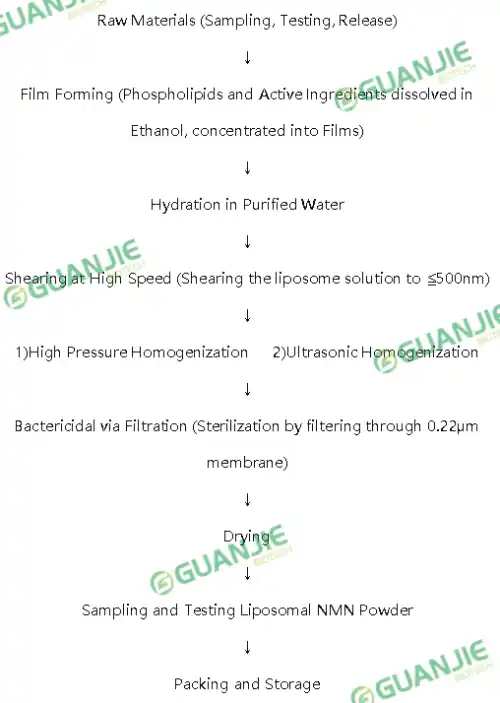
Flowchart of Key Control Points (CCPs) in Liposomal Vitamin C Production
References:
[1] FluidicLab. Experimental protocol for the synthesis of vitamin C liposome nanoparticles by microfluidic mixing [EB/OL]. (2026-02-02).
[2] Romano E, Palladino R, Cannavale M, et al. Enhanced Stability of Oral Vitamin C Delivery: A Novel Large-Scale Method for Liposomes Production and Encapsulation through Dynamic High-Pressure Microfluidization [J]. Nanomaterials, 2024, 14(6): 516.
[3] Zhou Yao, Cao Xinyu, Zhou Jiamin, et al. Preparation and stability study of oral vitamin C liposomes [J]. Journal of Nantong University (Medical Edition), 2020, 40(6): 515-518.
[4] Amalraj A, Abraham EK, Nair AS, et al. Development of Highly Stable Vitamin C Gummies Using Innovative In Situ Soft Sphere Integrated (ISSI) Liposomal Technology[J]. ACS Omega, 2026.
[5] Kirby CJ, Whittle CJ, Rigby N, et al. Stabilization of ascorbic acid by microencapsulation in liposomes[J]. International Journal of Food Science & Technology, 1991, 26(5): 437-449.
[6] Enhancing vitamin C stability through liposomal encapsulation with optimised pressure and cycle conditions[J]. Directory of Open Access Journals.