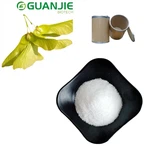
Raspberry ketone bulk powder has a distinctive aroma and also acts as a weight-loss agent by inhibiting the absorption of dietary fats into the cells of the small intestine. The cost of extracting raspberry ketone from the plant is very high. It is also produced in small quantities and is expensive. Nowadays, raspberry ketones are mainly produced through chemical synthesis or microbial fermentation. Guanjie Biotech is a producer of raspberry ketone. Now let's look at the difference between chemically synthesised raspberry ketone and microbially fermented raspberry ketone.

Production Method:
• Chemical synthesis of raspberry ketone
Chemically synthesised raspberry ketones are mainly prepared by organic chemical synthesis. Usually, p-hydroxybenzaldehyde and acetone are used as raw materials, and the condensation reaction occurs under the action of an alkaline catalyst.
Under alkaline conditions, the aldehyde group of p-hydroxybenzaldehyde reacts with the hydrogen on the α-carbon of acetone in a nucleophilic addition reaction, followed by a series of steps such as dehydration to form a raspberry ketone. The reaction process requires precise control of conditions such as reaction temperature, reaction time and amount of catalyst.
For example, commonly used alkali catalysts include sodium hydroxide and potassium hydroxide, etc. The reaction temperature is generally between 50 - 100°C. If the reaction temperature is too high, it may result in the formation of raspberry ketone. If the temperature is too high, it may lead to an increase in side reactions and the generation of some impurities. If the temperature is too low, the reaction rate is too slow. The reaction time usually ranges from a few hours to tens of hours. This depends on the concentration of the feedstock and the reaction conditions.
• Microbial fermentation of raspberry ketone
Microbial fermentation for the production of raspberry ketone bulk powder uses the metabolic activity of microorganisms to synthesise the target product. The principle of microbial fermentation is based on the transformation of the substrate by the enzyme system in the microbial cell. Firstly, a suitable microbial strain is selected. Such as certain yeasts or bacteria. These microorganisms can utilise specific nutrients such as carbon and nitrogen sources for growth and metabolism. For example, a medium with glucose as the carbon source and yeast extract as the nitrogen source can be used to cultivate microorganisms for the fermentative production of raspberry ketone.
During growth, microorganisms progressively convert substrates (e.g., some naturally occurring aromatic compounds or their precursors) into raspberry ketones via enzymes in the body. This process involves complex biosynthetic pathways. It includes the synergistic action of various metabolic pathways such as sugar metabolism and amino acid metabolism.
For example, some microorganisms can put aromatic amino acids such as phenylalanine through a series of enzymatic reactions. Steps such as deamination, oxidation, and condensation eventually synthesise raspberry ketone. The microbial fermentation process needs to be carried out under suitable conditions such as temperature, pH and dissolved oxygen. This ensures proper microbial growth and product synthesis. Generally, the fermentation temperature is between 25 - 37°C, the pH is between 5.5 - 7.5, and the dissolved oxygen level needs to be controlled by aeration or agitation.
Product Quality Differences
• Chemically synthesised raspberry ketones in terms of purity and impurities
The purity of chemically synthesised raspberry ketone can be achieved to a high level by fine separation and purification processes. However, during synthesis, some by-products may be produced due to the complexity of the reaction. For example, in the condensation reaction, some structurally similar impurities may be produced due to over-condensation or other side reactions. The presence of these impurities may affect the quality and application properties of raspberry ketone.
These impurities can be detected by advanced analytical techniques such as high-performance liquid chromatography (HPLC). In industrial production, the purity of chemically synthesised raspberry ketones is usually required to be above 98% to meet the requirements of most applications. However, even after multiple purification steps, a very small amount of impurities such as catalysts or incompletely reacted raw materials may remain.
• Microbial fermentation of raspberry ketones
Microbial fermentation of pure raspberry ketone powder can also achieve high levels of purity but may be affected by microbial metabolites. In addition to the target product raspberry ketone, the fermentation broth may also contain the microorganism's metabolic by-products, such as organic acids and amino acids. The types and contents of these impurities are related to microbial strains, fermentation conditions and other factors.
In the extraction and purification process, suitable methods are needed to separate raspberry ketone from these impurities. For example, some macromolecular impurities can be removed by membrane separation technology, and then raspberry ketone can be further purified by methods such as adsorption and elution. In general, microbial fermentation of raspberry ketones can also achieve a purity of more than 95%, although the impurity profile is different from that of chemical synthesis.
• Stereochemical and isomeric aspects of chemical synthesis of raspberry ketones
Chemical synthesis methods may produce different isomers. Raspberry ketones have chiral centres and during chemical synthesis, different isomers with different configurations may be obtained. These isomers may differ in physical and chemical properties, e.g., they may have different melting points, boiling points, solubilities, etc.
In certain applications, such as the flavour industry, the aroma properties of the different isomers may also differ. For applications requiring a single isomer, chemical synthesis followed by separation of the isomers by methods such as chiral splitting is required, which increases the complexity and cost of production.
• Microbial fermentation of raspberry ketones
Raspberry ketone bulk powder produced by microbial fermentation usually have a specific stereochemical configuration. Enzymes in microorganisms are highly stereoselective and can synthesise raspberry ketones with specific conformations. Therefore, microbial fermentation products have advantages in terms of stereochemistry. For some applications with stringent isomer requirements, microbial fermentation of raspberry ketones may be more compliant. For example, in high-end flavours and pharmaceutic
Application
• Chemical synthesis of raspberry ketones
Chemically synthesised raspberry ketone is mainly used in the flavour industry. It has a strong raspberry aroma and is an important ingredient in the formulation of fruit flavours, which are used for flavouring food, beverages, cosmetics and other products. In the food industry, it can be used to make candies, jellies, beverages and so on.
In addition, the chemical synthesis of raspberry ketone has some applications in the pharmaceutical field. For example, as an intermediate for drug synthesis, it is used to synthesise some compounds with pharmacological activity.
• Microbial fermentation of raspberry ketone
Microbiologically fermented raspberry ketone bulk powder is preferred in the high-end fragrance market due to their natural origin. Some high-end perfume and cosmetic brands prefer to use raspberry ketone produced by microbial fermentation due to increasing consumer demand for products with natural ingredients.
It also has potential applications in the pharmaceutical sector. Especially for the synthesis of drugs with stringent purity and isomer requirements. The natural properties of microbially fermented raspberry ketone make it advantageous in the development of some natural medicines and nutritional supplements as well.
• Market acceptance of chemically synthesised raspberry ketones
Chemically synthesised raspberry ketones have been on the market for a long time and their prices are relatively stable. Due to its mature production process, it is able to be produced on a large scale and holds a share of the low to mid-range market. However, as consumer interest in natural products increases, chemically synthesised raspberry ketones may be somewhat limited in some high-end markets.
• Microbial fermented raspberry ketones
Microbial fermentation of raspberry ketone is gaining market share as a relatively new production method. It has high market acceptance. However, the cost of microbial fermentation production is relatively high and the product price is relatively expensive. This limits its promotion in some price-sensitive markets to some extent.
Guanjie Biotech is a raspberry Ketone powder supplier. We provide Pure Raspberry Ketone Powder with an assay≥99% with Microbial fermented and Chemically synthesised methods. If you need to buy raspberry ketone bulk powder, you are welcome to consult us at info@gybiotech.com.