


No, glutathione and sulforaphane are not the same. They are distinct biochemical entities with different chemical structures, origins, functions, and roles within the human body. However, pure sulforaphane and pure glutathione powder paths intersect in a profoundly significant way within the realm of cellular defense and detoxification, leading to a common conflation. Let's look at why there are differences between glutathione and sulforaphane.

What is Glutathione?
Glutathione (GSH) is a tripeptide, meaning it is a molecule composed of three amino acids: cysteine, glutamate, and glycine. It is not a vitamin or mineral extracted from food. Rather, pure glutathione powder is an endogenous antioxidant, meaning it is produced inside nearly every cell of the human body. The liver synthesizes it in particularly high concentrations for detoxification purposes.
Chemical Structure:
Its power largely resides in the sulfur-containing thiol (-SH) group on its cysteine residue. This group is a potent electron donor, allowing glutathione to neutralize free radicals and reactive oxygen species (ROS).

Primary Functions and Roles:
• Master Antioxidant and Redox Regulator:
GSH is the body's most abundant and crucial intracellular antioxidant. It directly scavenges harmful free radicals, preventing them from damaging cellular components like DNA, proteins, and lipids. Furthermore, it regenerates other essential antioxidants, such as vitamins C and E, back to their active forms, making it the central hub of the antioxidant network.
• Detoxification Agent (Phase II Conjugation):
This is one of its most critical roles. The liver uses enzymes from the Glutathione S-Transferase (GST) family to conjugate (attach) glutathione to toxins, heavy metals, drugs, and carcinogens. This conjugation makes the substances water-soluble, allowing for their safe excretion via bile or urine.
• Immune System Modulation:
Pure glutathione powder is essential for the optimal function of lymphocytes (white blood cells), enabling the body to mount an effective response against pathogens and diseased cells.
• Cellular Health and Signaling:
It plays a role in DNA synthesis and repair, protein synthesis, and the regulation of cellular processes like proliferation and apoptosis (programmed cell death).
The Glutathione Dilemma:
A significant challenge with pure glutathione powder is its bioavailability when taken orally. As a peptide, it is largely broken down by digestive enzymes in the gut into its constituent amino acids before it can be absorbed intact. This has led to the development of alternative strategies to raise intracellular glutathione levels, primarily by providing the raw materials for its synthesis (e.g., N-acetylcysteine, or NAC, which provides cysteine) or by upregulating the body's own production machinery. This is precisely where sulforaphane enters the picture.
What is Sulforaphane?
Pure sulforaphane is an organosulfur compound. It is classified as an isothiocyanate and is a phytochemical-a bioactive compound derived from plants. It is not produced by the human body; it is exogenous. Its primary dietary source is cruciferous vegetables, most notably broccoli sprouts, which contain levels 20-100 times higher than mature broccoli.
Origin and Activation:
Pure sulforaphane does not exist pre-formed in the plant. Instead, it is stored as its inert precursor, glucoraphanin, a glucosinolate. When the plant is damaged (chewed, chopped, blended), an enzyme called myrosinase comes into contact with glucoraphanin and hydrolyzes it, yielding sulforaphane. This is why chewing raw broccoli sprouts is more effective than eating cooked, intact broccoli (heat deactivates myrosinase).

Primary Functions and Mechanisms:
Sulforaphane's mechanism of action is fundamentally different from glutathione's direct scavenging. Its power is epigenetic.
• Nrf2 Activation – The "Master Regulator":
Sulforaphane's most celebrated function is its potent activation of the Nrf2 (Nuclear factor erythroid 2-related factor 2) pathway. Nrf2 is a transcription factor that acts as a "master switch" for antioxidant and detoxification genes. Under normal conditions, Nrf2 is bound to a protein called Keap1 in the cytoplasm and is targeted for degradation. Sulforaphane modifies Keap1, causing Nrf2 to be released. This free Nrf2 then translocates to the cell nucleus.
• Upregulation of Protective Genes:
Inside the nucleus, Nrf2 binds to the Antioxidant Response Element (ARE) in DNA. This binding initiates the transcription of over 200 cytoprotective genes. These genes code for a suite of protective enzymes, including:
Glutathione S-Transferases (GSTs): The very enzymes that use glutathione for detoxification.
Glutamate-cysteine ligase (GCL): The rate-limiting enzyme in the synthesis of new glutathione.
Heme oxygenase-1 (HO-1): An enzyme with potent anti-inflammatory and antioxidant properties.
NAD(P)H Quinone Dehydrogenase 1 (NQO1): An enzyme that helps detoxify quinones and reduces oxidative stress.
In essence, sulforaphane doesn't provide antioxidants; it turns on the body's own genetic machinery to massively upscale its production of antioxidants and detoxification enzymes.
Why are they confused?
The confusion between glutathione and sulforaphane arises from their intimate functional relationship. They are not the same thing, but they are powerful allies in the same cellular defense army.
Pure glutathione powder is the "Ammunition and Soldier." It is the direct, hands-on molecule that neutralizes threats (free radicals, toxins) through electron donation and conjugation.
Pure sulforaphane is the "General and Quartermaster." It does not fight directly. Instead, it gives the orders (via Nrf2 activation) to ramp up the production of more soldiers (pure glutathione powder), better weapons (antioxidant enzymes), and more efficient logistics (detoxification pathways).
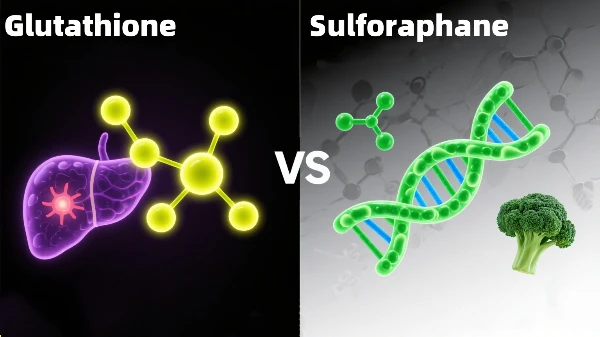
Sulforaphane's most significant contribution to glutathione biology is twofold:
• Pure sulforaphane increases the production of glutathione by upregulating the enzymes needed to synthesize it.
• It increases the utilization of glutathione by upregulating the GST enzymes that conjugate it to toxins.
Therefore, while glutathione and sulforaphane are distinct, supplementing with sulforaphane is one of the most effective dietary strategies to boost the body's endogenous levels and functional capacity of glutathione. This indirect, yet powerful, relationship is the core of the misconception.
Comparative Table: Glutathione vs. Sulforaphane
|
Feature |
Glutathione (GSH) |
Sulforaphane (SFN) |
|
Chemical Nature |
Endogenous tripeptide (3 amino acids) |
Exogenous isothiocyanate (phytochemical) |
|
Origin |
Synthesized in human cells |
Derived from cruciferous vegetables |
|
Primary Role |
Direct antioxidant; detoxifying agent |
Epigenetic activator of cytoprotective genes |
|
Mechanism of Action |
Electron donation, conjugation via GST enzymes |
Activation of the Nrf2 transcription factor pathway |
|
Key Function |
Neutralizes existing oxidants and toxins |
Upregulates production of antioxidants (incl. GSH) and detox enzymes (GSTs) |
|
Bioavailability |
Poor when taken orally; often broken down in the gut |
High in raw or properly prepared cruciferous sources |
|
Supplement Strategy |
Liposomal, sublingual, IV; precursors like NAC |
Extracts from broccoli sprouts, glucoraphanin + myrosinase |
Glutathione and sulforaphane are unequivocally not the same compound. They differ in their fundamental chemistry-one is a human-derived peptide, the other a plant-derived phytochemical. They differ in their mechanism-one is a direct-acting "doer," the other a genetic "activator."
However, to view them as completely separate is to miss a fundamental principle of nutritional science: synergy. The human body is a complex, interconnected system. Sulforaphane's profound value lies in its ability to optimize the body's innate defense systems, with the glutathione system being a prime beneficiary. By turning on the Nrf2 pathway, pure sulforaphane ensures that cells are better equipped to produce and utilize their own "master antioxidant," glutathione, creating a more resilient and robust cellular environment.
Therefore, the most effective strategy for enhancing antioxidant and detoxification capacity is not to choose one over the other, but to understand and leverage their relationship. Consuming sulforaphane-rich foods like broccoli sprouts empowers the body to produce and use its own pure bulk glutathione more efficiently, representing a powerful example of how food can act as information, instructing our genes to promote health and longevity.
Guanjie Biotech is a bulk glutathione and sulforaphane supplier. We have focused on natural ingredients for many years. Welcome to enquire with us at info@gybiotech.com.
References
[1] Forman, H. J., Zhang, H., & Rinna, A. (2009). Glutathione: overview of its protective roles, measurement, and biosynthesis. Molecular Aspects of Medicine, 30(1-2), 1–12.
Talalay, P., Fahey, J. W., Holtzclaw, W. D., Prestera, T., & Zhang, Y. (1995). Chemoprotection against cancer by phase 2 enzyme induction. Toxicology Letters, 82-83, 173–179.
[2] Zhang, Y., Talalay, P., Cho, C. G., & Posner, G. H. (1992). A major inducer of anticarcinogenic protective enzymes from broccoli: isolation and elucidation of structure. Proceedings of the National Academy of Sciences, 89(6), 2399–2403.
[3] Kwak, M. K., Itoh, K., Yamamoto, M., & Kensler, T. W. (2002). Enhanced expression of the transcription factor Nrf2 by cancer chemopreventive agents: role of antioxidant response element-like sequences in the nrf2 promoter. Molecular and Cellular Biology, 22(9), 2883–2892.
[4] Harvey, C. J., Thimmulappa, R. K., Singh, A., Blake, D. J., Ling, G., Wakabayashi, N., Fujii, J., Myers, A., & Biswal, S. (2009). Nrf2-regulated glutathione recycling independent of biosynthesis is critical for cell survival during oxidative stress. Free Radical Biology and Medicine, 46(4), 443–453.
[5] Pergola, P. E., Raskin, P., Toto, R. D., Meyer, C. J., Huff, J. W., Grossman, E. B., Krauth, M., Ruiz, S., Audhya, P., Christ-Schmidt, H., Wittes, J., & Warnock, D. G. (2011). Bardoxolone methyl and kidney function in CKD with type 2 diabetes. The New England Journal of Medicine, 365(4), 327–336.
[6]Nakagawa, K., & Miyazawa, T. (1997). Chemiluminescence-high-performance liquid chromatographic determination of tea catechin, (-)-epigallocatechin 3-gallate, at picomole levels in rat and human plasma. Analytical Biochemistry, 248(1), 41–49.
[7] Tarozzi, A., Morroni, F., Hrelia, S., Angeloni, C., Marchesi, A., Cantelli-Forti, G., & Hrelia, P. (2007). Neuroprotective effects of anthocyanins and their in vivo metabolites in SH-SY5Y cells. Neuroscience Letters, 424(1), 36–40.


