Although Spermine and bulk Spermidine are similar in name, they have significant differences in chemical structure, function, and physiological actions. The following is a detailed description of them, covering a comparison of their definitions, chemical properties, sources, metabolic pathways, biological functions, and clinical applications.
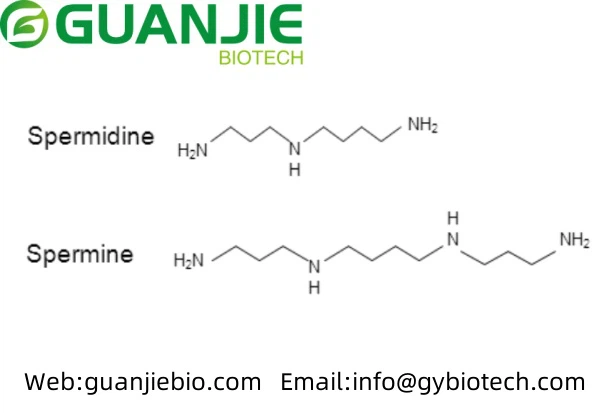
Description And Chemical Structure
- Spermine:
Spermine is a polyamine derived from an amino acid with the chemical formula C₇H₁₉N₃. Its structure consists of a tetrazolium ring nitrogen atom attached to a carbon chain and two amine groups. Spermine is found in many organisms and is a key factor in cell proliferation, survival, and growth.
-Spermidine:
Spermidine is a larger molecular polyamine derived from spermine with the chemical formula C₁₂H₃₀N₄. Spermidine has a larger molecular weight than spermine and contains four nitrogen atoms and two amine groups. Spermidine powder plays a variety of biological roles in the cell, especially closely related to the stability of the nucleus and the structure and function of DNA and RNA.
Source and Metabolism
- Source of spermine:
Spermine is usually synthesized from a precursor substance, spermidine, by an enzyme called spermine synthase. It can also be converted from amino acids such as methionine and arginine via a synthetic pathway. The metabolism of spermine involves the regulation of a variety of enzymes, mainly in the nucleus and cytoplasm.
- Sources of Spermidine:
The synthesis of spermidine also involves the conversion of amino acids such as methionine and arginine. It can be synthesized in two ways: one from spermidine, and the other through the intracellular degradation of other polyamines to produce bulk spermidine. The metabolism of spermidine bulk powder is similar to that of spermine but is more complex because its synthesis involves longer chain-like carbon structures.
Physiological Functions and Roles
- Physiological functions of spermine:
Spermine mainly plays an important role in cell proliferation, DNA repair, protein synthesis, and other processes. It is also involved in the regulation of cell death and apoptosis. Spermine interacts with intracellular RNA, DNA, and proteins to maintain the stability of cell function. In addition, spermine plays an important role in several physiological systems such as the nervous system, immune system, and cardiovascular system.
- Physiological functions of Spermidine:
Spermidine is similar to spermine. It is an important member of the polyamine family and plays a role in regulating cell growth and proliferation. Spermidine powder wheat germ extract is particularly important for the stability and structural integrity of DNA and RNA in the cell nucleus. It is also thought to regulate the cell cycle, promote anti-aging and slow down the aging process. Recent studies have shown that spermidine is expected to serve as a potential molecule for anti-aging through mechanisms such as delaying the aging process and enhancing autophagy.
Health effects
• Health effects of spermine
The intake of spermine has certain effects on human health. It has been found that moderate amounts of spermine can increase cell proliferation and improve immune system function, which in turn can help prevent aging and promote health. However, excessive amounts of spermine may lead to excessive cell proliferation, thereby increasing the risk of cancer. Therefore, spermine needs to be used within the appropriate dosage range.

• Health Effects of Spermidine
The health effects of bulk spermidine are much broader, especially in terms of anti-aging and longevity. Spermidine is unique in its ability to help remove waste products and damaged cells from the body by activating the autophagy mechanism, which is important for slowing down aging. By regulating the immune system, antioxidants, and other effects, spermidine can help improve the body's resistance and prevent the occurrence of aging-related diseases.
Relationship with anti-aging
• Spermine and aging:
There is relatively little research on spermine in anti-aging, but some studies have shown that it is related to delaying aging and enhancing immune response. Spermine can promote cell proliferation and repair and is an important regulator in the cell life cycle.
• Spermidine and aging:
Spermidine has made remarkable progress in the field of anti-aging. Studies have shown that spermidine is effective in slowing down aging and improving health by activating the autophagic self-cleaning process, regulating the cell cycle, and enhancing the antioxidant capacity of cells. Spermidine wheat germ extract has attracted attention in aging research because it can promote cell self-repair and improve cell survival.
Relationship with cellular autophagy
• Spermine and autophagy:
Spermine can promote the process of cellular autophagy. Autophagy is a key mechanism for the clearance and recycling of intracellular wastes and is essential for normal cellular function. Spermine regulates intracellular protein quality control by interacting with autophagy-related signalling pathways.
• Spermidine and autophagy:
Spermidine is thought to regulate the autophagy process more effectively. It promotes autophagy by activating the mTOR pathway and the SIRT1 pathway, thus helping to remove aged organelles and proteins and slowing down the aging process. Therefore, bulk spermidine has great potential in anti-aging and delaying aging-related diseases such as Alzheimer's disease and cardiovascular disease.
Applications
• Application of spermine
As an important biomolecule, spermine has a wide range of applications in medicine and biotechnology. Spermine has important applications in cell culture, genetic engineering, and anti-aging research. For example, spermine is used to promote cell proliferation and tissue repair, especially in tumor research and tissue engineering. In addition, spermine can be used in the research of aging-related diseases, such as the development of anti-aging drugs.
• Applications of spermidine
As a natural compound for anti-aging and life extension, spermidine has received widespread attention in recent years in nutrition and health research. Studies have shown that spermidine has multiple effects such as promoting autophagy, delaying aging, and improving immune system function, so it is widely used in the development of anti-aging supplements. In addition, spermidine has been used as an adjunctive ingredient in drug development, especially in antioxidant, anti-inflammatory, and immunomodulatory applications, where bulk spermidine shows great potential.
Differences Between Spermidine And Spermine
|
Characteristics |
Spermidine |
Spermine |
|
Chemical structure |
C7H19N₃,3 nitrogen atoms, 2 amine groups |
C12H30N4,4 nitrogen atoms,2 amine groups |
|
Molecular weight |
Smaller |
Larger |
|
Source |
Synthesized by spermidine or through amino acid synthesis |
Mainly converted from spermine |
|
Physiological effects |
Promotes cell proliferation, involved in DNA repair and protein synthesis |
Regulating cell nuclear stability, promoting anti-aging, enhancing autophagy |
|
Anti-aging |
Has a role, but less researched |
Significant anti-aging effect, able to enhance autophagy, delay aging |
|
Clinical Applications |
Cellular research, anti-aging research |
Delaying aging, improving cognitive function, anti-cancer research |
Spermidine and spermine are structurally similar, but there are significant differences in their molecular weights, functions, and metabolic pathways. Although both have their biological functions and potential. Guanjie Biotech is a bulk spermidine supplier, we use the fermentation method to extract bulk spermidine. Our products pass HALAL, Kosher, HACCP, ISO9001. High-quality spermidine wheat germ extract, welcome to inquiry: info@gybiotech.com.