


Bulk apigenin is in many plants, includes celery,beer and so on. Apigenin is a flavonoid, which has a variety of biological activities. Guanjie Biotech has focused on apigenin powder for many years. Today let's know about apigenin.
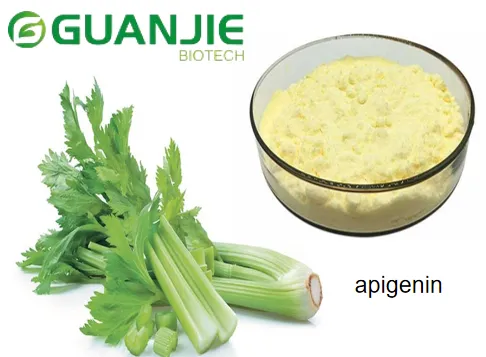
Apigenin Foods
Foods that contain apigenin include, but are not limited to, the following:
• Celery:
Apigenin was first discovered in celery, making celery a natural source of apigenin. Celery is high in apigenin, especially parsley and celery.Guanjie Biotech's bulk apigenin powder comes from celery.
• Cilantro:
Cilantro is very high in apigenin. With up to 45,035 mcg of apigenin per 1 gram of dried cilantro, it is one of the very highest food sources of apigenin.
• Chamomile:
Chamomile is also a plant rich in apigenin. Each 1 gram of dried chamomile contains 3,000-5,000 micrograms of apigenin, which is more than 10 times more than tangelos.
• Yerba Mate (Artichoke):
Commonly found in the Mediterranean diet, it also contains apigenin.
• Oregano:
Belongs to the herb family and is commonly found in the Mediterranean diet and Italian dishes and contains apigenin.
• Parsley:
Also a plant that contains apigenin.
• Mint:
A vanilla plant, apigenin can also be found in mint.
• Grapefruit:
Certain citrus fruits, such as grapefruit, contain apigenin.
• Kumquats:
Kumquats are also one of the fruits that contain apigenin.
• Artichokes (kale):
Kale is also a vegetable source of bulk apigenin powder.
• Onions:
Onions also contain apigenin.
• Beer:
Certain alcoholic beverages, such as beer, contain apigenin.
• Dandelion:
This plant also contains apigenin.
• Tea:
Apigenin content can be enjoyed in certain tea beverages.
• Red Wine:
Red wine also contains apigenin.
• Goji berries:
Goji berries contain high amounts of apigenin.
• Verbena:
Contains apigenin.
Are there any side effects of apigenin?
Apigenin is generally considered safe and is widely available in a wide variety of foods. However, as with all nutrients, there may be some side effects associated with excessive intake. Here is some information about bulk apigenin powder side effects:
• Stimulates Melanin Synthesis:
Some studies have suggested that apigenin can stimulate melanin synthesis. However, the results of this study were limited to rat samples, so they cannot be directly extrapolated to humans, and more research is needed to determine its effects on human skin.
• Upset Stomach:
Although apigenin itself is not toxic and is a safe nutrient, excessive intake bulk apigenin powder may cause stomach upset.
• Reproductive effects:
Some scientists have experimented with apigenin bulk powder and found that it has some toxicity to the testes of mice, as well as negative effects on the fertility of female mice. However, it is also important to note that these findings are based on animal experiments, and further research is needed on the effects on humans.
• Safety:
Apigenin is characterized by low toxicity and non-mutagenicity compared to other flavonoids.
Overall, moderate intake of apigenin is usually considered safe, but excessive intake may cause some side effects.
How Much Apigenin Does The Body Need Per Day?
There are currently no recommended amounts of bulk apigenin powder intake established by countries. However, reference can be made to the amount used in clinical trials, starting with a supplement of 2.5 milligrams per day. Therefore, although there is no specific recommended daily intake, it is known that apigenin is beneficial in moderation as a healthful phytochemical. If supplementation with apigenin is being considered, it is recommended to start with a lower dose and be mindful of one's dietary balance and overall health.

Apigenin's Anti-Cancer Effects
A few examples of apigenin's anti-cancer effects:
Highlighted below are some examples of apigenin's cancer-preventive effects and its synergistic effects with chemotherapy in specific cancer types.
• Apigenin in Gastrointestinal Cancers.
In the case of gastrointestinal cancers, apigenin has been found to induce cell death and impede the growth of new blood vessels that contribute to tumor growth. In addition, apigenin makes the tumor environment more hostile by reducing the uptake of glucose by the cancer cells, interfering with the remodeling of the external and surrounding matrix of the cancer cells and blocking the processes that promote cancer progression and spread.
• Effectiveness of bulk apigenin powder in Combination with Gemcitabine Chemotherapy for Pancreatic Cancer - Experimental Study
A laboratory study conducted by researchers at Seoul National University College of Medicine in South Korea found that apigenin enhanced the anti-tumor efficacy of gemcitabine against pancreatic cancer.
Another study conducted by researchers at the Feinberg School of Medicine in Chicago also found that the use of apigenin with gemcitabine inhibited the growth of pancreatic cancer cells and induced cancer cell death (apoptosis).
In short, several studies using cell cultures and animal models have found that apigenin enhances the efficacy of gemcitabine chemotherapy in otherwise difficult-to-treat pancreatic cancers.
• Effectiveness of Apigenin in Combination with Cisplatin Chemotherapy - Experimental Study
In a study conducted by researchers at Trakya University in Turkey, the combination of Apigenin with the chemotherapeutic drug cisplatin significantly enhanced its cytotoxic effect on prostate cancer cells (the anticancer effect of Apigenin), and the molecular mechanism of Apigenin's action was determined.
Why Is Apigenin An Anti-cancer Agent?
Apigenin's anti-cancer properties are largely attributed to its multiple biological activities and mechanisms of action. Here are some key points:
• Antioxidant activity:
The hydroxyl group in the apigenin molecule can bind to free radicals and inhibit their production. This allows for an antioxidant effect.
• Regulation of the cell cycle:
Apigenin is able to by affecting the activity of cell cycle proteins and cell cycle dependent kinases. Blocking tumor cells at specific cell cycle phases (e.g. G0/G1 phase or G2/M phase), thus inhibiting tumor cell proliferation.
• Promoting apoptosis:
Bulk apigenin powder can induce apoptosis in tumor cells through multiple pathways. For example, inhibition of signaling pathways such as PI3K/AKT/mTOR and activation of apoptosis-related proteins such as caspases.
• Anti-tumor invasion and metastasis:
Apigenin is able to inhibit the Wnt/β-linker protein signaling pathway, reduce the expression of cell adhesion molecules and other mechanisms. It can inhibit the invasion and metastatic ability of tumor cells.
• Immunomodulatory effects:
Apigenin also has immunomodulatory functions. It is able to alter the spectrum of cytokines involved in regulating the immune response, thereby enhancing the body's immune response to tumors.
• Inhibition of tumor angiogenesis:
Apigenin is able to inhibit key factors of tumor angiogenesis, thus depriving tumor cells of nutrient and oxygen supply and limiting tumor growth and spread. Such as the expression of VEGF.
• Induction of cancer cell differentiation:
Bulk apigenin powder also has the ability to induce tumor cell differentiation towards normal cells.
Guanjie Biotech offers bulk apigenin powder that appears as a brownish-yellow to light yellow powder. Our product is analyzed using the High-Performance Liquid Chromatography (HPLC) method. We are capable of conducting tests in our laboratory, or we can supply third-party testing reports. For further inquiries, please contact us at info@gybiotech.com.


