

Latest Products



Contact Us
-
6th Floor, 2nd Building, Xijing NO.3, XiJing Industrial Park, DianZi Western Street, Xi'an, Shaanxi, China
-
+86-2988253271
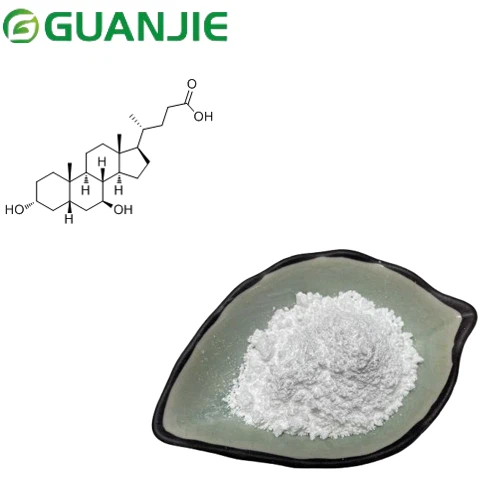
Bulk Ursodeoxycholic Acid
Specification: 99%
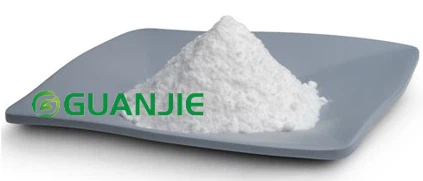
Characters: White or off-white powder
Test Method: HPLC
Two Factories & Three production lines
GMP standard workshop & two independent laboratories
FDA Cert.
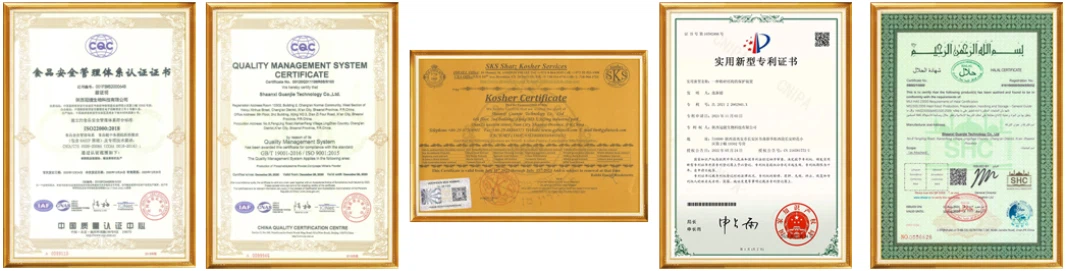
Certifications: Halal,ISO9001,PAHS Free,NON-GMO,KOSHER,SC
Overseas warehouse(NJ,USA)
Delivery term: DHL, FEDEX, Air freight,Sea freight
Provide Free Sample
MOQ: 1KG
Not for Private Person Sale
Description
What Is Ursodeoxycholic Acid?
Bulk ursodeoxycholic acid, chemically known as 3α,7β-dihydroxy-5β-cholestan-24-oic acid, is a hydrophilic bile acid recognized for its diverse biological functions and wide application potential. As a professional bulk UDCA powder supplier, Guanjie Biotech provides high-quality bulk ursodeoxycholic acid powder products and reliable solutions to customers worldwide. We have an experienced R&D team and independent laboratories to ensure strict quality control throughout product development and production processes. Our focus on innovation and quality helps us provide stable and consistent products that meet international standards. If you would like to learn more about our Bulk Ursodeoxycholic Acid Powder or discuss your specific requirements, please feel free to contact us at: info@gybiotech.com. We look forward to working with you.
Why Choose Guanjie Biotech?
● Two independent factories and three production line.
● Professional research team and have own labs
● Provide the third-party testing.
● Have strong Collaborators: Northwestern University and the Chinese Academy of Sciences research center
COA:
|
Items |
Specification |
Results |
|
Appearance |
White or off-white powder |
White powder |
|
Identification IR |
Complies with reference |
Complies |
|
Solubility |
Insoluble in water,insoluble in methylene chloride,freely soluble in ethanol,slightly soluble in acetone |
Complies |
|
Loss on drying |
≤1.0% |
0.36% |
|
Melting Point |
200°C~204°C |
200.2°C~201.0°C |
|
Heavy Metal |
≤20ppm |
Complies |
|
Specific Optical Rotation |
+58.0°~+62.0° |
+58.7° |
|
Lithocholic acid |
≤0.1% |
Comlies |
|
Chenodeoxycholic acid |
≤1.0% |
0.04% |
|
Single Impurity |
≤0.1% |
0.07% |
|
Total Impurities |
≤1.5% |
0.21% |
|
Assay |
99.0%~101.0% |
100.0% |
|
Residual Solvent |
|
|
|
Acetone |
≤0.5% |
0.11% |
|
Ethyl Acetate |
≤0.5% |
Not detected |
|
Isopropanol |
≤0.5% |
Not detected |
|
Conclusion |
We certify that the quality of this product conforms with EP9.0 |
|
How Is Ursodeoxycholic Acid Produced?
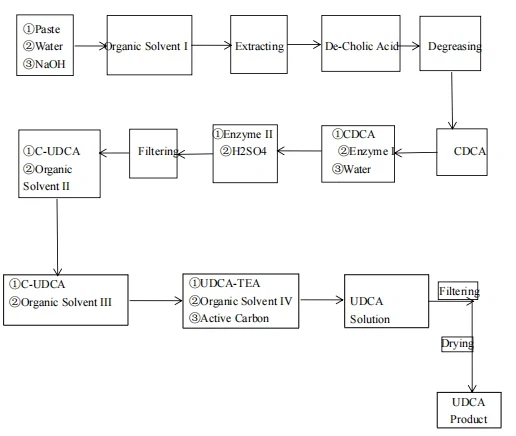
The biosynthesis of bulk ursodeoxycholic acid has developed rapidly. Compared with chemical synthesis, the biocatalytic method is green, efficient and safe. The research on the synthesis of UDCA by biocatalytic method has also made great progress.
• Biosynthesis Related Enzymes
7α-Hydroxysteroid dehydrogenase (7α-HSDH) and 7β-Hydroxysteroid dehydrogenase (7β-HSDH) belong to the short chain dehydrogenase/reductase (SDR) family. 7α-HSDH oxidizes the 7α-hydroxyl group of steroid substrates to a carbonyl group, while 7β-HSDH selectively reduces the 7-carbonyl group. 7α-HSDH oxidizes the 7α-hydroxyl group of steroid substrates to a carbonyl group, while 7β-HSDH selectively reduces the 7-carbonyl group to a 7β-hydroxyl group. 7α-HSDH was isolated from Clostridium absonum, and the mutant R194A obtained by gene editing had a high catalytic efficiency ( Kcat / Km ) .

7α-HSDH in E. coli has the highest activity for the conversion of CDCA to UDCA. Currently, domestic and international studies have focused on the heterologous expression of engineered enzymes. These dehydrogenases can be produced by wild-type bacteria, and some of the reported wild-type microorganisms catalyzing the conversion to Bulk Ursodeoxycholic Acid are shown in the Table.
• Coenzyme Regeneration Factors
NADP+ and NAP+ are coenzyme regenerating factors. NADP+ and NAP+ are coenzyme regenerators that participate in a variety of metabolic reactions in the body as hydrogen donors. In particular, the coenzyme cycle is at the heart of the redox enzyme catalytic system. Microorganisms that use dehydrogenases regenerate the substrate (e.g., glucose) by supplying the appropriate coenzymes. The microbial coenzyme regeneration system is utilized to recycle the coenzyme.
Most 7β-HSDH are NADPH-dependent kinases. NAD + is more economical than NADP +. A cofactor-specific inversion strategy based on structural information and conserved sequence comparison was utilized. The investigators rationalized a recombinant 7β-HSDH derived from Ruminococcus torques, which efficiently converted the cofactor NADPH of 7β-HSDH to NADH. A wild-type NADP+-dependent 7β-HSDH from Lactobacillus spicheri was identified. recombinant, purified, and biochemically characterized. This enzyme, in combination with 7α-HSDH isolated from Stenotrophomonas, enabled the conversion of CA to UDCA.
• Biosynthetic route to UDCA
Bulk ursodeoxycholic acid can be produced from CDCA in a two-step reaction, i.e., oxidation of the 7-hydroxyl group to a carbonyl group to produce the intermediate 7-ketolithocholic acid (7KLCA), which is reduced to UDCA. 7KLCA is oxidized to 7K-LCA by 7α-HSDH during the oxidation process, while the cofactor NAD + (NADP + ) is converted to NADH (NADPH). At the same time, the cofactor NAD + (NADP + ) is converted to NADH (NADPH), and NADH (NADP + ) is converted to NAD + (NADP + ) catalyzed by lactate dehydrogenase (LDH). Thus, the coenzyme cycle is realized.
The coenzyme cycle is thus realized. Subsequently, heat quenching inactivates 7α-HSDH and LDH to avoid a reversible reaction. In the reduction reaction, 7β-HSDH reduces the intermediate 7K-LCA to Bulk Ursodeoxycholic Acid, while the cofactor NADH (NADPH) is converted to NAD + (NADP + ). At the same time, cofactor NADH (NADPH) is converted to NAD + (NADP + ) and regeneration of cofactor NADH (NADPH) is achieved by the action of glucose dehydrogenase (GDH).
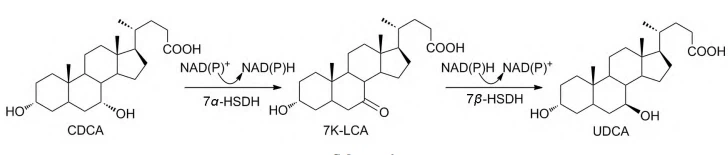
This method is effective in minimizing side reactions and prolonging the enzyme recycling period. Special attention should be paid to the compatibility of the chemical and enzyme combination steps. This pathway is also an important method for obtaining high yields of UDCA.
• Biosynthesis of UDCA
A large number of multi-enzyme cascade reactions exist for different metabolic pathways in the cell. These reactions are usually accomplished with the participation of two or more enzymes. Toxic or unstable intermediates in multi-enzyme cascade reactions may be consumed at the very moment of their appearance. This changes the reaction equilibrium in favor of product formation. It promotes the completion of reversible reactions, reduces the reaction time and lowers the cost. The researchers investigated the key steps in the chemoenzymatic preparation of Bulk Ursodeoxycholic Acid. The two-step reduction of dehydrocholic acid (DHCA) to 12K-UDCA was carried out using mutants 7β-HSDH from Collinsella aerofaciens, 3α-HSDH from Comamonas testosteroni. a fully biocatalytic system was constructed to study three different one-pot reactions. The system was able to completely convert 100 mM DHCA into 12K-UDCA (> 99.5 mM) within 4.5 h. The system was also able to convert 100 mM DHCA into 12K-UDCA (> 99.5 mM) within 4.5 h.

What Is Ursodeoxycholic Acid Used For?
Bulk Ursodeoxycholic Acid Powder is a normally happening bile acid that has different clinical applications. Here are a portion of the normal applications of Ursodeoxycholic Acid Powder:
• Treatment of Liver Sicknesses:
UDCA is broadly utilized in the treatment of different liver illnesses, including essential biliary cholangitis (PBC), essential sclerosing cholangitis (PSC), and non-alcoholic greasy liver disease (NAFLD). It assists with working on liver capability, lessen irritation, and forestall the development of harmful bile acids.
• Disintegration of Gallstones:
UDCA can be utilized to break down specific kinds of gallstones in patients who are not appropriate for careful mediation. It works by lessening the cholesterol content in the gallbladder, consequently working with the disintegration of cholesterol gallstones.
• Counteraction of Gallstone Arrangement:
For people at high gamble of creating gallstones, Bulk Ursodeoxycholic Acid might be recommended as a preventive measure. It assists with diminishing the cholesterol immersion in bile, forestalling the arrangement of new gallstones.
• Bile Reflux Gastritis:
UDCA has shown likely in the treatment of bile reflux gastritis, a condition described by the unusual in reverse progression of bile into the stomach. It assists with lessening the aggravation in the stomach lining and further develop side effects like stomach torment and nausea.
• Cystic Fibrosis-Related Liver Sickness:
Bulk Ursodeoxycholic Acid is in some cases utilized in the administration of liver disease related to cystic fibrosis. It can work on liver capability and decrease the risk of complications in these patients.
6. Drug-Incited Cholestasis:
UDCA might be utilized in the treatment of medication-induced cholestasis, a condition characterized by weakened bile stream because of drug use. It assists with reestablishing the normal bile flow and improving liver function.
What Is Bulk Ursodeoxycholic Acid Used For?
Ursodeoxycholic Acid (UDCA) is a naturally occurring bile acid widely used in the pharmaceutical and healthcare industries due to its beneficial effects on bile flow and liver function. Bulk Ursodeoxycholic Acid has multiple clinical applications and is commonly used in the treatment and management of various liver and biliary disorders.
1. Treatment of Liver Diseases
Bulk Ursodeoxycholic Acid is extensively used in the management of several chronic liver conditions, including primary biliary cholangitis (PBC), primary sclerosing cholangitis (PSC), and non-alcoholic fatty liver disease (NAFLD). UDCA helps improve liver function by promoting bile secretion, reducing liver inflammation, and decreasing the accumulation of toxic bile acids that may damage liver cells. Long-term use may help slow disease progression and support overall liver health.
2. Dissolution of Cholesterol Gallstones
UDCA is commonly prescribed for patients with cholesterol gallstones who are not suitable candidates for surgery. It works by lowering the cholesterol concentration in bile and gradually reducing the cholesterol content within existing gallstones. Over time, this process can help dissolve certain types of gallstones and reduce related symptoms.
3. Prevention of Gallstone Formation
For individuals at increased risk of gallstone development, such as those experiencing rapid weight loss or undergoing bariatric procedures, UDCA may be used as a preventive treatment. By reducing cholesterol saturation in bile, it helps decrease the likelihood of new gallstone formation.
4. Management of Bile Reflux Gastritis
UDCA powder has shown potential benefits in patients with bile reflux gastritis, a condition in which bile abnormally flows backward into the stomach. It may help protect the stomach lining, reduce inflammation, and relieve symptoms such as nausea, discomfort, and abdominal pain.
5. Support for Cystic Fibrosis-Associated Liver Disease
Bulk Ursodeoxycholic Acid is sometimes used in patients with cystic fibrosis-related liver disorders. It may improve bile flow, support liver function, and help reduce complications associated with long-term liver involvement.
6. Treatment of Drug-Induced Cholestasis
UDCA may also be used in cases of drug-induced cholestasis, a condition characterized by impaired bile flow caused by certain medications. It can assist in restoring normal bile circulation and improving liver function recovery.
Factory&Team:

Certification
Package & Shipment

Hot Tags: bulk ursodeoxycholic acid, China bulk ursodeoxycholic acid manufacturers, suppliers, factory, L-carnitine Fumarate Powder, D-Chiro Inositol Powder, Alpha-GPC Powder
You Might Also Like


