


GHK-Cu (Copper Tripeptide-1) is a copper-binding tripeptide composed of glycine, histidine, and lysine and is widely studied as a copper peptide and cosmetic active ingredient. In GHK-Cu serum development, formulation design should consider raw material purity, active concentration, pH, solvent system, chelating agents, and processing conditions. GHK-Cu for skincare is commonly investigated in anti-aging formulations addressing the appearance of fine lines, wrinkles, reduced elasticity, and environmental oxidative stress. Its performance depends on the complete formulation system, including ingredient compatibility, stability, packaging, and storage. Therefore, developing products with GHK-Cu powder requires systematic evaluation of dissolution, ion compatibility, preservation, manufacturing processes, and long-term stability to support consistent product quality.
Chemical Structure and Basic Physicochemical Properties of GHK-Cu
GHK-Cu, also known as copper tripeptide or GHK-Cu peptide, is a coordination complex formed by the tripeptide Glycyl-L-histidyl-L-lysine (GHK) and divalent copper ions (Cu²⁺). It is widely used as a cosmetic peptide ingredient. GHK-Cu has a molecular formula of C14H23N5O4Cu and a molecular weight of approximately 403.92 Da.
Solubility:
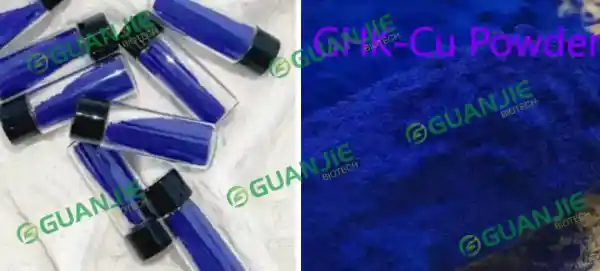
GHK-Cu peptide powder is readily soluble in water, propylene glycol, and glycerol, slightly soluble in ethanol, and poorly soluble in lipophilic organic solvents. Its aqueous solutions typically exhibit a characteristic blue color.
Complex Stability:
GHK-Cu demonstrates strong copper-peptide coordination under suitable pH conditions. However, extreme acidic or alkaline conditions and strong reducing environments may affect complex stability and peptide activity.
Formulation Considerations:
For products containing GHK-Cu powder, pH, temperature, light, and compatible excipients should be carefully controlled to maintain stability. These properties are important when developing GHK-Cu for skincare and other cosmetic formulations.
Why Is GHK-Cu Anti-aging?
The anti-aging potential of GHK-Cu, also known as copper tripeptide, is associated with its ability to regulate cellular activity, extracellular matrix (ECM) remodeling, antioxidant defenses, inflammatory responses, and skin repair. These mechanisms make GHK-Cu serum a widely studied active ingredient in anti-aging skincare formulations.
Promoting ECM Synthesis
GHK-Cu peptide may stimulate dermal fibroblast activity and support the synthesis of important ECM components, including type I, III, and V collagen and elastin. It may also promote the production of glycosaminoglycans, including hyaluronic acid, and proteoglycans such as decorin. These activities can contribute to skin hydration, structural integrity, and overall skin density, supporting the use of GHK-Cu for skin repair and anti-aging formulations.
Regulating Matrix Metalloproteinases
Skin aging involves continuous ECM degradation, partly through matrix metalloproteinases (MMPs). GHK-Cu has been studied for its potential role in regulating this remodeling process. It may support the removal of damaged matrix components while helping maintain a more balanced relationship between MMPs and tissue inhibitors of metalloproteinases (TIMPs). This may support the organization and renewal of collagen within the dermal matrix.
Supporting Antioxidant Defense
Copper is an essential cofactor for antioxidant enzymes such as superoxide dismutase (SOD). Through copper-binding activity, copper tripeptide GHK-Cu powder may also help regulate copper availability and oxidative processes. These properties are relevant to GHK-Cu anti-aging formulations designed to support skin against oxidative stress.
Modulating Inflammation and Skin Repair
GHK-Cu has also been investigated for its potential effects on inflammatory signaling and tissue repair. Its biological activity may help regulate pro-inflammatory mediators and support processes associated with skin barrier recovery. Therefore, GHK-Cu skincare formulations are commonly positioned around collagen support, skin repair, and overall skin rejuvenation.
GHK-Cu Formulation Guide:
When formulating a GHK-Cu serum, chemical and physical compatibility are critical factors affecting formulation stability and product performance. GHK-Cu, also known as copper tripeptide-1, requires careful control of pH, chelating agents, antioxidants, polymers, temperature, light, and oxygen.
pH Control:
For a GHK-Cu formulation, the target pH should generally be maintained within 5.5–6.5. Excessively low pH may promote protonation of histidine residues and affect copper complexation, while excessively high pH may increase the risk of copper salt precipitation or peptide degradation.
Chelating Agents and Incompatibilities:
EDTA and other strong chelating agents can competitively bind copper ions and potentially disrupt the GHK-Cu complex. Therefore, ingredients such as EDTA-2Na should be carefully evaluated or avoided when developing a copper peptide serum.
Strong reducing antioxidants, including high concentrations of ascorbic acid and glutathione, may reduce Cu²⁺ and affect complex stability, potentially resulting in discoloration. Acidic ingredients such as AHAs, BHAs, and certain water-soluble retinoid derivatives may also lower formulation pH and influence complex stability.
Polymer Compatibility:
Strongly anionic polymers, including some conventional carbomers, may interact with charged GHK-Cu and contribute to precipitation or aggregation. Nonionic thickeners such as xanthan gum and hydroxyethyl cellulose may provide alternative formulation options.
Stability Measures:
Protect the GHK-Cu serum from excessive light, oxygen, and heat. Suitable packaging, such as opaque or airless containers, can help minimize environmental exposure. During manufacturing, GHK-Cu is preferably added during the later production stage at temperatures below 40°C to reduce prolonged heat exposure.
Comparison of GHK-Cu with Other Anti-Aging Active Ingredients
To assess GHK-Cu Blue Copper Peptide's position in active ingredient selection, the table below lists a horizontal comparison with mainstream anti-aging ingredients on the market across multiple dimensions.
|
Comparison Dimensions |
GHK-Cu |
Retinol |
Ascorbic acid (Vitamin C) |
Argireline |
|
Main Mechanism of Action |
Activates fibroblasts, regulates gene expression, and reconstructs ECM |
Accelerates epidermal cell renewal and promotes collagen synthesis |
Scavenges free radicals, promotes collagen cross-linking |
Blocks neurotransmitter release, soothes expression lines |
|
Recommended Usage |
0.05% - 0.5% (or up to 2.0%) |
0.1% - 0.5% |
5.0% - 20.0% |
0.5% - 10.0% |
|
Skin Tolerance |
Extremely high concentration, non-irritating, suitable for sensitive skin |
Low concentration, easily causes peeling, erythema, and dryness/itching |
Moderate, the original ascorbic acid is irritating at low pH |
Extremely high, non-irritating |
|
Formula Stability Difficulty |
High (sensitive to pH and metal chelating agents) |
High concentration (easily oxidized and decomposes in sunlight) |
Extremely high (easily oxidized and discolored in aqueous solution) |
Moderate |
|
Repair and Anti-inflammatory Capabilities |
Extremely potent, possessing wound repair and anti-inflammatory activity |
None (may initially induce inflammation) |
Moderate (primarily an antioxidant) |
None |
Typical Formulation Structure and Addition Process
In developing GHK-Cu anti-aging serum, aqueous carriers or liposome microencapsulation carrier systems are typically used to improve the penetration rate and physical stability of the active ingredients.
GHK-Cu Anti-aging Serum Reference Formulation Composition Table
|
Ingredient Classification |
INCI Name / Chemical Name |
Percentage by weight (wt%) |
Main functions in the formulation: |
|
Solvent/Carrier |
Water (Aqua) |
Balance (To 100%) |
Formula matrix solvent |
|
Humoisturizer |
Glycerine / 1,3-Propanediol |
5.00% - 8.00% |
Basic polyol moisturizing |
|
Core Active Ingredient |
Sodium Hyaluronate (High/Low Molecular Weight) |
0.20% - 0.50% |
Formula forms a mesh-like water-locking film, aiding in the penetration of active ingredients |
|
Synergistic Active Ingredient |
GHK-Cu (Blue Copper Peptide Lyophilized Powder) |
0.10% - 0.50% |
Promotes collagen regeneration, anti-aging, and matrix repair |
|
Thickener |
Acetyl Hexapeptide-8 / Palmitoyl Pentapeptide-4 |
0.05% - 0.20% |
Synergistic anti-wrinkle effect through multiple pathways |
|
Soothing Agent |
Ammonium Polyacrylamide Dimethyl Taurate |
0.50% - 1.00% |
Salt-resistant rheological regulation, forming a refreshing fluid |
|
Preservative System |
Allantoin / Panthenol (Pro-Vitamin B5) |
0.50% - 1.00% |
Synergistically soothing, maintaining skin barrier stability |
|
pH Adjuster |
p-Hydroxyacetophenone / 1,2-Hexanediol |
0.80% - 1.00% |
Gentle, antibacterial-free system |
|
Ingredient Classification |
Citrate / Sodium Citrate Buffer |
Appropriate |
Stabilizes system pH to 6.0 ± 0.2 |
FAQs:
Q1: What is GHK-Cu, and how does it work in anti-aging serums?
A: GHK-Cu (Glycyl-L-Histidyl-L-Lysine Copper) is a naturally occurring human tripeptide copper complex. In anti-aging serum formulations, it acts as a signaling peptide that stimulates collagen I and III synthesis, promotes elastin production, and activates skin remodeling pathways. It also upregulates glycosaminoglycans like hyaluronic acid to restore skin firmness, elasticity, and hydration at the cellular level.
Q2: What is the optimal concentration of GHK-Cu for cosmetic serum development?
A: The effective clinical concentration of GHK-Cu in topical anti-aging formulations ranges from 0.05% to 2.0%. Higher concentrations do not necessarily improve performance; exceeding 2% can lead to skin irritation or peptide instability. Formulations targeting daily maintenance typically use 0.1% to 1.0% for maximum efficacy without compromising skin barrier tolerance.
Q3: What ingredients are incompatible with GHK-Cu in serum formulations?
A: GHK-Cu should not be formulated alongside direct strong acids (such as L-ascorbic acid, AHA, or BHA below pH 5.0) or strong chelating agents like disodium EDTA. Acidic environments destabilize the copper-peptide bond, causing the copper ion to detach and rendering the peptide inactive. Additionally, combining GHK-Cu with strong antioxidants like pure Vitamin C causes dual degradation through redox reactions.
Q4: How do cosmetic chemists stabilize GHK-Cu in water-based serum formulations?
A: Formulators stabilize GHK-Cu by maintaining a strict formulation pH range between 5.5 and 6.5. Recommended stabilization techniques include using non-ionic chelating buffers, pairing with neutral hydrating bases (such as hyaluronic acid or glycerin), and utilizing opaque or UV-blocking airless packaging to prevent photodegradation and oxidation.
Q5: Can GHK-Cu be combined with Retinol or Niacinamide in anti-aging products?
A: Yes, GHK-Cu pairs exceptionally well with Niacinamide (Vitamin B3) at a neutral pH (5.5–6.0), as both support barrier repair and skin brightening. While GHK-Cu can be used alongside Retinol, formulators often recommend separating them in layered routines or encapsulated delivery systems to avoid skin irritation, as retinol can compromise the barrier when combined with active signaling peptides.
Q6: What skin barrier benefits does GHK-Cu offer compared to Matrixyl or Argireline?
A: While peptides like Matrixyl (palmitoyl tripeptide-1/7) focus primarily on extracellular matrix synthesis and Argireline targets expression lines via neurotransmitter inhibition, GHK-Cu is unique in its tissue-repair and anti-inflammatory profile. GHK-Cu accelerates wound healing, enhances antioxidant enzyme activity (like superoxide dismutase), and regulates gene expression associated with skin repair and DNA integrity.
Q7: Is GHK-Cu suitable for sensitive or post-procedure skin formulations?
A: Yes. GHK-Cu exhibits significant anti-inflammatory and tissue-regenerative properties, making it ideal for sensitive skin and post-dermatological procedure recovery products (e.g., post-microneedling or post-laser care). It downregulates pro-inflammatory cytokines while accelerating skin re-epithelialization.
Q8: What are the shelf-life and storage requirements for GHK-Cu raw materials and finished serums?
A: Raw GHK-Cu powder should be stored tightly sealed at 2°C to 8°C (36°F to 46°F) away from light. Finished water-based serums stored in ambient conditions typically maintain a 12- to 24-month shelf life, provided appropriate broad-spectrum preservatives (e.g., phenoxyethanol, ethylhexylglycerin) and light-blocking airless containers are used.
Q9: How long does it take to see clinical results from a GHK-Cu serum?
A: Clinical studies show measurable improvements in skin hydration and barrier repair within 1 to 2 weeks of daily application. Visible reductions in fine line depth, improved skin elasticity, and increased firmness typically manifest between 8 and 12 weeks of consistent use at recommended active levels.
Conclusion:
GHK-Cu peptide is a versatile anti-aging ingredient that supports collagen synthesis, antioxidant defense, and skin repair. Effective GHK-Cu serum formulation requires careful pH control (5.5–6.5) and avoidance of strong chelators and reducing agents. Although stabilization can be challenging, its skin tolerance and regenerative properties make copper peptide GHK-Cu valuable for sensitive and post-procedure skincare. When properly formulated, GHK-Cu may improve skin firmness, hydration, and visible signs of aging. Guanjie Biotech is a bulk GHK-Cu supplier offering quality solutions for cosmetic formulations.
References:
[1] Pickart, L., & Margolina, A. (2018). Regenerative and protective actions of the GHK-Cu peptide in the light of the new gene data. International Journal of Molecular Sciences, *19*(7), 1987.
[2] Pickart, L., & Margolina, A. (2018). Skin regenerative and anti-cancer actions of copper peptides. Cosmetics, *5*(2), 29.
[3] Pickart, L., Vasquez-Soltero, J. M., & Margolina, A. (2012). The human tripeptide GHK-Cu in prevention of oxidative stress and degenerative conditions of aging: implications for cognitive health. Oxidative Medicine and Cellular Longevity, *2012*, 324832.
[4] BenchChem Technical Support Team. (2025). Troubleshooting low bioavailability of GHK-Cu in topical formulations. BenchChem Technical Support Center.
[5] Erdem, S., & Türkoğlu, M. (2014). Glycyl-L-histidyl-L-lysine-Cu(2+) loaded liposome formulations. Marmara Pharmaceutical Journal, *14*(2), 91-97.
[6] AMCOL Health & Beauty Solutions. (2026). GHK-Cu Copper Peptide Delivery System MSN702CU. Personal Care Magazine.
[7] A composition and preparation method for improving the stability of copper peptides. Chinese Invention Patent, CN115006273B. State Intellectual Property Office. (GHK-Cu stability improvement technology patent)
[8] A cosmetic composition containing copper peptides. Chinese Invention Patent, CN118845533A. State Intellectual Property Office. (GHK-Cu cosmetic composition formulation patent)


