Peptides lead modern anti-aging skincare. Copper peptide GHK-Cu and Matrixyl (Matrixyl 3000, Synthe'6) represent the industry standard for signal and carrier peptide technology. GHK-Cu accelerates skin remodeling, collagen production, and tissue repair. Matrixyl targets deep wrinkle reduction and extracellular matrix restoration.
For cosmetic formulators and brand R&D teams, selecting between bulk GHK-Cu raw material and Matrixyl requires evaluating core anti-aging claims, formulation pH stability, raw material cost-per-batch, and target demographic needs. Balancing these performance metrics ensures optimal product efficacy, regulatory compliance, and market viability.
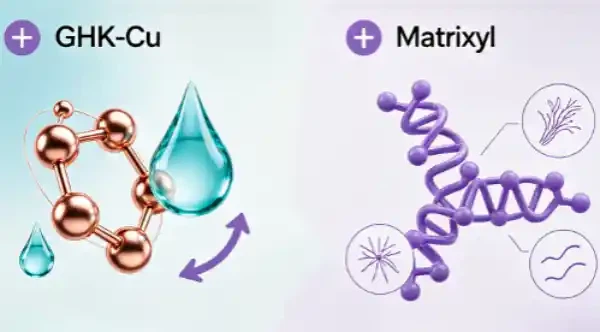
GHK-Cu vs. Matrixyl: How These Leading Anti-Aging Peptides Repair Skin
While both GHK-Cu and Matrixyl target extracellular matrix (ECM) repair, their biological targets and signaling pathways differ fundamentally.
• GHK-Cu (Copper Tripeptide-1)
Operating as both a carrier and signal peptide, cosmetic-grade GHK-Cu consists of a glycine-histidine-lysine tripeptide bound to a copper ion (Cu2+). This copper acts as an essential cofactor for vital enzymes, including superoxide dismutase (SOD) for antioxidant defense and lysyl oxidase (LOX) for collagen cross-linking. Beyond boosting types I and III collagen, elastin, and glycosaminoglycans (GAGs), High purity GHK-Cu actively reduces inflammation, accelerates wound healing, and modulates matrix metalloproteinases (MMPs) to balance skin remodeling.
• Matrixyl (Palmitoyl Tripeptide-1 & Tetrapeptide-7)
Matrixyl functions purely as a signal peptide complex designed to mimic natural collagen breakdown fragments. By binding to cell-surface receptors, it tricks dermal fibroblasts into producing fresh hyaluronic acid along with types I, III, and IV collagen. Simultaneously, it downregulates pro-inflammatory cytokines, preventing premature collagen degradation caused by UV damage and cellular stress.
Comparison Table of Key Biological Properties: GHK-Cu vs. Matrixyl:
|
Comparison Dimensions |
GHK-Cu peptide powder |
Matrixyl (Matrixyl 3000 / Synthe'6) |
|
Key Active Ingredients |
Copper Tripeptide-1 |
Palmitoyl Tripeptide-1 & Palmitoyl Tetrapeptide-7 and others |
|
Classification |
Carrier peptides / Signal peptides / Tissue repair peptides |
Signal peptide / Lipophilic synthetic peptide |
|
Primary Targets |
Regulation of Type I/III collagen, GAGs, SOD activity, and MMPs |
Type I, III, and IV collagen, hyaluronic acid, pro-inflammatory cytokines |
|
Mechanism Characteristics |
Combines potent repair, anti-inflammatory, and anti-aging properties with tissue regeneration |
Specifically promotes collagen regeneration and smooths out fine lines |
|
Molecular Weight/Structural Characteristics |
Low molecular weight; features a hydrophilic copper ion chelate |
Conjugated with a palmitoyl chain, offering high lipophilicity and skin penetration |
Cosmetic Formula Stability: GHK-Cu vs. Matrixyl Compatibility Guide
Understanding the physicochemical stability of active raw materials is critical for extending product shelf life and preserving anti-aging efficacy. GHK-Cu (Copper Tripeptide-1) and Matrixyl (Palmitoyl Peptides) require vastly different formulation strategies to maintain structural integrity and active concentration.
Formulation Guidelines for GHK-Cu
• pH Sensitivity:
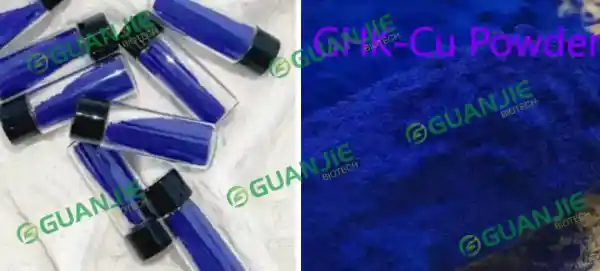
Maintains optimal stability within a pH range of 5.5–7.5. At a pH below 4.5, chelated copper ions dissociate, destroying the signature blue complex and causing a total loss of efficacy. A pH above 8.0 causes discoloration and precipitation.
• Chelator & Redox Incompatibilities:
Avoid strong chelating agents like EDTA-2Na, which strip copper ions directly from the peptide molecule. CAS 49557-75-7 GHK-Cu degrades rapidly when combined with strong reducing agents (L-ascorbic acid), oxidizers, or direct acids like AHAs and salicylic acid, turning the solution yellow or clear.
• Thickener Selection:
Anionic thickeners like classic Carbomer bind with positively charged GHK-Cu, breaking down colloidal systems. Formulate with non-ionic thickeners, neutral polymers, or specific grades of xanthan gum.
Formulation Guidelines for Matrixyl
• Broad pH Adaptability:
Palmitoylation increases lipophilicity and structural stability, enabling Matrixyl to remain fully functional across a wide pH window of 3.5–7.0.
• Synergistic Active Compatibility:
Matrixyl integrates smoothly with L-ascorbic acid, niacinamide, direct hydroxy acids, and standard preservative systems without triggering discoloration, precipitation, or degradation.
• Thermal & Processing Resilience:
Withstands standard phase emulsification heating (60°C–70°C). By contrast, heat-sensitive GHK-Cu must be post-added during the cool-down phase once the emulsion drops below 40°C.
Formulator Summary
Matrixyl excels in high-potency, multi-active acidic serums, offering exceptional processing flexibility. GHK-Cu requires a strictly controlled, pH-neutral environment free of strong chelators, direct acids, or anionic polymers to ensure maximum active retention.
Efficacy Positioning & Product Line Strategy
Choosing between GHK-Cu and Matrixyl requires aligning target claims with formula compatibility and product positioning.
GHK-Cu: High-Performance Repair & Scalp Health
• Post-Procedure Barrier Recovery:
Copper peptide serum ingredient is highly effective, single-use ampoules, and soothing sheet masks after clinical aesthetic procedures. Its bio-identical signaling speeds wound healing, calms inflammation, and restores compromised skin barriers.
• Prestige Anti-Aging & Repair:
The compound's natural blue hue offers a built-in visual signature for luxury serums without artificial dyes. It appeals directly to modern consumers seeking high-tech, bio-engineered skin remodeling.
• Scalp & Hair Follicle Care:
Formulated into scalp treatments and hair-density serums to stimulate follicle microcirculation, counter scalp aging, and promote healthier growth environments.
Matrixyl: Anti-Wrinkle & Daily Stability
• Targeted Firming & Wrinkle Reduction:
Ideal for targeted eye creams and rich face creams focusing on deep static lines, crow's feet, and firmness loss. Supported by extensive clinical data, Matrixyl reliably triggers collagen and elastin synthesis.
• Complex Multi-Active Formulations:
Matrixyl provides broad active compatibility where GHK-Cu might destabilize. It pairs safely with Vitamin C, Niacinamide, exfoliating acids, and complex antioxidant matrices without risking oxidation or formula breakdown.
• Photostable Daily Care & Sunscreens:
Highly resistant to thermal degradation and light-induced breakdown. This exceptional photostability makes it the primary choice for daily anti-aging lotions and broad-spectrum SPF formulas.
Product Development Matching and Selection Guide:
|
Evaluation Metrics |
GHK-Cu |
Matrixyl |
|
Ideal Formulation pH Range |
5.5 – 7.0 |
3.5 – 7.0 |
|
Incompatibilities |
Strong acids, pure Vitamin C, EDTA, strong oxidizing/reducing agents, Carbomer |
No significant chemical incompatibilities |
|
Appearance |
Imparts a natural blue color to the formula (no colorants needed) |
Colorless to pale yellow transparent liquid; does not affect formulation color |
|
Key Claim Focus |
Deep skin repair, soothing and anti-inflammatory effects, collagen regeneration, scalp care |
Specialized anti-wrinkle, firming and lifting, and fine-line smoothing effects; multi-functional anti-aging |
|
Addition Stage |
Add at low temperatures (< 40°C) |
Can be added during the mild heating stage |
|
Raw Material Cost |
Relatively high |
Moderate to high (depending on concentration in the formulation) |
Cosmetic Formulation Guide: Selecting Between GHK-Cu and Matrixyl
Optimizing anti-aging skincare formulations requires selecting high-efficacy active ingredients that balance stability, visual appeal, and clinical performance. Two premier choices for target extracellular matrix (ECM) regeneration are GHK-Cu (Copper Tripeptide-1) and Matrixyl (Palmitoyl Pentapeptide-4 / Palmitoyl Tripeptide-1).
GHK-Cu: Premium Visual Differentiation & Tissue Repair
For formulations targeting immediate skin barrier recovery and post-procedure soothing, GHK-Cu is the ideal active.
• Visual Appeal:
Its rich blue hue offers natural visual differentiation, removing the need for artificial colorants in premium serums.
• Biological Function:
Cosmetic-grade peptide powder accelerates wound healing, reduces inflammation, and stimulates glycosaminoglycan synthesis to restore compromised skin.
Matrixyl: Superior Stability & Targeted Wrinkle Reduction
For high-performance anti-aging creams requiring long shelf-life and clinical validation, Matrixyl (Palmitoyl Tripeptide-1 and Palmitoyl Tetrapeptide-7) delivers optimal performance.
• Formulation Stability:
Unlike metal-bound peptides, Matrixyl exhibits broad pH tolerance and compatibility with common cosmetic emulsifiers, minimizing deactivation risks during scaled manufacturing.
• Anti-Aging Efficacy:
Supported by extensive in vivo clinical data, Matrixyl rebuilds the extracellular matrix, effectively boosting deep-layer collagen synthesis to smooth fine lines and firm sagging skin.
|
Active Ingredient |
Primary Benefit |
Key Formulation Advantage |
Ideal Applications |
|
GHK-Cu |
Barrier repair & anti-inflammation |
Vibrant blue color, rapid cell recovery |
Post-procedure serums, soothing gels |
|
Matrixyl |
Long-term firming & anti-wrinkle |
High processing stability, low reactivity |
Daily anti-aging creams, firming lotions |
Synergistic Dual-Peptide Strategy
Integrating both peptides into a single system creates a comprehensive anti-aging matrix. Maintaining a neutral pH (~5.5–6.5) and avoiding strong acids or chelating agents allows GHK-Cu and Matrixyl to work synergistically-simultaneously soothing inflammation while stimulating structural skin density.
FAQs:
Q1: Can GHK-Cu and Matrixyl be used together?
Yes. Combining Anti-aging peptide ingredient GHK-Cu and Matrixyl creates a comprehensive anti-aging strategy. Matrixyl focuses on structural repair by signaling collagen production, while GHK-Cu accelerates overall skin remodeling and healing.
Q2: Are there ingredients that shouldn't be mixed with GHK-Cu or Matrixyl?
● Strong Acids (AHAs/BHAs):
Direct acids lower pH and can break down (hydrolyze) peptide bonds, rendering them ineffective.
●Pure Vitamin C (L-Ascorbic Acid):
Highly acidic environments degrade peptides. Additionally, copper ions in the GHK-Cu skincare ingredient can oxidize Vitamin C, neutralizing both ingredients.
● Retinoids:
Safe to use in the same routine, but best applied at different times (e.g., peptides in the morning, retinoids at night) to prevent skin irritation.
Q3: Which peptide is better for sensitive skin?
Matrixyl is generally better tolerated by sensitive skin types because it is non-irritating and rarely reacts with other formulation elements. GHK-Cu raw material is also soothing due to its anti-inflammatory properties, but higher concentrations of copper peptides can occasionally trigger mild redness or sensitivity in reactive skin.
Q4: What is the difference between GHK-Cu and Matrixyl peptides in anti-aging products?
GHK-Cu Copper Tripeptide-1 is a carrier peptide delivering copper to repair tissue, boost antioxidant enzymes, and remodel skin. Matrixyl uses synthetic matrikines to signal fibroblasts to specifically synthesize structural collagen.
Q5: Which peptide ingredient is better for collagen support, GHK-Cu or Matrixyl?
Matrixyl offers targeted signaling specifically optimized for fresh collagen production and line smoothing. However, Natural Copper Peptide Ingredient provides overall structural remodeling, supporting collagen while simultaneously aiding tissue repair and antioxidant defense.
Q6: How do cosmetic brands choose a reliable copper peptide supplier?
Brands select vendors offering minimum 98% HPLC purity, cGMP/ISO certifications, and transparent batch tracking. They prioritize consistent manufacturing capabilities, reliable stability testing, and strong third-party analytical verification standards.
Q7: What documents should buyers request when purchasing GHK-Cu raw materials?
Buyers must request a Certificate of Analysis showing HPLC purity and heavy metal profiles, a Safety Data Sheet, Technical Data Sheets, and ISO/cGMP compliance documentation.
Conclusion
In the GHK-Cu vs. Matrixyl debate, there is no universally "better" peptide-the optimal choice depends entirely on formulation goals. Water-soluble copper peptide excels in premium repair serums, leveraging its copper-driven tissue regeneration, anti-inflammatory action, and distinctive blue visual cue, though it demands strict pH control (5.5–7.0) and careful ingredient selection. Matrixyl offers superior versatility for daily anti-aging products, providing broad pH tolerance (3.5–7.0), excellent stability, and seamless compatibility with Vitamin C, acids, and complex matrices. For maximum efficacy, formulators can combine both peptides in a neutral pH system (5.5–6.5), creating a synergistic anti-aging matrix that simultaneously soothes, repairs, and rebuilds skin structure.
Guanjie Biotech supplies high-purity GHK-Cu skincare ingredients and Matrixyl raw materials supported by strict quality control. Contact our technical team for custom OEM/ODM solutions, formulation guidance, and bulk ingredient sourcing tailored to your brand's specifications. Welcome to enquire with us at info@gybiotech.com.
References:
[1] Johnson, W., Bergfeld, W. F., Belsito, D. V., Hill, R. A., Klaassen, C. D., Liebler, D. C., Marks, J. G., Shank, R. C., Slaga, T. J., Snyder, P. W., Gill, L. J., & Heldreth, B. (2018). Safety Assessment of Tripeptide-1, Hexapeptide-12, Their Metal Salts and Fatty Acyl Derivatives, and Palmitoyl Tetrapeptide-7 as Used in Cosmetics. International Journal of Toxicology, *37*(3_suppl), 90S-102S. https://doi.org/10.1177/1091581818807863
[2] Robinson, L. R., Fitzgerald, N. C., Doughty, D. G., Berge, C. A., & Bissett, D. L. (2005). Topical palmitoyl pentapeptide provides improvement in photoaged human facial skin. International Journal of Cosmetic Science, *27*(3), 155-160.
[3] Siméon, A., et al. (2000). The tripeptide-copper complex glycyl-L-histidyl-L-lysine-Cu²⁺ stimulates matrix metalloproteinase-2 expression by fibroblast cultures. Life Sciences, *67*, 2257.
[4] Trapaidze, A., et al. (2012). Thermodynamic study of Cu²⁺ binding to the DAHK and GHK peptides by isothermal titration calorimetry (ITC) with the weaker competitor glycine. JBIC Journal of Biological Inorganic Chemistry, *17*, 37.
[5] Sánchez-Peña, M. J., Magallón-Chávez, O., & Rivas-Loaiza, J. A. (2025). Neurocosmetics and Aromatherapy Through Neurocutaneous Receptors and Their Functional Implications in Cosmetics. Cosmetics, *12*(5), 179. https://doi.org/10.3390/cosmetics12050179
[6] Compositions comprising Paulownin and/or Paulownia extracts and uses thereof. CN103228261B. Google Patents.