Beta-glucan yeast powder is used in dog nutrition. Current evidence suggests that beta-glucan supplements from specific sources (such as Saccharomyces cerevisiae) and at specific doses (such as 0.14% of the total diet) have a high safety profile for healthy adult dogs. This demonstrates positive effects in regulating gut microbiota, improving protein digestibility, and modulating immunity. However, rigorous risk assessments are necessary for individuals with specific underlying diseases (especially inflammatory bowel disease) or immune dysregulation.
Is Beta-Glucan Safe For Dogs?
The core of assessing the safety of beta-glucan yeast powder lies in understanding its mechanism of action. As a pathogen-associated molecular pattern, β-glucan exerts its effects by binding to specific receptors (such as Dectin-1) on the surface of immune cells (such as macrophages). It is noteworthy that β-glucan is not a substance produced by the dog body itself; therefore, it is recognized by the immune system as a "non-self" component. This recognition is the biological basis for its immunomodulatory functions and, in rare cases, a potential cause of excessive immune responses.
In healthy dogs, this recognition mechanism typically induces a protective regulatory response rather than pathological inflammation. For example, a dose-response study published in *Microorganisms* in 2024 clearly indicated that adding 0.07% to 0.28% purified β-1,3/1,6-glucan to the diet of healthy adult dogs did not result in any adverse reactions. In this study, no negative changes were observed in fecal pH, short-chain fatty acid concentration, phagocytic activity, or lymphocyte subset counts in the experimental dogs, confirming high tolerability within this dose range.
Are There Any Risks for Dogs?
While beta-glucan yeast powder has a good safety profile in healthy individuals, recent case reports have raised concerns about its use in specific pathological conditions.
• Sensitivity in Patients with Inflammatory Bowel Disease (IBD)
A case report published in MDPI in 2026 detailed adverse reactions in two dogs with IBD after oral administration of beta-glucan yeast powder. Both dogs, whose conditions were initially under control, exhibited severe skin anaphylaxis (erythema, papules) and intense itching after beta-glucan intake. Researchers hypothesized that impaired intestinal barrier function and loss of oral tolerance associated with IBD may lead to an abnormal Th2-type immune bias in response to beta-glucan.
• Obesity and Allergic Reactions
Another case study of obese dogs showed that a 6-year-old obese mixed-breed dog with no history of beta-glucan yeast powder exposure developed allergic symptoms such as hair loss, erythema, and severe itching within 30 days after consuming a diet containing 0.1% purified β-1,3/1,6-glucan. Symptoms subsided after withdrawal of this ingredient, but recurred upon re-exposure. Notably, the dog subsequently exhibited similar symptoms to β-1,3-glucan derived from Euglena gracilis, suggesting that this allergic reaction may have a cross-reactivity or non-specific immune hypersensitivity mechanism.
How to Add Beta-Glucan for Dogs?
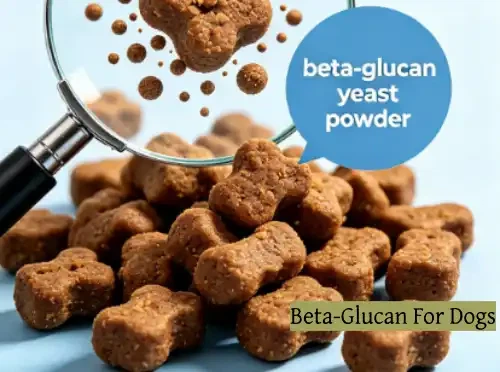
Determining a safe dosage range is an important step for B2B product development. Several studies provide useful safety and dosage data.
• Recommended Dosage for Healthy Dogs:
A 2024 study evaluated beta-glucan yeast powder extruded dog food. A 0.14% β-glucan addition showed optimal biological effects. It promoted the growth of beneficial bacteria, such as Faecalibacterium and Prevotella. It also improved the apparent digestibility of crude protein. The study further showed that a 0.28% addition level was still within the safe range. No abnormal physiological changes were observed in the dogs.
• Body Weight-Based Dosage:
Clinical studies have also examined dosage based on body weight. One study used oral beta-glucan yeast powder supplementation at approximately 9.13 ± 1.14 mg/kg body weight in dogs with controlled inflammatory bowel disease. Another study on healthy dogs used 1,000 mg/day of POLYCAN, a β-glucan derived from Brachystomata buddingae. The results showed no negative effects on growth performance, nutrient digestibility, or fecal pH. Researchers also observed increased serum immunoglobulin G and insulin-like growth factor-1 levels.
If you are a dog food manufacturer, developing standard pet food products can use healthy dog studies as a reference. An initial addition level of 0.1%–0.2% is recommended. Digestibility should be verified according to the specific formulation. When selecting beta-glucan yeast powder suppliers, companies should carefully review heavy metal control, microbial limits, and mycotoxin testing data. Guanjie Biotech's Yeast Beta Glucan Powder undergoes strict quality system certification. This helps ensure batch-to-batch consistency, high purity, and reduced raw material risks.
|
Dogs |
Safety Assessment |
Key Data/Conclusions |
Commercial Recommendations: |
|
Healthy adult dog |
High |
The recommended supplemental dose is 0.14%. At this dose, protein digestibility is significantly improved, butyrate-producing beneficial bacteria (such as Faecalibacterium) are enriched, and no hematological or behavioral abnormalities are observed. |
Suitable for mid-to-high-end daily health supplements and functional snacks. Claims of supporting immunity and optimizing gut microbiota are permitted. Warnings of contraindication or extremely low dosage are required. |
|
IBD/Chronic Enteropathy in Dogs |
High Risk |
Even during remission (CCECAI ≤ 3), a dose of 9.13 mg/kg may induce severe pruritus and erythema. |
Beta-glucan yeast powder is recommended to develop hypoallergenic formulas without yeast extract, or to conduct rigorous tolerability testing before use. |
|
Dogs with atopic dermatitis/osteoarthritis |
Potential and risks coexist. |
Theoretically, it has anti-inflammatory properties. However, in real-world cases, oral administration may exacerbate skin symptoms in dogs with IBD complications. |
Topical formulations are recommended over oral administration to avoid the risk of excessive activation of the gut immune system. |
Summary
In summary, beta-glucan yeast powder is safe and an effective functional nutritional supplement for the vast majority of dogs. However, certain dogs with severe gastrointestinal diseases (active IBD), a known history of allergies, or obesity accompanied by metabolic disorders should be considered a "potentially high-risk group."
When developing daily health supplements for general pets, safe dosages should be used, focusing on immune support and gut microbiota regulation. Collaborating with suppliers possessing strong research capabilities and transparent quality control systems ensures clear sourcing and compliance with purity standards for raw materials, reducing supply chain risks. Through rigorous scientific formulation design and risk-management-based customer communication, beta-glucan yeast powder will unlock greater commercial potential in the dog nutrition market.
References
[1] Amaral, A.R., et al. Translating Human and Animal Model Studies to Dogs' and Cats' Veterinary Care: Beta-Glucans Application for Skin Disease, Osteoarthritis, and Inflammatory Bowel Disease Management. Microorganisms, 2024, 12(6), 1071.
[2] Marchi, P.H., et al. Effects of Increasing Levels of Purified Beta-1,3/1,6-Glucans on the Fecal Microbiome, Digestibility, and Immunity Variables of Healthy Adult Dogs. Microorganisms, 2024, 12(1), 113.
[3] Adverse Reactions to Yeast Beta-Glucan Supplementation in Two Dogs with Inflammatory Bowel Disease. MDPI, 2026, 3(1), 7.
[4] Marchi, P.H., et al. Allergic Reaction to Beta‐Glucans in an Obese Dog: A Case Report of Confirmed and Suspected Sources. Journal of Animal Physiology & Animal Nutrition, 2025, 1-6.
[5] Response of gut microbiome and metabolomic profiles to POLYCAN, a β-glucan derived from Aureobasidium pullulans SM-2001 in beagles. Journal of Animal Science and Biotechnology, 2026, 17, 63.