With the rapid growth of the health nutrition, functional food, sports nutrition, and healthy aging industries, NAD+ has become one of the most popular functional ingredients in the global market. As an important coenzyme in human cells, NAD+ is involved in energy metabolism, redox reactions, DNA repair, and cell signaling. However, traditional NAD+ has several limitations. These include poor stability, a high degradation rate in the digestive tract, and low absorption efficiency. As a result, liposomal NAD+ technology has gained increasing attention. For functional food companies, dietary supplement brands, OEM manufacturers, and ingredient buyers, the bioavailability of liposomal NAD+ powder is an important factor when evaluating product value. What is the bioavailability of liposomal NAD+ powder? What are its technological advantages?
What Are Challenges of Traditional NAD+?
Bioavailability refers to the amount of an ingredient that is absorbed and utilized by the body after ingestion. It is a key indicator of NAD+ quality. Traditional free-form NAD+ has three major limitations.
Severe Degradation in the Gastrointestinal Tract
NAD+ bulk powder is a water-soluble molecule with limited stability. It can be rapidly broken down by stomach acid and digestive enzymes. More than 90% may degrade after oral administration, leaving less than 10% available for intestinal absorption.
Low Transmembrane Absorption Efficiency
NAD+ is a charged molecule. It cannot easily pass through the phospholipid bilayer of cell membranes. Absorption through passive diffusion or active transport is limited. As a result, much of the remaining NAD+ is excreted before it can be utilized.
Short Retention Time in the Body
Even the small amount of absorbed NAD+ has a short half-life. It does not easily accumulate in target tissues such as the liver and mitochondria. This limits the duration of its biological effects.
Because of these limitations, the overall bioavailability of traditional NAD+ is often reported to be below 5%. This creates the common industry challenge of high dosage requirements but limited effectiveness, increasing formulation costs and market risks for customers.
What Is Liposomal NAD+?
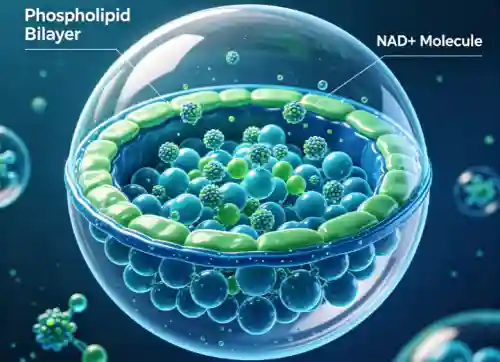
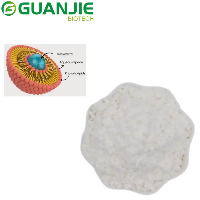
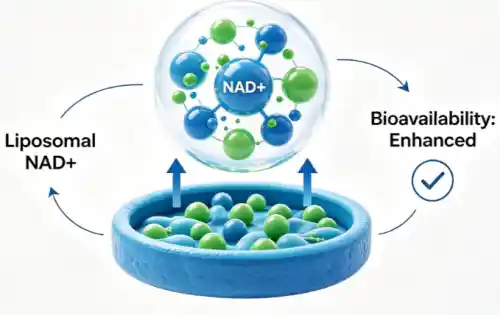
Liposomal NAD+ is a micro- or nano-delivery system that encapsulates NAD+ within a phospholipid bilayer. Liposomes are usually made from natural phospholipids. Their structure is highly compatible with cell membranes.
Liposomes can be produced through technologies such as high-pressure homogenization, ultrasonic dispersion, and nano-emulsification. When NAD+ is enclosed inside the liposome, the phospholipid layer acts as a protective barrier. This improves ingredient stability during storage, transportation, and digestion.
Commercial liposomal NAD+ powder products commonly use soybean phospholipids, sunflower phospholipids, or other food-grade phospholipids as encapsulation materials.
How Liposome Improves NAD+ Bioavailability?
liposomal NAD+ powder are nanoscale vesicles made from a natural phospholipid bilayer. Their structure closely resembles human cell membranes. This makes them an efficient delivery system.
Through high-pressure homogenization and nano-encapsulation, NAD+ is enclosed within the liposome core.
Gastrointestinal Protection
The phospholipid shell protects NAD+ from stomach acid and digestive enzymes. This reduces degradation before absorption. Comparative industry data suggest that liposomal encapsulation can increase the gastrointestinal retention rate of NAD+ to more than 60%. This helps reduce ingredient loss and improves overall delivery efficiency.
Enhanced Cellular Absorption
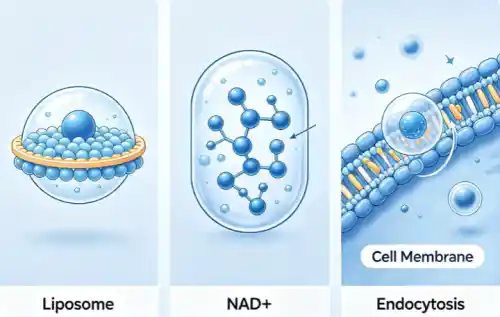
The phospholipid structure of liposomal NAD+ powder is similar to that of intestinal cell membranes. Liposomes can enter cells through membrane fusion and endocytosis. This bypasses many of the absorption barriers associated with free NAD+. It also reduces dependence on active transport systems.
Testing data indicate that high-quality liposomal NAD+ powder may provide absorption efficiency that is 5–10 times higher than conventional NAD+. Bioavailability may be 3–4.5 times greater than that of free NAD+.
Extended Metabolic Half-Life
Liposomal NAD+ powder help protect NAD+ from rapid degradation in the bloodstream. This slows metabolic clearance and extends circulation time. After administration of conventional liposomal NAD+, effective concentrations may remain stable for more than 12 hours. Traditional NAD+ often remains active for only 2–3 hours.
Improved Tissue Delivery
Nanosized liposomes may reduce rapid clearance by the reticuloendothelial system. They can help increase NAD+ delivery to important target tissues, including the liver, mitochondria, and skin. This may improve ingredient utilization while reducing unnecessary metabolic loss.
What Factors Affect Liposomal NAD+ Bioavailability?
From a manufacturing perspective, the bioavailability of liposomal NAD+ powder depends on production technology, quality control, and formulation design.
Encapsulation Efficiency and Particle Size
Encapsulation efficiency directly affects ingredient loading and protection. High-quality liposomal NAD+ powder products generally target an encapsulation efficiency of 98% or higher. Lower encapsulation efficiency leaves more free NAD+, reducing the benefits of liposomal delivery. Particle size should generally be controlled within the 50–200 nm range. Uniform particle size distribution supports consistent absorption and product stability. Guanjie Biotech uses a high-pressure homogenized nano-encapsulation process to achieve consistent control of encapsulation efficiency and particle size distribution. This helps maintain batch-to-batch consistency.
Phospholipid Quality and Composition
The purity and composition of phospholipids influence liposome stability and membrane fusion performance. Low-purity phospholipids may contain impurities that increase the risk of vesicle leakage or rupture. This can lead to NAD+ degradation during storage and digestion.
Storage Stability and Processing Compatibility
Some low-quality liposomal products experience vesicle instability during storage. This can reduce encapsulation efficiency and bioavailability over time. Guanjie Biotech has developed quality control systems and optimized freeze-drying and liquid formulation technologies to improve long-term stability. These processes of liposomal NAD+ powder help maintain encapsulation efficiency during storage, transportation, and end-product manufacturing.
What Are The Advantages of Liposomal NAD+ in Formulations?
For companies in dietary supplements, functional foods, and related industries, liposomal NAD+ powder offers several practical advantages.
Lower Dosage Requirements
Higher bioavailability may allow lower NAD+ inclusion levels while achieving comparable performance. This can help reduce formulation costs and improve overall product economics.
More Consistent Product Performance
Standardized liposomal NAD+ powder provides improved stability and delivery. This helps address common challenges associated with standard NAD+ products, including inconsistent performance and low customer satisfaction.
Compatibility with Multiple Dosage Forms
Liposomal NAD+ powder offers good process compatibility and can be used in a variety of formulations, including:
- Powders
- Capsules
- Liquid drops
- Tablets
- Functional foods
- Compressed candies
This flexibility supports diverse product development strategies.
Global Supply Chain Support
Guanjie Biotech provides large-scale production capabilities for liposomal NAD+ powder. The company supports customized development and commercial manufacturing projects for customers worldwide. Its products are designed to meet different regulatory and market requirements, helping B2B customers accelerate product launches and expand into international markets.
Conclusion:
From a technical perspective, liposomal NAD+ offers significant advantages in bioavailability compared to traditional NAD+. Its core value lies in protecting the active ingredient through a phospholipid bilayer structure, improving stability, reducing gastrointestinal degradation, and promoting absorption and cellular uptake.
For functional food brands, nutritional supplement companies, and OEM/ODM manufacturers, liposomal NAD+ not only enhances product technological competitiveness but also facilitates the development of high-value-added functional nutritional products. As liposome delivery technology continues to mature, liposomal NAD+ powder is expected to find wider application in the health and nutrition industry. In the future, bioavailability optimization will continue to be a crucial direction in the research and development of functional raw materials, and liposomal NAD+ will become one of the most anticipated innovative products in the market.
Guanjie Biotech can quickly respond to the customized R&D and mass production needs of customers in different countries and industries. If you are interested in our liposomal NAD+ powder products, please feel free to contact us at info@gybiotech.com.
References:
[1] Blair E, Miller AL, McDonald R. Increased Intracellular NAD+ Levels via Oral Supplementation With a Novel Liposomal Delivery Method: A Non-Randomized Crossover Study. Journal of Applied Natural Medicine. 2026.
[2] Khan AU, Delude RL, Han YY, et al. Liposomal NAD(+) prevents diminished O(2) consumption by immunostimulated Caco-2 cells. American Journal of Physiology-Lung Cellular and Molecular Physiology. 2002;282(5):L1082-L1091.
[3] Covarrubias AJ, Perrone R, Grozio A, Verdin E. NAD+ metabolism and its roles in cellular processes during ageing. Nature Reviews Molecular Cell Biology. 2021;2:119-141.
[4] Xie N, Zhang L, Gao W, et al. NAD+ metabolism: pathophysiologic mechanisms and therapeutic potential. Signal Transduction and Targeted Therapy. 2020;5:227.
[5] Ministrini S, Liberale L, Erle HE, et al. Liposome formulation enhances the anti-aging properties of nicotinamide adenine dinucleotide (NAD+) in endothelial and keratinocyte cells. Current Issues in Molecular Biology. 2025;47(9):722. DOI: 10.3390/cimb47090722
[6] Blair E, Miller AL, McDonald R. Oral supplementation to increase intracellular NAD+ levels via novel liposome delivery method: a non-randomized crossover study. Journal of Applied Natural Medicine. 2026.
[7] Khan AU, Delude RL, Han YY, et al. Liposome NAD+ prevents reduced oxygen consumption in immune-stimulated Caco-2 cells. American Journal of Physiology-Lung Cellular and Molecular Physiology. 2002;282(5):L1082-L1091.
[8] Covarrubias AJ, Perrone R, Grozio A, Verdin E. NAD+ metabolism during aging and its role in cellular processes. Nature Reviews Molecular Cell Biology. 2021;2:119-141.
[9] Xie N, Zhang L, Gao W, et al. NAD+ metabolism: pathophysiological mechanisms and therapeutic potential. Signal Transduction and Targeted Therapy. 2020;5:227.