Yes, Urolithin A UA, a natural polyphenolic compound produced by gut microbiota through the metabolism of ellagic acid and ellagitannins, has garnered significant attention in the field of life sciences in recent years. Based on existing scientific evidence, the molecular mechanisms and efficacy data of pure Urolithin A as an antioxidant, along with its broad application prospects in the raw material market, warrant further investigation.
What Are The Chemical Properties of Urolithin A?

Urolithin A has the chemical formula C₁₃H₈O₄ and the CAS number 1143-70-0. It is a polyphenolic metabolite with a dibenzo[b,d]pyran-6-one skeleton. Chemically, it belongs to the category of bioactive natural products. Its precursors are mainly found in plants such as pomegranates, nuts, and berries. The human body cannot directly absorb urolithin a natural sources. Instead, intestinal microorganisms convert ellagic acid into urolithin A. Due to individual differences in gut microbiota, the efficiency of converting ellagic acid-rich foods into urolithin A varies significantly between individuals. This variation forms the basis for the commercial rationale behind exogenous urolithin A supplementation.
Is Urolithin A An Antioxidant?
Yes, urolithin A is an antioxidant.
Direct Free Radical Scavenging Capacity of Urolithin A
In vitro free radical scavenging experiments provide quantitative evidence for evaluating the direct antioxidant capacity of compounds. Using the oxygen radical absorbance capacity (ORAC) method, the antioxidant activity of bulk urolithin A was equivalent to 13.2 μM Trolox. In the superoxide anion free radical scavenging experiment, the half-maximal inhibitory concentration (IC₅₀) of urolithin A was 5.01 μM. In the DPPH free radical scavenging experiment, the IC₅₀ was 152.66 μM.
These data indicate that urolithin A can directly interact with free radicals. From a molecular structure perspective, the phenolic hydroxyl groups in the molecule are the active sites that provide hydrogen atoms. This is the structural basis for the direct antioxidant activity of polyphenolic compounds. However, compared with some traditional strong antioxidants, the in vitro free radical scavenging activity of pure urolithin A is not its main feature. Research suggests that the in vivo antioxidant effects of this compound depend more on its regulatory role in the cellular antioxidant network than on simple free radical neutralization.
Regulatory Role of Urolithin A in Antioxidant Enzyme Activity
• Regulation of SOD2 and Mitochondrial Reactive Oxygen Species Scavenging
Superoxide dismutase 2 (SOD2) is a key antioxidant enzyme located in the mitochondrial matrix that is responsible for converting superoxide anions into hydrogen peroxide. In experiments using vascular smooth muscle cells from spontaneously hypertensive rats, treatment with urolithin A (25 μM) significantly reduced mitochondrial reactive oxygen species (ROS) levels and enhanced SOD2 activity.
Mechanistic studies revealed that urolithin A powder promotes the production of the short isoform of SIRT3 (SL-SIRT3) in mitochondria, thereby mediating the deacetylation of SOD2. Deacetylated SOD2 exhibits higher enzymatic activity. The SIRT3 inhibitor 3-TYP abolished the regulatory effects of urolithin A on SOD2 deacetylation, mitochondrial ROS levels, and cell proliferation and migration. These findings establish a complete signaling pathway: urolithin A → SIRT3 → SOD2 deacetylation → mitochondrial ROS reduction.
In animal experiments, intraperitoneal injection of urolithin A (50 mg/kg every 2 days for 4 weeks) in spontaneously hypertensive rats increased SL-SIRT3 levels and SOD2 activity in the aorta and mesenteric arteries while decreasing SOD2 acetylation and mitochondrial ROS levels. These data confirm that urolithin A can also regulate antioxidant enzyme activity in vivo.
• Enhancement of CAT, GPx, and GR Activities
In a Neuro-2a cell oxidative stress model, pretreatment with urolithin A (0.5–4 μM), followed by exposure to 250 μM hydrogen peroxide, significantly improved catalase (CAT), glutathione peroxidase (GPx), and glutathione reductase (GR) activities. Simultaneously, urolithin A upregulated the expression of peroxiredoxin 1 (Prdx1) and peroxiredoxin 3 (Prdx3), both of which play important roles in hydrogen peroxide clearance.
• Activation of the NRF2 Pathway
NRF2 (nuclear factor erythroid 2-related factor 2) is a key transcription factor that regulates cellular antioxidant responses. Under normal physiological conditions, NRF2 binds to KEAP1 in the cytoplasm and undergoes ubiquitin-mediated degradation. Upon activation, NRF2 translocates to the nucleus, binds to antioxidant response elements (AREs), and initiates the transcription of downstream antioxidant genes.
In a UVA-induced photoaging model using human dermal fibroblasts, urolithin A powder promoted the phosphorylation and nuclear translocation of NRF2, thereby activating downstream antioxidant enzymes. This mechanism synergizes with the induction of mitophagy by urolithin A, jointly mediating cytoprotective effects.
Inhibitory Effects of Urolithin A on Oxidase Activity
Another strategy for reducing oxidative stress is to inhibit enzymes that produce reactive oxygen species (ROS). Studies have shown that urolithin A exhibits a dose-dependent inhibitory effect on monoamine oxidase A (MAO-A) and tyrosinase. MAO-A, located on the outer mitochondrial membrane, catalyzes reactions that produce hydrogen peroxide as a byproduct. By inhibiting this enzyme's activity, urolithin A can reduce mitochondrial ROS generation.
Furthermore, in vascular smooth muscle cells, urolithin A (25 μM) inhibits NADPH oxidase (NOX) activity and downregulates NOX1 expression, but has no significant effect on NOX2 and NOX4 expression. NADPH oxidase is one of the main sources of superoxide anions in cells, and inhibiting this enzyme activity further enriches the multi-pathway antioxidant mechanism of urolithin A powder.
A key study published in the Journal of Agricultural and Food Chemistry by Kallio's team in 2013. This study indicates that the redox properties of urolithin A depend on the detection system:
• Organic oxidative assay (ORAC):
Urolithin A exhibits extremely strong antioxidant activity.
• Cellular-based assays:
In the absence of stressors, urolithin A may exhibit mild pro-oxidative properties within cells, while its parent compound, ellagic acid, does not show this reaction.
How To Add Urolithin A to Formulation?
As a polyphenolic compound, urolithin A powder should be formulated to avoid strong alkaline and oxidizing environments. Microencapsulation or liposome encapsulation is recommended to improve its delivery efficiency in the gastrointestinal tract. Guanjie Biotech's bulk urolithin A powder has high purity and good flowability, making it suitable for tableting, capsule, and powder production lines.
Conclusion:
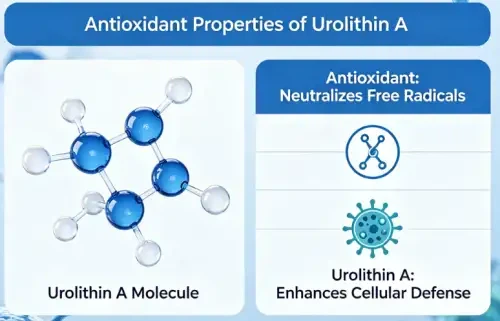
In summary, the antioxidant effect of urolithin A UA is based on a triple mechanism: direct scavenging of free radicals, activation of the Nrf2-ARE antioxidant pathway, and fundamental reduction of oxidative stressors by inducing mitophagy. Current preclinical evidence supports its potential applications in alleviating vascular remodeling, neuroprotection, and anti-aging.
For B2B clients seeking differentiated products, urolithiasis A's mechanism of action differs from traditional nutritional supplements. It represents the next generation of functional raw materials targeting mitochondria. It is recommended that purchasers focus on the purity, microbial stability, and heavy metal control standards of the supplier's products when selecting a bulk urolithin A supplier.
References:
[1] Urolithin A alleviates vascular remodeling through mitochondrial SIRT3-mediated SOD2 deacetylation and antioxidation in hypertensive rats. Redox Report, 2026, 31(1): 2622255.
[2] Urolithin A (3,8-dihydroxy-6H-dibenzopyran-6-one). Abmole Bioscience.
[3] Mechanistic Insights into the Biological Effects and Antioxidant Activity of Walnut Ellagitannins: A Systematic Review. Antioxidants, 2024, 13(8): 974.
[4] The Metabolite Urolithin-A Ameliorates Oxidative Stress in Neuro-2a Cells, Becoming a Potential Neuroprotective Agent. Antioxidants, 2020, 9(2): 177.
[5] Research progress on the pharmacological effects and mechanisms of urolithiasis A. Central South Pharmacy, 2022, 20(1).
[6] Targeting aging with urolithin A in humans: A systematic review. Ageing Research Reviews, 2024, 100: 102406.
[7] Effects of Urolithin A supplementation on performance and antioxidant status in academy soccer players during preseason: a pilot randomised controlled trial. DOAJ, 2025.
[8] Urolithin A protects human dermal fibroblasts from UVA-induced photoaging through NRF2 activation and mitophagy. J Photochem Photobiol B, 2022.