In the functional foods, dietary supplements, and cosmetics field, liposomal Coenzyme Q10 has become a popular functional ingredient. It uses phospholipid encapsulation technology. This technology helps overcome the limitations of traditional CoQ10, such as poor water solubility, low bioavailability, and susceptibility to oxidation. Today, liposomal CoQ10 is mainly available in powder and liquid forms. Both forms contain the same active ingredient and use the same liposome technology. However, they differ in production methods, stability, supply chain costs, processing flexibility, and suitability for large-scale production. So, which one is the better choice?

Which one is the better choice, Liposomal Coenzyme Q10 Powder or Liquid?
What Are The Physicochemical Properties of Liposomal Coenzyme Q10?
The main difference between these two forms comes from the final manufacturing process. This difference directly affects their industrial performance and physicochemical properties.
• Liposomal CoQ10 liquid
Liposomal CoQ10 liquid is a primary emulsified system. Food-grade phospholipids, CoQ10, and purified water are blended through high-speed emulsification and high-pressure homogenization. This creates a uniform liquid suspension. No drying process is required. The active ingredient concentration and solid content are fixed. The product can be used directly in production. The liposome vesicles remain intact and evenly distributed in the liquid system. No additional emulsification is needed. Its dispersion properties meet the requirements of most liquid formulations.
• Liposomal CoQ10 powder
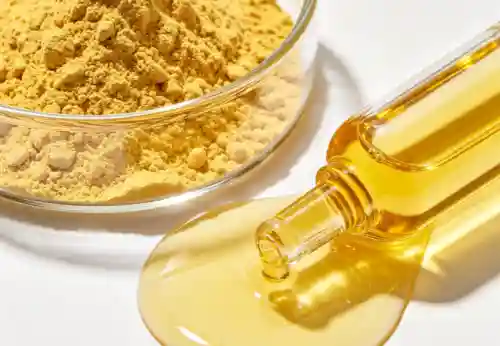
Liposomal CoQ10 powder is produced from a liquid liposome concentrate. The liquid is processed by freeze-drying or spray-drying at low temperatures. This removes moisture while minimizing oxidation. The process preserves the phospholipid vesicle structure and produces a dry powder ingredient. Standardized manufacturing helps maintain product quality and reduces active ingredient loss. The powder also offers excellent redispersibility. It can be used in water-based, oil-based, and dry powder formulations. This gives it greater formulation flexibility and makes it suitable for a wide range of end products.
What Is Storage Stability and Shelf-Life of liposomal CoQ10?
Stability is a key factor when selecting B2B bulk ingredients. It directly affects product quality, shelf life, and quality control costs. It is also important for bulk storage and international distribution.

• Liquid liposomal CoQ10
Liquid liposomal CoQ10 contains a high level of water. During long-term storage, it may experience vesicle aggregation, separation, sediment formation, and active ingredient oxidation. Therefore, strict control of temperature, light exposure, and packaging is required. Under normal storage conditions, the active ingredient level gradually decreases over time. The commercial storage period is usually less than six months. In addition, the water-based system can support microbial growth. This requires stronger sterilization procedures, better packaging, and temperature-controlled transportation. These factors increase quality control costs. As a result, liquid products are less suitable for long-distance shipping and extended inventory turnover.
• Liposomal CoQ10 powder
Liposomal CoQ10 powder removes moisture through the drying process. This greatly improves stability. The dry and sealed system helps protect the product from oxygen and microbial contamination. It also reduces CoQ10 oxidation and prevents liposome damage. Under normal storage conditions, with protection from light and moisture, the shelf life can exceed 24 months. The active ingredient retention rate can remain above 98%. Problems such as separation, sedimentation, and microbial growth are effectively avoided. This makes the powder form ideal for bulk storage, global transportation, and long-term inventory management. It helps reduce material loss, lowers quality risks, and supports large-scale industrial supply chains.
What Are the Storage and Transportation Costs of liposomal CoQ10?
In bulk procurement scenarios, logistics volume, warehousing space, transportation conditions, and packaging costs are key factors in controlling overall production costs. The supply chain economics of the two dosage forms differ significantly.
•Liposomal Coenzyme Q10 liquid
Liposomal Coenzyme Q10 liquid dosage forms contain high water content and a low proportion of active ingredients. For the same amount of active ingredients, liquid materials have a much larger volume and higher weight than powder forms. It also requires strict temperature-controlled and light-protected storage and transportation. It depends on sealed drum packaging with high standards. As a result, packaging costs, cold chain logistics costs, and warehouse management costs are high. There is also a risk of leakage and damage during transport. Therefore, it is not suitable for large-volume and long-distance cross-border bulk trade. The total supply chain cost is higher.
•Liposomal Coenzyme Q10 powder
In contrast, liposomal Coenzyme Q10 powder is produced through dehydration and purification. It has higher purity, smaller volume, and lighter weight. Under the same active ingredient content, logistics volume can be reduced by more than 60%. It does not require cold chain logistics. Normal ambient temperature transport is sufficient. It is packed in moisture-proof sealed bags and drums. This reduces packaging cost and avoids leakage or breakage risks. It is suitable for sea, land, and air transport. It better meets global bulk supply and large-scale distribution needs.
What is the end-product compatibility of liposomal CoQ10?
Dosage forms affect production processes and product applications. Customers can choose the right form based on their product needs.
Liposomal CoQ10 liquid is easy to use. It does not require extra dissolution or emulsification. It can be added directly to functional beverages, oral liquids, liquid supplements, and water-based skincare products. It provides good short-term dispersion because the liposome structure remains intact. However, it is mainly suitable for liquid products. Its stability is lower, which may shorten shelf life and affect product quality during long-term storage.
Liposome CoQ10 powder is suitable for many product formulations. It is a preferred ingredient for a wide range of products. The powder can be fully dissolved into a uniform liquid system. It can replace liquid ingredients in many liquid products. It can also be directly blended into tablets, solid beverages, meal replacement powders, and capsules. In addition, it can be used in softgels, functional oils, and skincare products. Liposome CoQ10 powder provides accurate dosing and flexible formulation adjustment. It helps maintain solid content, reduces production losses, and supports efficient large-scale manufacturing.
Bioavailability:
Both dosage forms are produced using standardized processes. They use liposome encapsulation technology. This helps overcome the limitations of traditional CoQ10, such as low absorption and instability in stomach acid. It improves the bioavailability of the active ingredient. It also maintains consistent core efficacy.
The main difference is long-term stability and mass production suitability. Liposomal CoQ10 liquid forms are stable only in the fresh state. During storage and transport, their vesicle structure and activity gradually decline. This limits commercial use.
Liposomal CoQ10 powder maintains stable liposome structure over time. It ensures consistent quality throughout the full product lifecycle. It also provides better stability in efficacy.
How to Choose Liposomal CoQ10 Powder or Liquid?
In raw material procurement and production planning, customers should match the dosage form based on production scale, product type, storage cycle, trade model, and cost requirements. This helps avoid quality loss, waste, and compatibility issues. Selection can be based on five key factors.
1. Product category
Companies producing liquid products, such as oral liquids, functional beverages, herbal drinks, and water-based skincare, can choose liposomal CoQ10 liquid raw materials. It can be added directly. No reconstitution or emulsification is needed. It fits liquid systems well and improves production efficiency.
Companies producing multiple product types, especially solids or oil-based products such as tablets, capsules, soft capsules, powders, and creams, should choose powder forms. Powder has better water and oil compatibility. It supports flexible formulation across different products.
2. Production and inventory model
Small and medium factories with small batch production and fast turnover can use liquid forms. This reduces preparation steps and lowers initial equipment and raw material costs.
Large-scale manufacturers and OEM factories should use Coenzyme Q10 powder forms. Powder has higher stability and lower degradation risk during long storage. It ensures consistent quality across batches.
3. Storage, transport, and trade
Companies serving local markets and short-distance logistics can use Coenzyme Q10 liquid forms. Transport time is short, so stability risks are lower.
Companies involved in export and long-distance supply should use powder forms. Coenzyme Q10 Powder is easier to store and transport. It has a longer shelf life and lower shipping risk. It is more suitable for global supply chains.
4. Quality control requirements
Brands with high-end positioning and strict quality stability requirements should choose powder forms. Coenzyme Q10 Powder maintains active ingredient stability throughout the product lifecycle.
Fast-moving consumer goods with short shelf cycles can use Coenzyme Q10 liquid. They support quick production and fast market turnover.
5. Production cost control
When precise control of dosage and active content is required, Coenzyme Q10 powder forms are better. They provide accurate measurement and are not affected by dilution.
For simple formulations and cost-sensitive liquid products, liquid forms are acceptable. They meet basic production needs with lower processing complexity.
Frequently Asked Questions
Are powder and liquid liposomal CoQ10 different in active ingredient?
+
-
No. Both forms contain the same active ingredient, Coenzyme Q10. They also use the same liposomal encapsulation technology. The difference is not in the ingredient itself. It is only in the final physical form after processing. One is a liquid system, and the other is a dried powder system.
Which one is better overall, Liposomal CoQ10 liquid or Liposomal CoQ10 Powder?
+
-
There is no absolute better form. Each form has different strengths. Liposomal CoQ10 liquid is more suitable for small-batch production and fast manufacturing cycles. It is easy to use and can be added directly into liquid products. Liposomal CoQ10 powder is more suitable for industrial-scale production. It offers better stability, easier storage, and more efficient global transportation. The final choice depends on production goals and application needs.
Which one has better formulation flexibility, Liposomal CoQ10 liquid or Liposomal CoQ10 Powder?
+
-
Liposomal CoQ10 powder has higher formulation flexibility. It can be used in a wider range of products, including capsules, tablets, powders, softgels, and also reconstituted liquid systems. It supports multi-category product development. Liposomal CoQ10 liquid is mainly used in liquid-based systems such as beverages, oral liquids, and some cosmetic emulsions. Its application range is more limited.
Do powder and liquid CoQ10 have different bioavailability?
+
-
No. Both forms use liposomal encapsulation technology, which enhances absorption and improves bioavailability compared to standard CoQ10. The core absorption mechanism is the same. However, liquid forms may have reduced stability over time during storage and transport, which can affect long-term consistency. Powder forms maintain better structural stability throughout shelf life.
Which one should manufacturers choose, Liposomal CoQ10 liquid or Liposomal CoQ10 Powder?
+
-
The choice depends on production strategy. Liquid liposomal CoQ10 is suitable for companies that need fast production, short supply chains, and direct-use formulations. Powder liposomal CoQ10 is better for companies focused on global distribution, long-term inventory management, and multi-product manufacturing systems.
Conclusion
There is no absolute superiority or inferiority between liposomal coenzyme Q10 powder and liquid formulations. The main difference lies in commercial use. Their core efficacy is the same, based on liposomal absorption advantages.
• Coenzyme Q10 Liquid offers strong process flexibility. They are easy to produce and require lower initial investment. They are suitable for small-batch production and short production cycles. They are often used in fast-moving consumer goods (FMCG) liquid products. However, they have lower stability. They require strict storage and transportation conditions. The shelf life of Coenzyme Q10 oil is short. Supply chain costs are higher. They are also limited in formulation compatibility. They are not ideal for large-scale global production.
• Coenzyme Q10 Powder provides better long-term stability. They have a longer shelf life and stronger physicochemical stability. They are highly compatible with different formulations. They also reduce logistics and storage costs. Because of these advantages, powder forms are widely used by medium and large manufacturers and global brand owners. They can be applied in solid, liquid, and oil-based products. They support large-scale production and long-term inventory planning. This makes them more suitable for global supply chains.
As a global bulk liposomal CoQ10 supplier, Guanjie Biotech focuses on R&D and large-scale production of liposomal CoQ10 powder and oil. We have a standardized quality control system. It ensures consistent particle size, stable encapsulation efficiency, and compliant active ingredients in every batch. Its products are supplied to more than 100 countries and regions. The company provides bulk supply, formulation support, and technical services. It helps customers reduce costs, improve product quality, and strengthen market competitiveness. Welcome to enquire with us at info@gybiotech.com.
References:
[1] Acosta, E. (2009). Bioavailability of nanoparticles in nutrient and nutraceutical delivery. Current Opinion in Colloid & Interface Science, 14(3), 168-175.
[2] Bhardwaj, P., & Mishra, B. (2022). Liposomal drug delivery system: A review. International Journal of Pharmaceutical Sciences and Research, 13(2), 567-578.
[3] Fang, Y. P., et al. (2016). Coenzyme Q10: From bench to clinic. Journal of Food and Drug Analysis, 24(3), 473-484.
[4] Hsu, C. H., et al. (2019). Stability and bioavailability of coenzyme Q10 formulated in different delivery systems. Journal of Functional Foods, 59, 233-240.
[5] Kalén, A., et al. (2015). Coenzyme Q10: Absorption, tissue uptake, metabolism and pharmacokinetics. Free Radical Research, 49(4), 391-404.
[6] Mozafari, M. R., et al. (2008). Nanoliposomes and their applications in food nanotechnology. Journal of Liposome Research, 18(4), 309-327.
[7] Pignitter, M., & Somoza, V. (2018). Stability of coenzyme Q10 in food products and dietary supplements. Nutrients, 10(3), 341.
[8] Sahoo, S. K., & Parveen, S. (2019). Liposomal formulations in clinical use: A review. Nanomedicine, 14(6), 759-778.
[9] Shabbir, M. A., et al. (2021). Lipid-based nanoencapsulation for the delivery of bioactive compounds in functional foods. Food Science & Nutrition, 9(8), 4513-4525.
[10] Zhang, Y., et al. (2020). Comparative study on the physicochemical stability of liposomal coenzyme Q10 in liquid and powder forms. International Journal of Nanomedicine, 15, 4567-4578.