Generally,pure phosphatidylserine extracts from kinds of foods. Such as, soybean, sunflower and other foods. But what is Phosphatidylserine? It is also known as Complex Neurotic Acid, or PS for short, has been recognized as an emerging "smart nutrient" after choline and DHA, the "brain gold". It is extracted from natural soybean oil residue. It is the active substance of cell membrane. Especially in the brain cells, accounting for about 18% of all phospholipids in the brain.
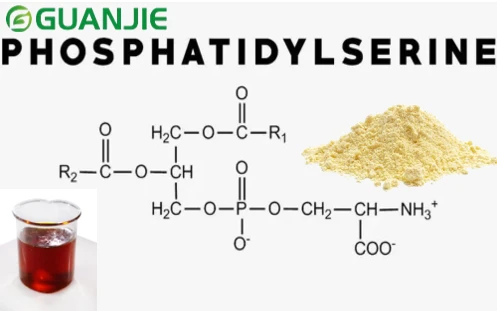
It plays an important role in regulating various functions of the brain, especially memory and emotional stability. For example, it affects the fluidity and permeability of cell membranes. And it can activate the metabolism and synthesis of a variety of enzymes.
Phosphatidylserine (PS) is produced by the body using serine synthesis. It affects the transmission of chemical messages in the brain and helps brain cells store and read information. It is an important nutrient for maintaining normal memory, response and healthy mood in the brain.
Phosphatidylserine is also known as the "brain vitamin". It is important for improving memory and cognitive ability, improving Alzheimer's disease, depression and relieving mental stress.
Mechanism of action of PS on brain function
- It can increase the number of brain synapses and the fluidity of brain cell membranes, thus improving the efficiency of neuronal information conduction;
- It can promote glucose metabolism in brain cells, thus making brain cells more active. It can make people's attention more focused, and improve the alertness and memory level of the brain.
- It is the only negatively charged cytoplasmic membrane phospholipid and the only phospholipid that can regulate the functional state of key cell membrane proteins. It is an indispensable substance for human body.
- It is nutrition, activation of various enzyme activities in the brain. It helps to repair and renew damaged cells in the brain;
- It can reduce the level of stress hormones in the body, which helps to reduce stress and relieve brain fatigue.
Phosphatidylserine Effects
- PS Supplement For Memory And Analysis And Thinking Skills
- The Nutrition and Food Safety Research Center of the Third Military Medical University randomly assigned 120 high school students aged 17 to 18 years old. They were supplemented with pure phosphatidylserine containing milk (100mg/day) or regular milk every day for 40 days. The results of the study showed that in pointing memory, associative learning, image free recall, and meaningless graphic recollection. Portrait feature linkage recall, an average improvement of 12 percentage points in five areas.

- Effective in improving cognitive function
PS for brain health 300mg per day. 6 and 12 weeks later, cognition, retrospection, execution, and flexibility of thought were all improved.
- Effective in improving concentration
19 children aged 4~14 with Attention Deficit/Hyperactivity Disorder (ADHD) took PS phosphoserine supplement 200mg daily. Hyperactivity improved significantly after 2 months.
- Relieves stress and balances emotions

PS efficacy certified in many countries
PS is certified safe by the FDA. And it is the only functional ingredient with cognitive function health claims certified by FDA.
New Resource Foods approved by China's Announcement No. 15 of 2010, approved by Japan's Food and Drug Administration HBM, and recognized by Korea Food and Drug Administration (KFDA).
The Korea Food and Drug Administration (KFDA) allows PS-added products to be prominently displayed and advertised as having the function of "improving bad moods and enhancing memory".
Limited Phosphatidylserine Daily Dosage
- National people's intake of PS is generally insufficient
- According to statistics, there is a difference of 70-150 mg between people's daily ps brain supplement intake and their normal requirement. For vegetarians, the difference is as high as 200-250 mg.
- However, although the pure phosphatidylserine content of fatty foods is high, there are health risks. Dairy products or vegetables, on the other hand, are too low in PS. For example, in corn seeds the PS content is about 1.0%. In soybeans, lipids make up 1.6% to 2% of the total weight of soybeans. Of this, PS accounts for 0.5% to 1%. That is, each kilogram of soybeans contains only 80 to 200 mg of PS.
Who need supply PS ?
- Office workers who work six days a week in a high-pressure environment.
- High school and graduate school students who study intensely every day
- Older middle-aged and elderly people
- Pregnant women after giving birth, because breastfeeding their children every day will lose a lot of nutrients, including PS.
- PS is also needed by people with memory loss and other groups.
Considering the health and safety issues, consuming phosphatidylserine products with natural soybean extracted PS is a more effective way. Guanjie's bulk phosphatidylserine powder and bulk phosphatidylserine liquid extract from soybeans without any additives and preservatives. If you want know more, welcome to enquiry us: info@gybiotech.com

Where does PS in the body come from?
Because of its importance to the survival of life, ps supplement is a component that can synthesize itself. At the same time, we naturally consume PS from food every day, and animal offal is one of the foods that are rich in PS. However, the ability to synthesize PS on its own is affected by the age of the individual and the activity of the body's enzymes. And due to the popularity of healthy eating in today's world, fewer and fewer people like to consume offal. And although offal is high in PS, it also contains a lot of unhealthy cholesterol.
The FDA has confirmed, based on available information, that the average person's daily intake of PS through a normal diet is now about 130 mg lower than it was in the 1980s, and some scientists have confirmed through clinical trials that changes in best phosphatidylserine intake can have an impact on the level of mental activity.
How much does ps phosphatidylserine eat? When to eat? How to eat?
- How much to eat?
In the United States organic phosphatidylserine has received FDA approval to claim cognitive efficacy as an ingredient. In China, the Ministry of Health declared it as a new resource food in Announcement No. 15 of 2010, with a daily intake limit of 600mg.
Various authoritative organizations recommend that the dosage for children under 10 years of age is generally 100mg/day to meet health needs, and 200mg/day is generally recommended for children over 10 years of age and adults.
Warm reminder: Due to individual differences, it is best to take the dose under the guidance of a medical professional.

- When should I take it?
It is generally recommended to take phosphatidylserine bulk in the morning after a meal for the best effect. PS is absorbed efficiently and can form a peak in the brain quickly, which can effectively help the neurons in the brain signaling and retention of information during the whole day.
- How to take PS?
Pure phosphatidylserine with DHA to take is best. Phosphatidylserine supplement (PS) and DHA have the ability to protect nerve cells in the brain, promote neuronal renewal, prevent rapid programmed death, and enhance signaling. DHA alone is inefficiently absorbed through the intestinal tract, and DHA with phosphatidylserine has a significant bidirectional effect, which can only be maximized by using them together.
Reference (The Literature)
[1]Y.Y. Zhang et al .Genetics and Molecular Research. 2015,14 (3): 9325-9333 .
[2]Minsook Ye et al.Int. J. Mol. Sci. 2020, 21(14), 4901; https://doi.org/10.3390/ijms21144901
[3] Hellhammer et al.Stress.2009,7(2):119-126
[4]Alisha Bruton, Joy Nauman et al.The Journal of Alternative and Complementary Medicine. 2021,27(4)312-322.http://doi.org/10.1089/acm.2020.0432
[5] Hirayama S,Terasawa Ket al.J Hum Nutr Diet. 2014,27 (2): 284–291 doi:10.1111/jhn.12090