Guanjie Biotech provides high-quality bulk inulin powder - chicory root inulin powder and inulin powder Jerusalem artichoke with an assay of 90% and 95%. This high-purity inulin can meet the needs of food, health products and pharmaceuticals. But What Is The Richest Source Of Inulin? Inulin is a naturally occurring polysaccharide found in many plants, especially those belonging to the Asteraceae and Iris family. Especially in plants belonging to the Asteraceae and Iridaceae families. inulin is a dietary fibre, and the main sources of inulin are various plants. Among them, Jerusalem Artichoke and Chicory Root are the best known. Small amounts of inulin are also found in vegetables such as onions, garlic, leeks, etc. However, Jerusalem Artichoke and Chicory Root are the preferred sources of inulin due to their high content, excellent quality and wide application potential.
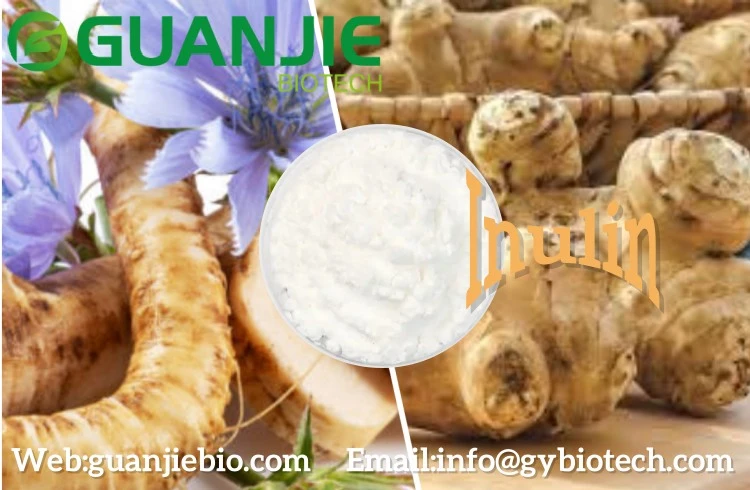
Main sources of inulin
● Jerusalem Artichoke
Jerusalem Artichoke is a perennial plant native to North America. the tubers of Jerusalem Artichoke are rich in inulin, which is particularly suitable as an industrial source of inulin. Jerusalem Artichoke is not only adaptable and can be grown in poor soils, but also has a high inulin content in its tubers, which usually reaches 15-20 per cent. In addition, the molecular structure of inulin in Jerusalem Artichoke is relatively simple, which makes it easier to extract and process, thus making Jerusalem Artichoke one of the most important sources of inulin extraction.
● Chicory Root)
Chicory Root is a common wild plant native to Europe and Asia. chicory root is one of the most common sources of inulin, and the content of inulin in chicory root is about 15-20%, and even higher in certain species. Chicory root contains a relatively stable structure of inulin, and the inulin molecular structure is relatively simple, which makes it easier to extract and process. Chicory root fibre powder has a relatively stable structure and long molecular chains, allowing it to function better as a dietary fibre in the body's digestive process.
● Ginger:
Ginger has a lower inulin content but is still a common source of dietary fibre in traditional herbs.
● Dandelion Root and Asparagus:
Dandelion root and asparagus also contain some amount of inulin. However, due to the relatively low inulin content in these plants, industrial extraction is costly. Thus, they are less frequently used as a major source of inulin.
Chicory Root Inulin And Jerusalem Artichoke Inulin
Although Chicory Root and Jerusalem Artichoke are both rich sources of inulin, there are some differences in the inulin extracted from them in the composition, nutritional value and application.
1. Compositional differences
● Chicory Root inulin:
The main component of inulin from Chicory Root is straight-chain fructans, with a relatively simple molecular structure. This kind of inulin has good solubility and is suitable for use in beverages and other foods. In addition, organic chicory root inulin powder is rich in other polyphenolic antioxidants, which help to enhance the antioxidant properties.
● Jerusalem Artichoke inulin:
In addition to fructans, inulin powder Jerusalem artichoke also contains other types of dietary fibre, such as dextran. organic Jerusalem artichoke inulin has a more complex structure and is slightly less soluble than Chicory Root inulin, but the fibrous structure is more conducive to stimulating intestinal peristalsis, which is a good way to promote Digestive function.
2. Sensory properties:
The two types of inulin produced by Guanjie Biotech are both white powders but with slightly different flavours. Jerusalem Artichoke inulin has a slightly sweet taste, which is softer and suitable for adding to drinks. On the other hand, chicory root inulin powder has a bitter taste and is suitable for dietary fibre supplements.
3. Nutritional Value Differences
The inulin in Chicory Root and Jerusalem Artichoke also differs in nutritional value in terms of prebiotic activity, gut health promotion and immune support.
● Prebiotic Activity:
Chicory root inulin supplement has a simpler structure and is more easily utilised by probiotics in the intestinal tract, resulting in higher prebiotic activity and rapid growth of beneficial bacteria in the intestinal tract. Jerusalem Artichoke inulin, on the other hand, has a slightly weaker prebiotic activity due to its more complex structure, but the presence of its long-chain polysaccharides allows for slow fermentation in the gut, providing longer-lasting intestinal support.
● Gut Health:
Both types of inulin help to maintain gut health, but the crude fibre content of Jerusalem Artichoke inulin better stimulates bowel movements, which is particularly beneficial for people suffering from constipation. Additionally, Jerusalem Artichoke inulin has a more diverse polysaccharide profile, which provides a wide range of gut health support.
Immune Support:
● The polyphenols contained in Chicory Root inulin have antioxidant and anti-inflammatory properties that can help boost immunity. In contrast, inulin powder Jerusalem artichoke can support the immune more indirectly through prebiotic activity.
4. Differences in Extraction Processes
Due to the different structural compositions of chicory root and inulin, the extraction process also differs. The inulin chicory powder usually uses hot water extraction, centrifugal separation, drying and other steps, and the purity can be improved through multiple processes. The extraction process of inulin is relatively simple, and a higher content of inulin extract can be obtained through mild hydrolysis, but the purity may be slightly lower than that of inulin extracted from chicory root.
Application
Both inulin chicory root powder and Jerusalem Artichoke inulin have wide applications in the food industry and the production of nutraceuticals. However, there are slight differences in their adaptability to specific areas.
● Food thickeners and emulsifiers
Chicory root inulin powder has a high degree of polymerisation and strong water solubility. It is commonly used as a food thickener and emulsifier in dairy products such as yoghurt and ice cream. It can improve the taste and increase the stability of the product. Jerusalem artichoke inulin bulk powder is used in functional beverages to enhance the taste because of its low degree of polymerisation.
● Modulators of intestinal health
The high degree of polymerisation of chicory root inulin bulk powder makes it difficult to be rapidly digested in the gut. Therefore, it can promote intestinal peristalsis and is suitable in dietary fibre supplements. Jerusalem Artichoke inulin is easily utilised by beneficial intestinal flora because of the low polymerisation. This helps to maintain the micro-ecological balance of the intestinal tract and is more suitable for use as a prebiotic.
Inulin has good market potential as a functional food ingredient. With the popularity of health concepts, the demand for inulin is growing in a variety of areas such as food, nutraceuticals, pharmaceuticals, etc. Chicory root inulin powder and inulin powder Jerusalem artichoke each have their characteristics. Guanjie Biotech is an inulin supplier, we produce a high-quality powder with an assay of 90%-95%. In terms of application, we provide different specifications to meet the various needs of the food and healthcare industries. Welcome to enquiry:info@gybiotech.com.