What Are Different Types of Berberine?
Based on Chemical Structure
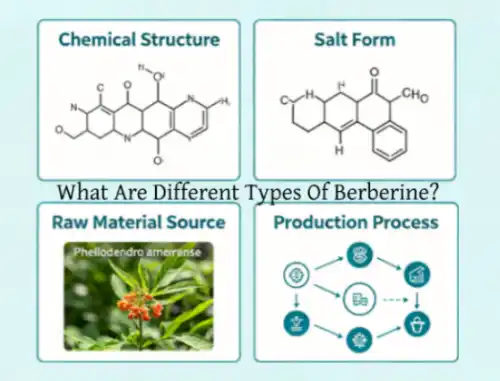
From the perspective of chemical structure, berberine bulk powder can be divided into three forms: quaternary ammonium, aldehyde, and alcohol forms. This classification is important because it affects stability and biological activity. It also influences storage life and industrial performance. These three forms can convert into each other under different pH and temperature conditions. The quaternary ammonium form is the most commonly used form in industry.

• Quaternary Ammonium Berberine
Quaternary ammonium berberine powder is the most stable form. It is also the main form found in natural plants. This structure contains a complete conjugated quaternary ammonium salt system. It appears as a yellow crystal and retains full biological activity. It has excellent stability and does not easily degrade during storage, room-temperature processing, or under weak acidic or weak alkaline conditions.
Because of its stability, it is suitable for large-scale production of food, health products, and feed products. Most commercial food-grade, feed-grade, and industrial-grade berberine products use this form as the active ingredient. It is the most widely used type of berberine in industrial applications.
• Aldehyde Form
Aldehyde berberine is an intermediate form produced from quaternary ammonium berberine under alkaline conditions. It has very poor stability. Berberine powder is easily affected by oxidation and reduction reactions at room temperature. These reactions can cause degradation and loss of activity.
This form has no independent commercial value. It exists only during chemical reactions and cannot be stored or sold as a separate product. It is considered an undesirable form in industrial production. Poor pH control during manufacturing may cause the conversion of quaternary ammonium berberine into the aldehyde form, reducing the active ingredient content of the final product.
• Alcohol Form Berberine
Alcohol-form berberine is another unstable conversion product. Bulk berberine powder is usually formed from quaternary ammonium berberine in weakly alkaline and low-temperature aqueous conditions. This structure loses its original conjugated system. As a result, its biological activity decreases significantly.
It also has poor solubility and dispersibility. Berberine bulk powder can easily cause precipitation and phase separation in water-based systems. This form has no commercial application value. Manufacturers should carefully control pH during dissolution, homogenization, and blending processes. This helps prevent structural conversion and ensures consistent product quality.
Industrial Berberine by Salt Form
Natural berberine has very poor water solubility. It cannot be used directly in most aqueous production systems. To improve solubility, dispersibility, and stability, manufacturers convert berberine into different salt forms through acid treatment. The main industrial berberine salts are berberine hydrochloride, berberine sulfate, and berberine nitrate. Each form has different properties and applications.

• Berberine Hydrochloride
Berberine hydrochloride powder is the most widely used form. It has the largest market share and the most mature production technology. It is a yellow crystalline powder with moderate water solubility and good stability. It is cost-effective and suitable for food, dietary supplements, pharmaceuticals, and feed products.
This form has good resistance to acids, alkalis, and low temperatures. It works well in common industrial processes such as stirring, homogenization, freezing, and drying. It is odorless, leaves no residue, and blends easily with other ingredients.
Berberine hydrochloride bulk powder is compatible with fruits, vegetables, proteins, and carbohydrates. It does not cause unwanted reactions in formulations. Because of its stable quality and reliable production process, berberine HCL powder is the preferred choice for large-scale manufacturing and bulk purchasing.
• Berberine Sulfate
Berberine sulfate powder has better water solubility than berberine hydrochloride. It dissolves faster and produces clearer solutions. It is suitable for products that require high transparency and good solubility, such as clear beverages, liquid supplements, and water-soluble formulations.
This form may provide slightly stronger antibacterial activity. However, its stability is lower. It can degrade under high temperatures or strong acidic and alkaline conditions. Production costs are also higher, resulting in a higher market price.
Berberine sulfate is mainly used in premium product development and specialized formulations. It is less suitable for large-scale, cost-sensitive production.
• Berberine Nitrate
Berberine nitrate powder has the highest water solubility among the three forms. It also shows strong antibacterial activity and dissolves quickly.
However, its chemical stability is relatively poor. It can oxidize and discolor easily. Light and heat may accelerate ingredient loss. Therefore, it requires strict storage conditions and has a shorter shelf life.
Production costs are high, and its compliant application range is limited. It is mainly used in pharmaceutical preparations and specialized antibacterial products. It is rarely used in large-scale production of conventional foods or mass-market dietary supplements.
Different Raw Material Sources
Based on the raw material source, industrial berberine bulk powder can be divided into three categories: Phellodendron chinense berberine, Coptis chinensis berberine, and other plant-derived berberines. These categories differ in active ingredient content, impurity levels, and flavor characteristics. They are suitable for different industry quality standards.

• Phellodendron chinense Berberine
Phellodendron chinense berberine is extracted from the bark of Phellodendron amurense and Phellodendron chinense trees. It is one of the main types used in large-scale industrial production.
Phellodendron amurense has a high yield and stable supply. The production cost is controllable. The extraction process is mature. The resulting berberine has high purity and low impurity levels. Berberine bulk powder also has very little odor and no strong bitter taste.
It is suitable for food, functional beverages, and dietary supplements where flavor and purity are important. Heavy metals and microbial levels are easier to control. Batch-to-batch consistency is also good. This type is suitable for large-scale production and bulk natural berberine powder purchasing. It is also a key product developed and manufactured by Guanjie Biotech.
• Berberine from Coptis chinensis
Berberine from Coptis chinensis is extracted from the rhizome of the plant. It usually has high purity and strong biological activity.
However, the raw material yield is limited. Production costs are high, and the product price is also high. In addition, natural berberine powder has a strong natural bitter taste, which can affect the flavor of the final product.
This type is mainly used in pharmaceutical products and high-end health supplements. It is not suitable for large-scale food production or mass-market functional beverages. Its industrial use is relatively limited.
• Other Plant-Derived Berberines
Other plant-derived berberines are mainly extracted from plants such as Trichosanthes kirilowii and Mahonia japonica. The raw material supply is scattered. Active ingredient content can vary significantly. There are also more impurities. Batch consistency is often poor.
A standardized large-scale production system has not been established. Quality control standards are difficult to unify. These natural berberine powder products are mainly used in some niche traditional Chinese medicine formulations. They generally do not meet the requirements for standardized, large-scale food-industry production.
Different Processes
Based on the production process, bulk berberine can be divided into plant-extracted berberine and chemically synthesized berberine. These two types differ in composition, compliance status, and application areas.
• Plant-Extracted Berberine
Plant-extracted berberine bulk is made from natural plants. It is produced through extraction, purification, refining, and drying. No chemical synthesis additives are used during production.
This type of berberine has a pure composition and high safety. It meets the market demand for natural and clean-label products. Natural berberine powder is widely used in food, dietary supplements, and functional products. It is also suitable for applications with strict quality requirements.
The active ingredient has the same structure as the naturally occurring compound. It provides stable bioavailability and good safety. Therefore, it is the preferred choice for many industry customers.
• Chemically Synthesized Berberine
Chemically synthesized berberine is produced through chemical synthesis. It has a lower production cost and a lower market price.
However, the product may contain impurities, synthetic intermediates, and chemical residues. As a result, its purity and safety are usually lower than those of plant-extracted berberine.
Some synthetic products may not meet the requirements for food-grade applications. Therefore, their use is limited. They are mainly used in low-cost feed products and industrial antibacterial applications where purity requirements are lower. They are generally not suitable for high-end food products or dietary supplements.
How to Choose Berberine?
For food, functional beverages, and dietary supplements, plant-extracted berberine from Phellodendron amurense is often the preferred choice. Hydrochloride-type berberine is widely used for its stability, safety, cost-effectiveness, and compatibility.
Berberine sulfate and berberine nitrate can also be selected for specialized applications based on specific solubility and activity requirements.
When selecting bulk berberine, companies should carefully evaluate the raw material source, salt form, production process, and structural stability. This helps avoid quality issues caused by unstable structures or high impurity levels.
Conclusion:
In conclusion, berberine can be classified by chemical structure, salt form, raw material source, and production process. These factors directly affect its stability, solubility, purity, biological activity, and industrial applications. For most food, dietary supplement, and functional product manufacturers, plant-extracted berberine hydrochloride from Phellodendron amurense offers an excellent balance of quality, safety, stability, and cost-effectiveness. By carefully selecting the appropriate berberine type, companies can improve product performance, ensure compliance, and achieve consistent production quality.
Guanjie Biotech has professional experience in the production of bulk berberine powder. The company uses mature plant extraction and purification technologies. Every step is strictly controlled, from raw material sourcing to finished product testing. We suppy high-purity plant-extracted berberine with stable quality. Purity, solubility, and activity remain consistent from batch to batch. The berberine bulk powder have low impurity levels and no unusual odors.
Our bulk berberine powder meets the production requirements of industries such as food, dietary supplements, and feed. Guanjie Biotech also has bulk berberine powder production capacity and can provide a stable supply of bulk berberine powder. Through its global service network, the company delivers compliant, high-quality, and reliable raw material solutions to customers worldwide.
References:
[1] Nechepurenko IV, Salakhutdinov NF, Tolstikov GA. Berberine: Chemistry and biological activity. Chemistry for Sustainable Development. 2010;18:1-23.
[2]Berberine alkaloid: Quantum chemical study of different forms by the DFT and MP2 methods. Chemical Physics Letters. 2006;430(4-6):409-413.
[3]Study on microwave extraction of berberine coloring compound and extracts stability: Process optimization by Response Surface Method (RSM). Industrial Crops and Products. 2025;222:120-129.
[4]Pharmaceutical Experiment Tutorial. Zhong FL, Chen S, eds. Beijing: Chemical Industry Press. (Provides solubility data of berberine hydrochloride, sulfate, etc.).
[5]Chemistry of Chinese Traditional Medicine. Beijing College of Traditional Chinese Medicine, ed. Shanghai: Shanghai People's Publishing House. (Provides solubility data of berberine inorganic salts).
[6]Luo KW, Huang Q, Ge YR, et al. Separation and beneficiation of berberine hydrochloride by aqueous two phase from Phellodendri Amurensis Cortex. Journal of Jiangsu University. 2012;(6).
[7]Study on microwave extraction of berberine coloring compound and extracts stability. Industrial Crops and Products. 2025;222:120-129. (Source: Phellodendron amurense Rupr.).
[8]Nguyen HTT. Development of a sustainable process for extracting alkaloids from Phellodendron amurense Rupr. Industrial Crops and Products. 2025. (Source optimization).